
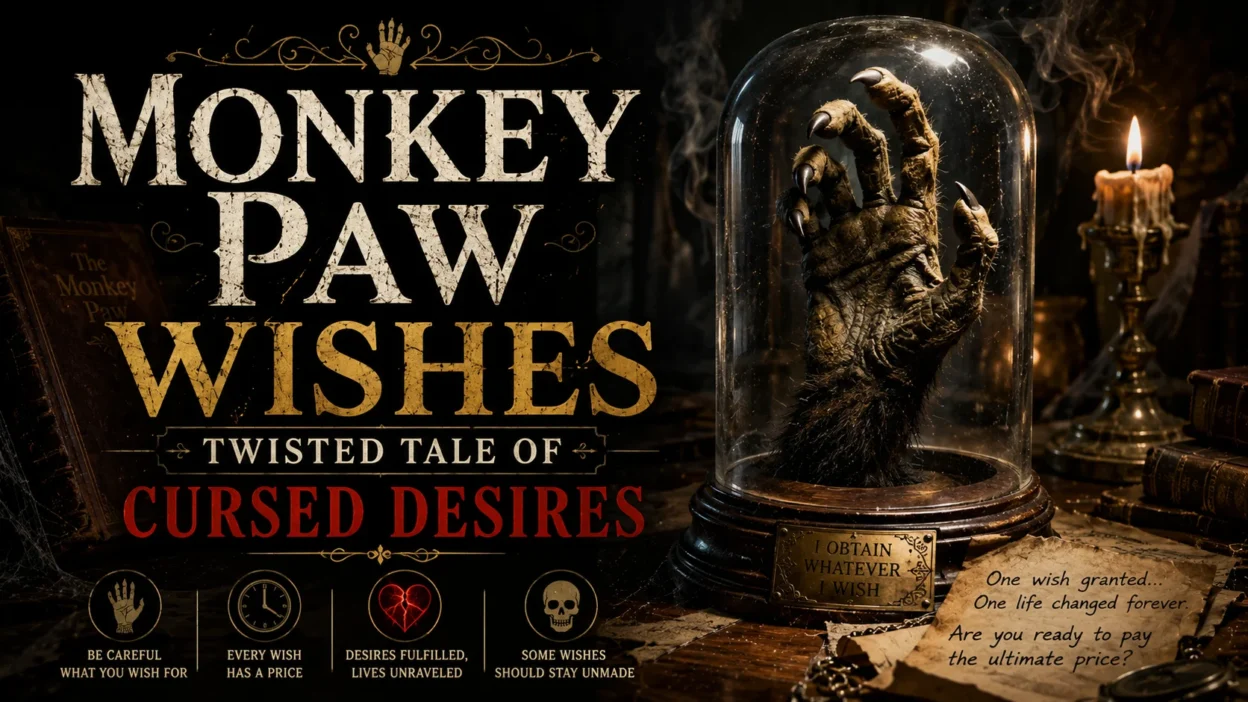
Monkey paw wishes have become a powerful cultural metaphor for the dangers of getting exactly what you ask for. W.W. Jacobs’ classic 1902 horror story “The Monkey’s Paw” introduced these cursed desires, and they have captured imaginations for over a century. A mummified monkey’s paw grants three wishes to its owner, but every wish comes with a terrible price—often far worse than what the person gained. This collection explores the legend of the monkey paw, its modern interpretations, and the timeless lessons it teaches us about greed, fate, and the consequences of interfering with destiny. Whether you’re curious about the original story, looking to understand its themes, or exploring its appearance in games like Phasmophobia, this guide covers everything you need to know about the chilling tale of monkey paw wishes. 🐒👋
The Original Story: W.W. Jacobs’ Horror Classic 📚
- Harper’s Monthly first published “The Monkey’s Paw” in September 1902, and Jacobs later included it in his collection “The Lady of the Barge.”
- The story centers on Mr. and Mrs. White and their adult son Herbert, who live in England during the early 1900s.
- Sergeant-Major Morris, a family friend who served in India, introduces the monkey’s paw—a dried, mummified hand that a holy man (fakir) enchanted to grant three wishes.
- The fakir designed the spell to demonstrate that “fate ruled people’s lives, and those who interfered with it did so to their sorrow.”
- Morris, who suffered from his own experience with the paw, throws the paw into the fire, but Mr. White retrieves it despite his friend’s warnings.
- The story unfolds in three parts, and each part marks a pivotal moment in the Whites’ tragic journey.
- Jacobs uses weather and setting—cold, rainy nights—to create an ominous, foreboding atmosphere throughout the tale.
- The narrative employs third-person voice and builds suspense through subtle foreshadowing, such as Herbert’s prophetic jokes about the paw’s magic.
- The story has inspired countless adaptations across films, television, plays, and literature since 1903.
- Scholars interpret the story as a criticism of British colonialism, a commentary on gender roles, and a meditation on fate versus free will.
- Many consider the story one of the most famous horror stories in the English language.
- Its influence extends beyond literature into popular culture, and references appear in countless movies and TV shows.
- The story’s brevity and impact make it a perfect teaching tool for literary analysis.
- Jacobs’ writing style creates a sense of dread that builds throughout the narrative.
- The ending of the story is famously ambiguous, leaving readers to imagine the horror that stood at the door.
The Three Wishes and Their Consequences 💔
- Mr. White makes his first wish at Herbert’s suggestion: for 200 pounds, the amount they need to pay off their house.
- The family makes the wish in a moment of skepticism and jest—they don’t fully believe in the paw’s power.
- The next day, Herbert dies in a workplace accident, and machinery horribly mutilates his body.
- A representative from Herbert’s employer, Maw and Meggins, arrives with compensation exactly equal to 200 pounds.
- The company denies responsibility but offers this “bereavement payment” to the family.
- This wish demonstrates the paw’s cruel logic: it grants what you ask for but in the most devastating way possible.
- Grief consumes Mrs. White, and she demands that Mr. White use the second wish to bring their son back to life.
- Mr. White, reluctant and afraid, eventually yields to his wife’s desperate pleas.
- He wishes for his son alive again but immediately feels dread—he knows the body was mangled beyond recognition.
- Later that night, a knocking begins at the door.
- Mrs. White, delirious with hope, rushes to open the door, believing her son has returned.
- As Mrs. White fumbles with the locks, Mr. White realizes the horror outside—Herbert’s reanimated corpse.
- He frantically searches for the paw and makes his third and final wish.
- The story intentionally leaves the exact wish ambiguous, but the consequences remain clear: the knocking stops.
- Mrs. White opens the door to find an empty, quiet road.
Major Themes: Fate, Greed, and Consequences ⚖️
- The story warns against trying to change destiny—the fakir designed the spell to show that tampering with fate leads to sorrow.
- The Whites’ desire for material wealth (200 pounds) costs them their son, illustrating the proverb “be careful what you wish for.”
- Every action carries consequences beyond what we can foresee—the monkey paw’s wishes always come with hidden costs.
- Mr. White’s fascination with the paw, despite Morris’s warnings, drives the tragedy forward.
- The story raises questions about whether the Whites are victims of destiny or responsible for their own choices.
- Mrs. White’s unrelenting grief leads her to demand a second wish, unwilling to accept the consequences.
- The paw represents temptation, power, and the corruption of human desire.
- The story is filled with threes—three wishes, three people in the family, three knocks—adding to the ominous atmosphere.
- Some interpretations view the story as a critique of British imperialism.
- The paw’s curse reflects the ancient Greek concept of “hubris” and its consequences.
- The story explores the limits of human control over nature and fate.
- Grief and desperation can override rational thought, as we see in Mrs. White’s actions.
- The power of suggestion and belief plays a key role in the story’s horror.
- The story questions whether we can ever truly change our circumstances.
- Ultimately, the story teaches that accepting fate is wiser than rebelling against it.
The Monkey Paw in Modern Culture 🎥
- The phrase “monkey paw wish” has become cultural shorthand for a wish that comes true in a terrible, ironic way.
- The story has inspired numerous film adaptations, including a 1915 silent British film (now lost) starring John Lawson.
- The Simpsons featured the monkey’s paw in their “Treehouse of Horror” episodes.
- The tale has inspired works across media, including plays, operas, novels, and comics.
- Horror icon Christopher Lee recorded a dramatization of the original story.
- The monkey’s paw appears as a cursed item in various video games.
- The story’s themes continue to resonate with modern audiences, leading to ongoing adaptations.
- Popular TV shows like Buffy the Vampire Slayer and The X-Files have referenced the concept.
- Various artists have referenced the story in songs.
- The monkey paw has become a recognizable symbol in pop culture.
- People often use the phrase in internet memes and social media posts.
- Discussions about unintended consequences frequently cite the story.
- Adaptations often update the story for contemporary settings.
- The concept has even appeared in advertising and marketing campaigns.
- The monkey’s paw remains a powerful cultural touchstone for cautionary tales.
Monkey Paw in Phasmophobia 🎮
- In Phasmophobia, the Monkey Paw appears as one of seven Cursed Possessions on maps.
- Players can make specific wishes by speaking them aloud or selecting them via a text-based UI.
- Each wish has a positive effect paired with a severe negative consequence.
- The wishes fall into three categories: ghost-based, player-based, and environmental.
- “I wish to see the ghost”: Forces a ghost event but initiates a cursed hunt and obscures vision.
- “I wish for activity”: Doubles ghost activity for two minutes but breaks the fuse box permanently.
- “I wish to trap the ghost”: Teleports the ghost to its favorite room but triggers a cursed hunt afterward.
- “I wish for sanity”: Sets sanity to 50% but drains sanity 1.5x faster afterward.
- “I wish to be safe”: Opens a blocked hiding spot but shatters lights and makes the ghost more sensitive to sound.
- “I wish to leave”: Unlocks all exits (even during hunts) but slows speed and reduces vision.
- “I wish to revive my friend”: Brings back a dead teammate but has a 50% chance of killing the wisher.
- “I wish for knowledge”: Eliminates wrong evidence but triggers a hunt with reduced sight and sound.
- “I wish for [weather]”: Changes the map’s weather but drains 25% sanity and blinds all players.
- “I wish for anything”: Randomly grants one of the other wishes.
- The game’s implementation captures the core theme: every wish carries a price.
The Monkey Paw as a Literary Device 📖
- The monkey’s paw serves as a powerful MacGuffin—an object that drives the plot forward.
- It also symbolizes temptation, greed, and the danger of interfering with fate.
- The story employs foreshadowing extensively, from Morris’s warnings to Herbert’s joking about his own death.
- Jacobs uses irony throughout—the Whites get exactly what they wish for, but in the worst possible way.
- The paw’s magical nature remains intentionally ambiguous—is it truly supernatural, or is it coincidence?
- The story’s ending leaves the third wish ambiguous, inviting reader interpretation.
- The narrative structure builds suspense through pacing and carefully placed details.
- The paw serves as a catalyst for the story’s tragic events.
- The object’s description—dried, shriveled, ancient—adds to its sinister nature.
- The paw’s “magic” never gets a full explanation, adding to the horror.
- The story uses the paw to explore themes of fate and free will.
- The paw’s presence creates a palpable sense of dread throughout the narrative.
- The object’s power is both literal and metaphorical.
- The paw ultimately represents the dangers of unchecked desire.
Why the Monkey Paw Story Endures 🌟
- The story taps into universal fears about death, loss, and the unknown.
- Its cautionary message—”be careful what you wish for”—resonates across cultures and generations.
- The concept of cursed wishes appears in folklore worldwide, from Aladdin to the legend of King Midas.
- The story’s brevity and impact make it a perfect teaching tool for literary analysis.
- Its themes of grief, greed, and fate remain deeply relevant in modern times.
- The ambiguous ending invites endless discussion and interpretation.
- The story’s influence on popular culture has kept it alive for over 120 years.
- The story’s simplicity makes it accessible to readers of all ages.
- The horror is psychological rather than graphic, making it more enduring.
- The story raises questions that have no easy answers.
- The characters are ordinary people, making their tragedy more relatable.
- The story’s moral lesson is timeless and universal.
- The narrative structure is both simple and masterfully executed.
- Critics and readers alike have praised the story.
- Its themes continue to inspire new creative works.
The Monkey’s Paw and Fate 🎭
- The fakir designed the spell specifically to teach that “fate ruled people’s lives.”
- The story raises the question: are the Whites victims of destiny, or do their own choices lead to tragedy?
- Mr. White’s decision to rescue the paw from the fire shows his active role in his family’s fate.
- Herbert’s joke about the paw’s magic foreshadows his own fate.
- Mrs. White’s desperate demand for a second wish shows how grief can override rational thought.
- Mr. White’s final wish shows his attempt to regain control, even at the cost of his son’s existence.
- The story suggests that fate is not something to tamper with.
- The paw’s curse reflects the idea of cosmic justice.
- The characters’ attempts to change their destiny only make things worse.
- The story questions whether free will truly exists.
- The paw’s power seems to punish those who use it.
- Fate is an inevitable force that we cannot overcome.
- The Whites’ tragedy results from their interference with fate.
- The story encourages acceptance of life’s circumstances.
- Ultimately, fate prevails despite human efforts to change it.
Symbolism and Imagery in the Story 🖼️
- The opening chess game symbolizes the strategic moves and consequences in the story.
- The fire represents both comfort and danger—Morris throws the paw into the flames, but Mr. White retrieves it.
- Cold and darkness throughout the story create an ominous, tragic ambiance.
- The paw appears shriveled and dried, emphasizing its ancient, sinister nature.
- The three knocks at the door symbolize the return of the repressed—Herbert’s reanimated corpse.
- The Whites’ home represents the ordinary world invaded by the supernatural.
- The stormy weather mirrors the family’s emotional turmoil.
- The 200 pounds represent the price of greed.
- The open door at the end symbolizes uncertainty and fear.
- The chess game also symbolizes the Whites’ attempt to control their destiny.
- The fire’s warmth contrasts with the story’s cold horror.
- The paw’s shriveled appearance suggests decay and death.
- The knocking at the door creates unbearable suspense.
- The story’s imagery is simple yet deeply evocative.
Historical Context: British Colonial Era 🌍
- The story takes place during the height of the British Empire, when India was a British colony.
- Sergeant-Major Morris’s service in India reflects Britain’s colonial presence there.
- Some scholars interpret the paw’s curse as a metaphor for the consequences of colonialism.
- The story reflects the anxieties of the British Empire during its decline.
- The paw’s origin in India carries connotations of colonial exploitation.
- Morris’s role as a soldier in India connects the story to imperial history.
- The story may criticize the British treatment of colonized peoples.
- The paw represents the dangers of taking from other cultures.
- The story’s setting in England contrasts with its Indian origins.
- The colonial context adds a layer of historical significance.
- We can read the story as a cautionary tale about imperialism.
- Understanding the colonial context enriches the story’s meaning.
The Monkey’s Paw in Literature and Academia 📚
- Literature classes frequently study the story to illustrate themes of fate, irony, and foreshadowing.
- Teachers use it as a cautionary tale about the dangers of greed and unintended consequences.
- The story is a classic example of the horror genre, building suspense through atmosphere and pacing.
- Critics often compare its themes to other works, such as “Aladdin” and “The Story of an Hour.”
- Scholars debate the meaning of the paw—is it truly magical, or are the events mere coincidence?
- The story is a staple in literary anthologies and textbooks.
- Academic papers analyze the story’s themes and cultural significance.
- Critics praise the story’s structure for its economy and effectiveness.
- Teachers often use it to teach the elements of fiction.
- Critics widely recognize the story’s influence on the horror genre.
- Psychological analyses explore its themes of grief and fate.
- The story is a common reference point in discussions of horror fiction.
- Its ambiguity makes it a favorite subject for literary criticism.
- The story has appeared in numerous translations.
- It remains a standard part of the literary canon.
Cultural Adaptations and Interpretations 🎬
- The story has inspired over a hundred film, television, stage, and radio adaptations.
- The 1915 silent film, starring John Lawson, was one of the earliest adaptations.
- The Simpsons parodied the story in their “Treehouse of Horror” episodes.
- The story continues to inspire new interpretations, including modern video games.
- Horror icon Christopher Lee recorded a famous dramatization of the story.
- The story has inspired operas and plays.
- Radio dramas, especially during the golden age of radio, featured the story.
- Countless TV shows and movies have referenced the story.
- Each adaptation adds its own twist to the original tale.
- Modern adaptations often update the story for contemporary audiences.
- Graphic novels and comics have also adapted the story.
- Independent filmmakers have also adapted the story.
- The story’s universal themes make it adaptable to any era.
- Adaptations range from faithful to highly creative reinterpretations.
- The story’s legacy is evident in its many adaptations.
The Monkey’s Paw in Folklore and Mythology 🌍
- The concept of a magical hand granting wishes appears in various cultures.
- The story draws on the universal trope of the “severed hand with magical powers.”
- Similar tales appear in Arab folklore (Aladdin’s lamp), Norse mythology, and other traditions.
- The paw’s curse reflects the ancient Greek concept of “hubris” and its consequences.
- The “be careful what you wish for” theme appears in many cultures.
- The paw shares similarities with cursed objects in other mythologies.
- The three wishes motif appears in many folk tales worldwide.
- The story incorporates elements of Eastern mysticism.
- The paw’s power is reminiscent of magical artifacts in folklore.
- The story’s use of a monkey paw is unique but draws on existing traditions.
- The cautionary tale format is common in folklore.
- The story blends horror with moral lessons.
- The paw’s origin in India adds to its mystical quality.
- The story’s themes are universal and cross-cultural.
- The paw has become a modern mythological symbol.
Lessons from the Monkey’s Paw 📝
- Be careful what you wish for: Every action carries consequences, and desires may come with hidden costs.
- Accept your fate: Trying to change destiny often leads to more suffering.
- Grief can blind us: Mrs. White’s grief leads her to make a wish she would never have considered rationally.
- Greed has a price: The desire for wealth cost the Whites their son.
- Listen to warnings: Mr. White ignored Morris’s advice and paid a terrible price.
- Fate cannot cheat: The paw proves that destiny always prevails.
- Appreciate what you have: The Whites’ dissatisfaction led to tragedy.
- Wisdom comes from accepting life’s limitations.
- Some doors are better left unopened.
- Not all magic is beneficial: The paw’s power is destructive.
- Family bonds can lead to poor decisions.
- We cannot undo the past: Herbert’s death could not be reversed.
- Grief is a powerful force: It drove Mrs. White to madness.
- Fear can overcome reason: Mr. White’s fear led him to use the third wish.
- The story teaches humility and acceptance.
Monkey Paw Wish: The Modern Expression 🗣️
- The phrase “monkey paw wish” describes a wish that comes true in a twisted, ironic way.
- Internet culture often uses the phrase to describe situations where people get what they want but with unintended consequences.
- Political commentary sometimes uses the term to describe policies that backfire.
- People also use it to describe personal dilemmas where pursuing a goal leads to unexpected problems.
- The phrase is a shorthand for “be careful what you wish for.”
- It appears frequently in memes and social media posts.
- Business and management contexts also use the term.
- Sometimes people use it to describe technological advancements that have negative side effects.
- The phrase serves as a cautionary reminder in everyday conversation.
- It has become a part of the modern lexicon.
- The phrase describes unintended consequences in any context.
- It reflects the enduring relevance of the original story.
- Educational settings often use the phrase.
- It is a concise way to warn against short-term thinking.
- The phrase has evolved to become a cultural touchstone.
The Monkey’s Paw and Horror Elements 😱
- The story relies on psychological horror rather than graphic violence.
- The suspense builds through anticipation—the fear of what the paw will bring.
- The ambiguity of the third wish adds to the horror—we never see what’s at the door.
- The story explores the terror of loss and the impossibility of reversing death.
- The mundane setting of the Whites’ home makes the horror more relatable.
- The horror comes from the characters’ own choices and grief.
- The story’s atmosphere is key to its horror effect.
- The paw’s power is terrifying because we cannot control it.
- The story leaves much to the imagination, which is more frightening.
- The knocking at the door is one of the most suspenseful moments in horror literature.
- The story plays on fears of death and the unknown.
- It explores the terror of grief and loss.
- The horror is quiet and subtle, not loud and shocking.
- The story’s horror is universal and personal at the same time.
- The story has influenced the development of psychological horror.
Writing Your Own Monkey Paw Story ✍️
- Start with a character who is dissatisfied with their life.
- Introduce an object or being that offers wishes.
- Establish that the wishes come with a price.
- Have the first wish come true, but with an ironic twist.
- Show the consequences leading to further tragedy.
- End with the character desperately trying to undo their mistake.
- The story should ultimately caution against interfering with fate.
- Use foreshadowing to build suspense.
- Create an atmosphere of dread and foreboding.
- Keep the characters relatable and ordinary.
- Use the ambiguous ending to leave readers thinking.
- Explore themes of grief, greed, and consequences.
- Use simple language that is effective and powerful.
- Build suspense through pacing and carefully placed details.
- Ensure the story’s message is clear but not preachy.
The Psychology of Cursed Wishes 🧠
- The desire for wishes stems from a feeling of dissatisfaction or lack in one’s life.
- People often believe they know what will make them happy, but they are often wrong.
- Greed can blind people to the potential consequences of their actions.
- Grief can override rational thought and lead to poor decisions.
- The story explores the power of hope and despair.
- The characters’ grief and desperation drive the plot.
- The story shows how desire can corrupt.
- The paw’s curse reflects the psychological concept of “unintended consequences.”
- The story demonstrates the dangers of wishful thinking.
- It explores the psychological impact of loss and grief.
- The characters’ actions are driven by their emotional states.
- The story is a study in human psychology.
- It shows how people can be led by their desires to their own destruction.
- The story explores the power of belief and suggestion.
- The characters’ psychology is key to the story’s power.
Comparing the Monkey Paw to Other Cursed Objects 🔮
- The monkey’s paw is similar to Aladdin’s lamp, but with a cruel twist.
- It differs from the Holy Grail, which grants eternal life.
- The paw is more malevolent than the wishing ring in some fairy tales.
- It shares similarities with the Midas touch myth.
- The paw is a cursed object that punishes its owner.
- It is often compared to the book “The Necronomicon.”
- The paw is unique in its specific “three wishes” limitation.
- Its curse is focused on greed and desire.
- The paw is a symbol of the dangers of magic.
- It represents the cost of interfering with fate.
- The paw is more sinister than typical magical objects.
- Its power is used for tragedy rather than good.
- The paw is a cautionary example of cursed items.
- It is often cited as the ultimate “be careful what you wish for” lesson.
- The paw’s influence continues to inspire similar cursed objects in fiction.
Conclusion: The Enduring Warning of the Monkey’s Paw 🐒👋
The monkey paw wishes legend is more than just a spooky campfire tale—it’s a profound cautionary story about the dangers of greed, the limits of human control, and the unforgiving nature of fate. Since W.W. Jacobs first published the story in 1902, its themes have resonated across cultures and generations, inspiring countless adaptations and interpretations. The warning is simple yet timeless: be careful what you wish for, because you just might get it. The monkey’s paw reminds us to be grateful for what we have, to accept the natural course of life, and to resist the temptation to tamper with forces beyond our understanding. So the next time you find yourself wishing for something—whether it’s money, success, or even a second chance—remember the Whites and their cursed paw. Some wishes are better left unmade. 🐒👋

Jessica Morgan is a writer and content creator at Blesslume, dedicated to sharing meaningful blessings, heartfelt prayers, inspiring wishes, and uplifting messages. She is passionate about helping people find the right words to celebrate special moments, offer encouragement, and spread kindness. Through thoughtful and inspiring content, Jessica aims to bring hope, positivity, and connection to readers around the world.