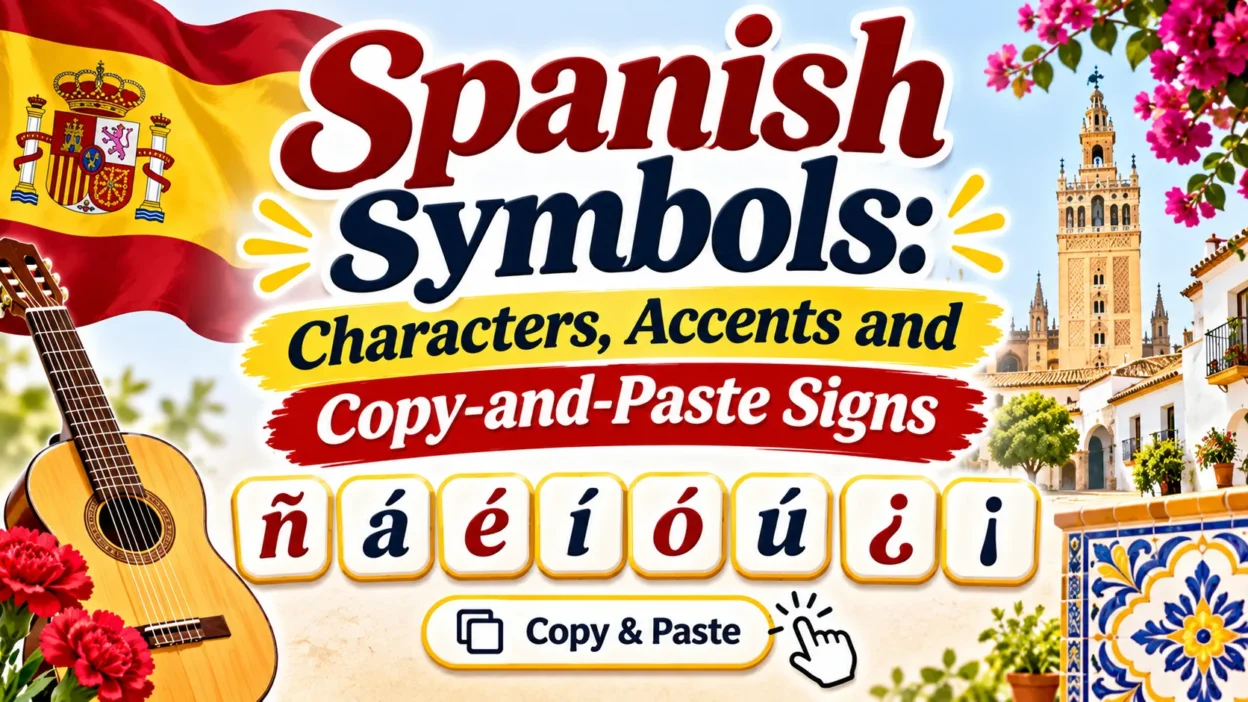
Spanish symbols are an important part of the Spanish language, writing system, and cultural identity. From the familiar letter ñ to accented vowels such as á, é, í, ó, ú, Spanish uses several special characters that help readers understand pronunciation, spelling, and meaning. It also has distinctive punctuation marks, including the inverted question mark ¿ and inverted exclamation mark ¡, which make written Spanish different from English.
However, Spanish symbols are not limited to letters and punctuation. People also search for Spanish-inspired decorative characters, cultural icons, currency signs, and symbols they can copy into social media profiles, usernames, messages, and documents.
Whether you are learning Spanish, studying its alphabet, or looking for special Spanish characters to copy and paste, this guide explains the most important symbols, their meanings, uses, and examples.
🇪🇸 What Are Spanish Symbols?
Spanish symbols are special letters, accent marks, punctuation signs, and other characters used in Spanish writing. They help represent the language correctly and make written communication easier to understand.
Some Spanish symbols are part of the alphabet, while others are added to letters or placed around sentences. For example, ñ is a separate letter in the Spanish alphabet, whereas the accent in á indicates which syllable receives stress.
The most recognizable Spanish symbols include:
- Ñ ñ: A distinct letter in the Spanish alphabet.
- Á á: An accented letter A.
- É é: An accented letter E.
- Í í: An accented letter I.
- Ó ó: An accented letter O.
- Ú ú: An accented letter U.
- Ü ü: A U with a diaeresis.
- ¿: An inverted question mark.
- ¡: An inverted exclamation mark.
These characters are essential for correct Spanish spelling and pronunciation. Some also distinguish words that have different meanings despite having similar spellings.
🔤 Spanish Alphabet Symbols
The Spanish alphabet, known as abecedario or alfabeto, contains 27 letters. It uses the Latin alphabet and includes one additional letter compared with the standard English alphabet: Ñ ñ.
Here is the complete modern Spanish alphabet:
A B C D E F G H I J K L M N Ñ O P Q R S T U V W X Y Z
The lowercase version is:
a b c d e f g h i j k l m n ñ o p q r s t u v w x y z
The letter Ñ is an important feature of Spanish spelling. It appears in everyday words such as niño (boy), niña (girl), and España (Spain).
Spanish also uses accented vowels and the letter Ü, but these are not counted as additional letters in the modern alphabet.
An important historical detail is that CH and LL were once treated as separate alphabet letters. The Royal Spanish Academy changed this classification in 2010, so they are now considered letter combinations rather than independent alphabet entries.
✍️ Spanish Accent Symbols (Á, É, Í, Ó, Ú)
Spanish uses an acute accent mark over vowels to indicate pronunciation and syllable stress. The mark looks like a small diagonal line rising from left to right.
Here are the five accented vowels:
| Symbol | Name | Example |
|---|---|---|
| Á á | A with an acute accent | Canción |
| É é | E with an acute accent | Café |
| Í í | I with an acute accent | País |
| Ó ó | O with an acute accent | Corazón |
| Ú ú | U with an acute accent | Música |
These marks are called acentos gráficos or tildes in Spanish.
Their main purpose is to show where the stress falls in a word. They can also distinguish words that would otherwise have the same spelling.
For example, sí means yes, while si means if. Similarly, tú means you, whereas tu means your.
Accent marks are not optional decorations. In many words, they are necessary for correct spelling and meaning.
🅽 What Does the Spanish Letter Ñ Mean?
The letter Ñ ñ is one of the most recognizable Spanish symbols. It is pronounced differently from the ordinary letter N and represents a palatal nasal sound.
You can find it in many common Spanish words:
| Spanish Word | English Meaning |
|---|---|
| Niño | Boy |
| Niña | Girl |
| España | Spain |
| Año | Year |
| Mañana | Tomorrow or morning |
| Sueño | Dream or sleep |
| Piña | Pineapple |
| Señor | Mr. or gentleman |
| Señora | Mrs. or lady |
| Pequeño | Small |
The small wavy mark above the letter is called a tilde. It changes the pronunciation of N, making Ñ a distinct letter rather than simply an accented version of N.
The letter is also used in other languages, but it is especially associated with Spanish.
Ü Spanish Symbol: Meaning and Pronunciation
The symbol Ü ü is another special character used in Spanish. It consists of the letter U with two dots above it, called a diaeresis or diéresis.
In Spanish, this mark is used in certain combinations to show that the U must be pronounced.
For example:
- Pingüino: Penguin
- Vergüenza: Shame or embarrassment
- Bilingüe: Bilingual
- Cigüeña: Stork
- Agüero: Omen or prediction
Without the diaeresis, the U in the combinations gue and gui is normally silent. The two dots indicate that it should be pronounced.
For example, in guerra, the U is silent. In vergüenza, the U is pronounced.
The diaeresis is therefore an important spelling feature, even though it appears in fewer words than the acute accent.
❓ Spanish Inverted Question Mark (¿)
The symbol ¿ is called the inverted question mark or signo de interrogación de apertura in Spanish.
It appears at the beginning of a direct question, while the regular question mark appears at the end.
For example:
English: How are you?
Spanish: ¿Cómo estás?
Another example:
English: Where do you live?
Spanish: ¿Dónde vives?
This punctuation system helps readers recognize the beginning of a question before reaching its final words.
In English, a question mark appears only at the end of a sentence. Spanish uses both opening and closing question marks.
If a question appears in the middle of a longer sentence, the inverted mark can begin only the questioning portion.
❗ Spanish Inverted Exclamation Mark (¡)
The symbol ¡ is the Spanish opening exclamation mark. It is used at the beginning of an exclamatory sentence, with a normal exclamation mark at the end.
For example:
- ¡Hola! — Hello!
- ¡Qué bonito! — How beautiful!
- ¡Felicidades! — Congratulations!
- ¡Muchas gracias! — Thank you very much!
- ¡Increíble! — Incredible!
This punctuation helps readers identify the emotional tone of a sentence immediately.
It can express excitement, surprise, happiness, frustration, admiration, or strong feelings.
Like the inverted question mark, the opening exclamation mark can also be used in the middle of a sentence when only part of the sentence is an exclamation.
📋 Spanish Symbols Copy and Paste
If you need Spanish characters for writing, school assignments, social media, or online communication, you can copy them directly from the following collections.
Accented lowercase letters:
á é í ó ú ü ñ
Accented uppercase letters:
Á É Í Ó Ú Ü Ñ
Spanish punctuation symbols:
¿ ¡
Common Spanish writing characters:
ñ Ñ á Á é É í Í ó Ó ú Ú ü Ü
Quotation and decorative punctuation:
- « » “ ” ‘ ’ — … ¿? ¡!
These characters can be pasted into most modern text editors, websites, messaging applications, and social media platforms. Their appearance may vary slightly depending on the font and device.
🌎 Spanish Cultural Symbols and Their Meanings
Spanish cultural symbols are visual representations associated with Spanish-speaking countries, traditions, celebrations, and historical identities.
It is important to understand that Spanish is spoken across many countries. A symbol associated with Spain may not represent Mexico, Argentina, Colombia, or every other Spanish-speaking community.
Here are some recognizable cultural symbols:
| Symbol | Common Association |
|---|---|
| 🇪🇸 | Spain |
| 🌹 | Flowers, romance, and traditional celebrations |
| 💃 | Flamenco and Spanish dance culture |
| 🥘 | Spanish cuisine, including paella |
| 🎸 | Spanish guitar and musical traditions |
| 🐂 | Bullfighting history and Spanish cultural imagery |
| 🏰 | Historic Spanish castles and architecture |
| 🍇 | Grapes and wine traditions |
| 🎉 | Festivals and celebrations |
| ☀️ | Sunshine and warm Mediterranean landscapes |
These are cultural associations rather than official symbols of the entire Spanish language. Their meanings depend on the country, community, and context.
🇪🇸 Spanish Flag Symbol and Its Meaning
The Spanish flag is one of the most recognizable national symbols associated with the Spanish language.
It has three horizontal stripes:
- A red stripe at the top.
- A wider yellow stripe in the middle.
- A red stripe at the bottom.
The national coat of arms appears toward the left side of the yellow stripe in the official version of the flag.
The flag represents Spain as a country, not every Spanish-speaking nation. Countries such as Mexico, Colombia, Argentina, Chile, and Peru have their own national flags and identities.
For social media posts or educational content, the Spain flag emoji 🇪🇸 is commonly used to indicate the Spanish language as spoken in Spain. However, it should not be treated as a universal flag for all Spanish speakers.
💃 Spanish Dance and Music Symbols
Music and dance are important parts of the cultural traditions found across Spanish-speaking communities.
One of the most recognizable dance forms associated with Spain is flamenco. It is especially connected to Andalusia and combines singing, guitar playing, rhythmic handclapping, and expressive dance.
The dancing woman emoji 💃 is often used to represent dancing, celebrations, music, and Spanish-inspired themes.
Other popular symbols include:
- 🎸 Guitar and traditional music.
- 💃 Flamenco-inspired dancing.
- 🥁 Percussion and rhythm.
- 🎶 Music and singing.
- 🎤 Performances and entertainment.
- 🎉 Festivals and celebrations.
Spanish-speaking countries also have many different musical traditions, including mariachi in Mexico, tango in Argentina, salsa in the Caribbean, and numerous regional styles.
These traditions should not be confused with one another because each has its own history and cultural background.
💰 Spanish Currency Symbols
Spanish-speaking countries use different currencies, so there is no single currency symbol for the entire Spanish language.
Here are some examples:
| Country | Currency | Common Symbol |
|---|---|---|
| Spain | Euro | € |
| Mexico | Mexican peso | $ or MX$ |
| Argentina | Argentine peso | $ or AR$ |
| Colombia | Colombian peso | $ or COP |
| Chile | Chilean peso | $ or CLP |
| Peru | Peruvian sol | S/ |
| Paraguay | Paraguayan guaraní | ₲ |
| Uruguay | Uruguayan peso | $U |
Some currency symbols are shared by multiple countries. For example, the dollar sign is used for several different peso currencies.
That is why country abbreviations or currency codes are useful when discussing prices internationally.
🔣 Spanish Special Characters and Decorative Symbols
Many people search for Spanish symbols because they want attractive characters for usernames, profile descriptions, captions, or decorative text.
The following characters can be used as visual decorations. However, not all of them are specifically Spanish-language symbols.
Stars and decorative marks:
✦ ✧ ★ ☆ ✨ ⋆ ❈ ❋
Hearts and affection:
♡ ♥ ღ ❥ ෆ ᥫ᭡
Flowers and nature:
❀ ✿ ❁ ❃ ❋ 🌸 🌹
Musical and celebration symbols:
♪ ♫ ♬ 🎶 🎸 💃 🎉
Decorative brackets and punctuation:
« » 『 』 「 」 【 】 〈 〉
Useful Spanish characters:
Ñ ñ Á á É é Í í Ó ó Ú ú Ü ü ¿ ¡
You can combine these characters to create an attractive Spanish-inspired username or social media bio.
For example:
- ✨ Español ✨
- ♡ Hola, mundo ♡
- ¡Viva España! 🇪🇸
- 🌸 Cultura Española 🌸
- ♪ Música y amor ♪
These are decorative combinations, not official Spanish expressions or symbols.
📱 How to Type Spanish Symbols on a Keyboard
Typing Spanish symbols is easier when you know the keyboard shortcuts for your operating system.
On Windows, several characters can be entered using Alt codes with a numeric keypad.
| Character | Windows Alt Code |
|---|---|
| á | Alt + 0225 |
| é | Alt + 0233 |
| í | Alt + 0237 |
| ó | Alt + 0243 |
| ú | Alt + 0250 |
| ñ | Alt + 0241 |
| Ñ | Alt + 0209 |
| ü | Alt + 0252 |
| ¿ | Alt + 0191 |
| ¡ | Alt + 0161 |
These codes generally require the numeric keypad and may depend on the keyboard configuration.
Another convenient option is to add a Spanish keyboard layout through your device’s language settings. This makes it easier to type accented letters and Spanish punctuation regularly.
On many smartphones, you can hold down a letter such as A, E, I, O, U, or N to display additional character options.
📚 Spanish Symbols vs. English Symbols: What Is the Difference?
Spanish and English use the same basic Latin writing system, but Spanish has several distinctive characters and punctuation conventions.
The biggest differences involve the letter Ñ, accented vowels, the diaeresis, and inverted punctuation.
| Feature | English | Spanish |
|---|---|---|
| Alphabet letters | 26 | 27 |
| Special letter | None in the standard alphabet | Ñ |
| Accented vowels | Not normally used in everyday spelling | Á, É, Í, Ó, Ú |
| Diaeresis | Uncommon in ordinary English | Ü in specific words |
| Opening question mark | Not used | ¿ |
| Opening exclamation mark | Not used | ¡ |
| Example question | How are you? | ¿Cómo estás? |
Spanish punctuation and accents are not merely decorative differences. They help communicate pronunciation, grammar, and meaning.
⚠️ Common Mistakes When Using Spanish Symbols
Spanish special characters are easy to recognize, but they are sometimes used incorrectly by people learning the language.
Here are some mistakes worth avoiding:
1. Replacing Ñ with N
The words año and ano have very different meanings. Removing the tilde can change the word completely.
2. Ignoring accent marks
Words such as sí and si have different meanings. Accent marks should be included when required.
3. Using only the closing question mark
A properly written Spanish question normally includes an opening inverted question mark and a closing question mark.
4. Confusing Ü with Ú
These marks serve different purposes. The acute accent in Ú indicates stress, while the diaeresis in Ü indicates that the U is pronounced in certain combinations.
5. Treating every decorative character as a Spanish symbol
Characters such as stars, hearts, and decorative brackets can be used alongside Spanish text, but they are not part of the Spanish alphabet.
Learning these differences helps you write more accurately and avoid confusing readers.
❓ Frequently Asked Questions About Spanish Symbols
What are the main Spanish symbols?
The main special Spanish characters are ñ, á, é, í, ó, ú, ü, ¿, and ¡. They are used in spelling, pronunciation, and punctuation.
What is the most famous Spanish letter?
The letter Ñ is probably the most recognizable Spanish letter. It represents a distinct sound and appears in words such as niño, España, and mañana.
How many letters are in the Spanish alphabet?
The modern Spanish alphabet contains 27 letters, including Ñ. CH and LL are no longer counted as separate alphabet letters.
What does the Spanish symbol ¿ mean?
The symbol ¿ is an inverted question mark. It appears at the beginning of a direct question in Spanish.
What does the Spanish symbol ¡ mean?
The symbol ¡ is an inverted exclamation mark. It appears at the beginning of an exclamatory sentence.
What are the five Spanish accent symbols?
The five accented vowels are á, é, í, ó, and ú. They indicate stress or help distinguish words with different meanings.
What does Ü mean in Spanish?
The letter Ü contains a diaeresis. It indicates that the U should be pronounced in certain combinations, such as güe and güi.
Is Ñ a separate letter in Spanish?
Yes. Ñ is an independent letter in the modern Spanish alphabet and comes after N.
Can I copy and paste Spanish symbols?
Yes. You can copy characters such as ñ, á, é, ü, ¿, and ¡ directly from this article and paste them into messages, documents, and social media posts.
Does every Spanish-speaking country use the same symbols?
The basic Spanish writing system is shared across Spanish-speaking countries. However, national flags, currencies, cultural icons, and regional traditions differ from one country to another.
What is the Spanish symbol for love?
There is no special official Spanish letter or punctuation mark that means love. The heart symbol ♡ or ❤️ is commonly used to represent love, while the Spanish word amor means love.
What is the difference between a tilde and an accent mark?
In Spanish, the word tilde can refer to the accent mark used over vowels and also to the wavy mark over Ñ. The acute accent indicates stress, while the tilde over N forms a distinct letter.
🎯 Final Thoughts on Spanish Symbols
Spanish symbols make the language distinctive, expressive, and easier to understand when used correctly. Special letters such as Ñ, accented vowels such as Á and É, and punctuation marks such as ¿ and ¡ all play important roles in Spanish writing.
Beyond the alphabet, Spanish-inspired cultural symbols, music icons, flags, currency signs, and decorative characters help people express their connection to Spanish language and culture.
Whether you are studying Spanish, preparing a school assignment, typing a message, or decorating a social media profile, knowing these symbols will help you use them with greater confidence. The most important thing to remember is that language symbols have specific purposes, so using the correct character can make a real difference in meaning and pronunciation.

Jessica Morgan is a writer and content creator at Blesslume, dedicated to sharing meaningful blessings, heartfelt prayers, inspiring wishes, and uplifting messages. She is passionate about helping people find the right words to celebrate special moments, offer encouragement, and spread kindness. Through thoughtful and inspiring content, Jessica aims to bring hope, positivity, and connection to readers around the world.