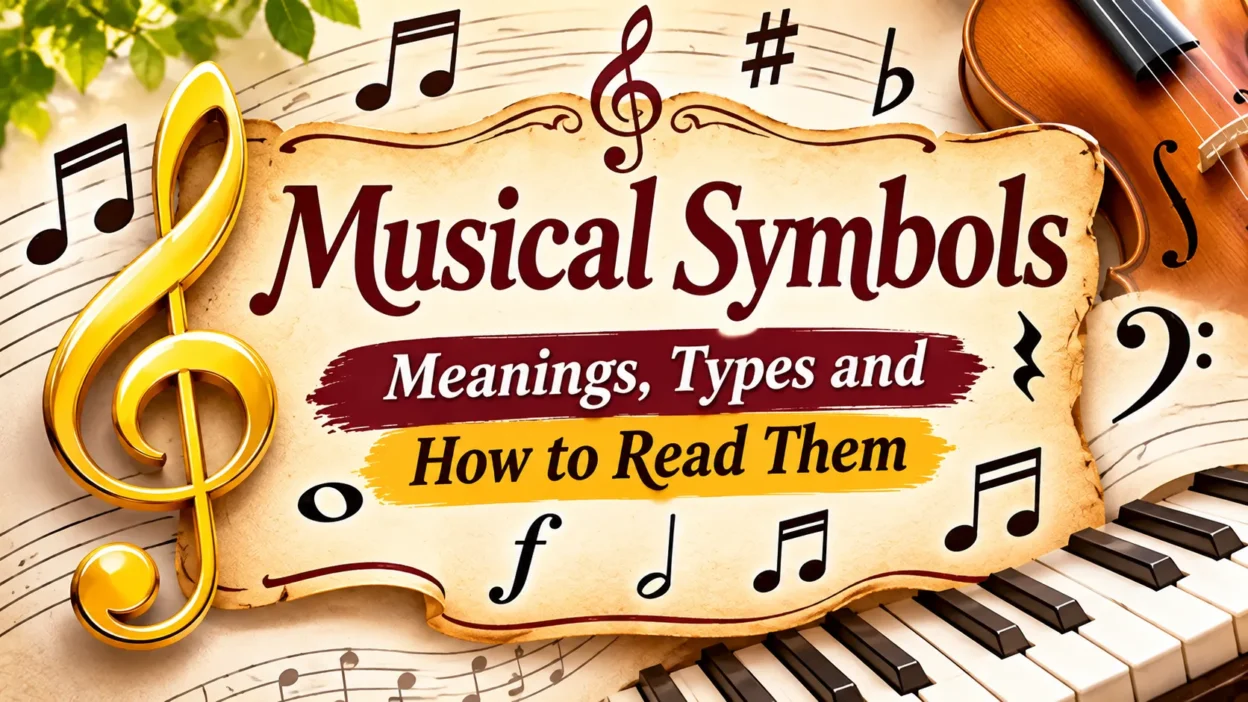
Musical symbols are the foundation of written music. They help musicians understand which notes to play, how long to hold them, when to pause, how loudly or softly to perform, and how a piece of music should sound. From the familiar treble clef and bass clef to notes, rests, sharps, flats, and time signatures, every musical symbol communicates important information.
Whether you are learning piano, guitar, violin, singing, or another instrument, understanding musical notation makes reading sheet music much easier. These symbols appear in beginner music lessons, professional scores, school textbooks, and digital music applications. Some symbols identify pitch, while others control rhythm, tempo, dynamics, and expression.
This guide explains common musical symbols, their names, meanings, and uses. You will also learn how to recognize music notes, understand rests, read accidentals, and identify the symbols musicians use to follow written compositions.
What Are Musical Symbols? 🎵
Musical symbols are written signs used to represent sounds, rhythms, pitches, pauses, and instructions in music. Musicians use them to communicate musical ideas without needing to hear a performance first. These signs form a system called musical notation.
A piece of written music usually contains several types of symbols. Notes show which pitches to play and how long to hold them. Rests indicate silence, while clefs establish the pitch range of the staff. Other symbols tell performers how quickly, loudly, or expressively to play.
Musical notation allows composers to share their work with musicians around the world. A pianist in the United States can read the same written composition as a violinist in another country, even if they have never met.
Basic Musical Symbols and Their Names 🎼
Learning the basic musical symbols gives beginners a strong foundation for reading sheet music. These signs appear in nearly every style of written music, including classical, jazz, pop, folk, and contemporary compositions.
Here are some of the most recognizable musical symbols:
| Symbol | Name | Meaning |
|---|---|---|
| 𝄞 | Treble clef | Identifies the higher-pitched staff range |
| 𝄢 | Bass clef | Identifies the lower-pitched staff range |
| 𝄡 | Alto clef | Commonly used for viola music |
| 𝄪 | Double sharp | Raises a note by two semitones |
| ♯ | Sharp | Raises a note by one semitone |
| ♭ | Flat | Lowers a note by one semitone |
| ♮ | Natural | Cancels a previous sharp or flat |
| 𝅝 | Whole note | Commonly lasts four quarter-note beats |
| 𝅗𝅥 | Half note | Commonly lasts two quarter-note beats |
| ♩ | Quarter note | Commonly lasts one beat |
| ♪ | Eighth note | Commonly lasts half a beat |
| ♬ | Sixteenth-note pair | Represents two sixteenth notes |
| 𝄽 | Quarter rest | Represents one beat of silence |
| 𝄾 | Eighth rest | Represents half a beat of silence |
| 𝄐 | Fermata | Holds a note or rest longer than its written value |
| 𝄀 | Single barline | Separates measures |
The exact duration of a note depends on the time signature and tempo. The table uses a common four-beat framework to explain basic note values.
Music Note Symbols and Their Meanings 🎶
Music note symbols tell performers which pitches to play and how long to sustain them. Notes appear on the five lines and four spaces of a musical staff. Their shapes indicate duration, while their positions indicate pitch.
Understanding note values helps musicians maintain a steady rhythm and play compositions accurately.
Whole Note Symbol
𝅝
A whole note has an open oval shape without a stem. In common time, it usually lasts four quarter-note beats. Musicians hold the note for the full duration unless the composition provides another instruction.
Whole notes often appear in slower passages, sustained melodies, and simple beginner exercises. They help students understand longer rhythmic values.
Half Note Symbol
𝅗𝅥
A half note has an open oval head with a stem. It usually lasts two quarter-note beats in common time.
Musicians hold a half note for twice as long as a quarter note. Two half notes can fill a measure of 4/4 time when no other rhythmic values appear.
Quarter Note Symbol
♩
A quarter note has a filled notehead and a stem. In common time, it represents one beat.
Quarter notes appear frequently in songs, exercises, and instrumental compositions. Beginners often learn them early because they provide a simple way to understand basic rhythm.
Eighth Note Symbol
♪
An eighth note has a filled notehead, a stem, and one flag. It usually lasts half the duration of a quarter note.
Two eighth notes can fit into one quarter-note beat. When several eighth notes appear together, musicians often connect their stems with a horizontal beam.
Sixteenth Note Symbol
𝅘𝅥𝅯
A sixteenth note has a filled notehead, a stem, and two flags. It usually lasts one-quarter of a quarter-note beat.
Four sixteenth notes fit into one quarter-note beat. They create faster rhythmic patterns and appear in many musical styles, including classical, pop, jazz, and electronic music.
Thirty-Second Note Symbol
𝅘𝅥𝅰
A thirty-second note has three flags or beams. It lasts half as long as a sixteenth note.
These notes appear in fast musical passages and complex compositions. Musicians often need careful practice to perform them accurately at higher tempos.
Sixty-Fourth Note Symbol
𝅘𝅥𝅱
A sixty-fourth note has four flags or beams and represents an even shorter rhythmic value. It lasts half as long as a thirty-second note.
This symbol appears less frequently than common note values. Composers may use it for extremely fast passages or highly detailed rhythmic writing.
Musical Rest Symbols and Their Meanings 🤫
Musical rest symbols represent silence. They tell performers when to stop playing or singing for a specific amount of time. Rests are just as important as notes because they create rhythm, separation, and musical expression.
Each rest symbol matches the duration of a corresponding note value.
Whole Rest
𝄻
A whole rest looks like a small dark rectangle hanging below a staff line. It commonly represents four beats in 4/4 time.
A whole rest can also indicate an entire measure of silence in many time signatures. Its exact duration depends on the notation and musical context.
Half Rest
𝄼
A half rest looks like a small dark rectangle sitting above a staff line. It commonly represents two quarter-note beats.
Musicians use half rests to create pauses that last half a measure in 4/4 time.
Quarter Rest
𝄽
A quarter rest has a distinctive curved shape. It represents one quarter-note beat in common time.
This rest appears frequently in everyday sheet music. It gives performers a short pause between notes or musical phrases.
Eighth Rest
𝄾
An eighth rest represents half a quarter-note beat. Its shape resembles a small curved mark with a flag.
It often appears between eighth notes or inside more complicated rhythmic patterns.
Sixteenth Rest
𝄿
A sixteenth rest represents one-quarter of a quarter-note beat. It has two small flags.
Composers use it to create short pauses within quick musical passages.
Thirty-Second Rest
𝅀
A thirty-second rest represents half the duration of a sixteenth rest. It has three flags.
This symbol is less common in beginner music but appears in advanced compositions with complex rhythms.
Sixty-Fourth Rest
𝅁
A sixty-fourth rest represents an extremely brief silence. It has four flags and matches the duration of a sixty-fourth note.
It appears in music that requires very precise rhythmic timing.
Musical Clef Symbols and Their Uses 🎹
Clef symbols appear at the beginning of a musical staff. They tell musicians which pitches correspond to the lines and spaces. Without a clef, performers would not know the exact pitch represented by a note.
The three main clefs used in traditional notation are the treble clef, bass clef, and C clef.
Treble Clef Symbol
𝄞
The treble clef is also called the G clef because its curved shape circles the second line of the staff, identifying that line as G above middle C.
It is commonly used for higher-pitched instruments and voices. Instruments that frequently use treble clef include:
- Flute
- Violin
- Trumpet
- Clarinet
- Guitar
- Right hand of the piano
- Soprano and alto vocal parts
The treble clef is usually the first clef beginners learn because it appears in many popular songs and basic music exercises.
Bass Clef Symbol
𝄢
The bass clef is also called the F clef. Its two dots surround the fourth line of the staff, identifying that line as F below middle C.
It is commonly used for lower-pitched instruments and voices, including:
- Bass guitar
- Cello
- Double bass
- Bassoon
- Trombone
- Tuba
- Left hand of the piano
- Bass vocal parts
Piano players usually learn both treble and bass clefs because their instrument covers a wide range of pitches.
Alto Clef Symbol
𝄡
The alto clef is a type of C clef. Its center identifies the middle line of the staff as middle C.
The viola is its most common user. The alto clef helps viola players read music within their instrument’s natural range without needing excessive ledger lines.
Tenor Clef
The tenor clef is another C clef. It places middle C on the fourth line of the staff.
It appears in some music written for cello, bassoon, trombone, and other instruments that move into higher registers. Using tenor clef can make notation easier to read when many notes would otherwise require ledger lines.
Musical Accidentals and Their Meanings ♯
Accidentals are symbols that change the pitch of a note. They can raise, lower, or restore a note to its natural pitch. These symbols appear directly before the note they affect.
Understanding accidentals is essential for reading melodies, scales, chords, and key signatures.
Sharp Symbol
♯
A sharp raises a note by one semitone, which is the distance between two adjacent keys on a piano, including black and white keys.
For example, F sharp is one semitone higher than F natural. The sharp symbol appears immediately before the note on a musical staff.
Flat Symbol
♭
A flat lowers a note by one semitone.
For example, B flat is one semitone lower than B natural. Flats frequently appear in key signatures and musical passages written in flat keys.
Natural Symbol
♮
A natural sign cancels an earlier sharp or flat for the relevant note within the measure.
For example, if a measure contains F sharp, an F natural sign changes the following F back to its natural pitch, according to standard notation rules.
Double Sharp Symbol
𝄪
A double sharp raises a note by two semitones, which is equivalent to one whole tone.
For example, F double sharp sounds like G natural on a standard piano. Although the notes sound the same in equal temperament, composers use the written spelling to preserve the musical structure.
Double Flat Symbol
𝄫
A double flat lowers a note by two semitones.
For example, B double flat sounds like A natural on a standard piano. This symbol often appears in advanced music theory and certain key signatures.
Musical Dynamics Symbols: Loud and Soft Sounds 🔊
Dynamics symbols tell musicians how loudly or softly to perform a note, phrase, or passage. They help create emotional contrast and give music its expressive character.
Most traditional dynamics markings use Italian words or abbreviations.
| Symbol | Name | Meaning |
|---|---|---|
| ppp | Pianississimo | Extremely soft |
| pp | Pianissimo | Very soft |
| p | Piano | Soft |
| mp | Mezzo piano | Moderately soft |
| mf | Mezzo forte | Moderately loud |
| f | Forte | Loud |
| ff | Fortissimo | Very loud |
| fff | Fortississimo | Extremely loud |
| sfz | Sforzando | Sudden strong emphasis |
| fp | Forte-piano | Loud, then immediately soft |
These markings help performers shape the sound of a composition. A quiet passage may create a gentle atmosphere, while a loud section can build excitement or intensity.
Crescendo Symbol
𝆒
A crescendo tells musicians to gradually increase the volume. It often appears as two lines that spread farther apart toward the right.
Composers use crescendos to build tension, excitement, and emotional intensity.
Diminuendo Symbol
𝆓
A diminuendo tells musicians to gradually decrease the volume. Its two lines move closer together toward the right.
It can create a softer ending, a gentle transition, or a gradual reduction in musical intensity.
Decrescendo
Decrescendo is another instruction to gradually reduce volume. It is often used interchangeably with diminuendo, although composers may use the terms to communicate slightly different expressive intentions.
Tempo Symbols and Musical Speed ⏱️
Tempo symbols and markings tell musicians how fast or slowly to perform a composition. And Tempo affects the overall mood, energy, and movement of music.
Composers often use Italian tempo terms, but modern scores may also include a precise beats-per-minute number.
| Tempo marking | Meaning |
|---|---|
| Largo | Very slow and broad |
| Lento | Slow |
| Adagio | Slowly |
| Andante | At a walking pace |
| Moderato | Moderate speed |
| Allegretto | Moderately fast |
| Allegro | Fast and lively |
| Vivace | Lively and brisk |
| Presto | Very fast |
| Prestissimo | Extremely fast |
Metronome Marking
A metronome marking gives a specific tempo using beats per minute, often written as a note symbol followed by a number.
For example, ♩ = 120 means the music should have 120 quarter-note beats per minute.
A metronome helps musicians maintain a steady pulse during practice and performance.
Fermata Symbol
𝄐
A fermata looks like a curved arc with a dot underneath. It tells performers to hold a note or rest longer than its written value.
The performer or conductor usually determines how long to sustain it based on the musical context.
Accelerando
Accelerando instructs musicians to gradually increase the tempo. The music becomes faster over time.
Ritardando
Ritardando tells performers to gradually slow down. Composers often use it near the end of a piece or before an important musical transition.
Time Signature Symbols and Their Meanings 🥁
A time signature appears near the beginning of a musical composition, usually after the clef and key signature. It tells musicians how beats are organized within each measure.
A time signature contains two numbers. The top number indicates how many beats or counting units appear in each measure. The bottom number identifies the note value used as the basic unit.
| Time signature | Common name | Basic meaning |
|---|---|---|
| 2/4 | Two-four time | Two quarter-note beats per measure |
| 3/4 | Three-four time | Three quarter-note beats per measure |
| 4/4 | Four-four time | Four quarter-note beats per measure |
| 5/4 | Five-four time | Five quarter-note beats per measure |
| 6/8 | Six-eight time | Six eighth-note units per measure |
| 9/8 | Nine-eight time | Nine eighth-note units per measure |
| 12/8 | Twelve-eight time | Twelve eighth-note units per measure |
Common Time Symbol
𝄴
The common time symbol looks like a capital C. It represents 4/4 time, which contains four quarter-note beats in each measure.
This time signature appears in many popular songs, classical compositions, and contemporary music.
Cut Time Symbol
𝄵
Cut time looks like a C with a vertical line through it. It represents 2/2 time, also called alla breve.
It indicates two half-note beats per measure and often helps musicians read music with a faster two-beat feel.
Musical Barline Symbols and Their Meanings 📏
Barlines divide sheet music into measures, making rhythm easier to organize and follow. Each measure contains the number and type of beats indicated by the time signature.
Different barlines show where musical sections begin, end, or change.
| Symbol | Name | Meaning |
|---|---|---|
| | | Single barline | Separates measures |
| ‖ | Double barline | Marks a section boundary |
| 𝄂 | Final barline | Indicates the end of a piece |
| 𝄆 | Start repeat | Marks the beginning of a repeated section |
| 𝄇 | End repeat | Marks where the repeated section finishes |
Barline symbols help performers follow the structure of a composition. Repeat signs also reduce the amount of notation composers need to write.
Musical Articulation Symbols and Their Meanings 🎻
Articulation symbols explain how musicians should begin, connect, or separate notes. They influence the character of a melody and help performers express a composer’s intentions.
The same sequence of notes can sound very different depending on its articulation.
Staccato Symbol
•
A staccato dot appears above or below a note. It tells musicians to play the note shorter and more separated than its normal written duration.
Staccato creates a light, crisp, and detached sound.
Legato Symbol
Legato means that notes should flow smoothly into one another without noticeable gaps. A curved line called a slur often connects the notes.
Legato playing is common in singing, string instruments, wind instruments, and expressive piano passages.
Accent Symbol
>
An accent mark tells musicians to emphasize a particular note. The note receives more stress than surrounding notes.
Accents can add energy, rhythmic definition, and expression to a musical phrase.
Marcato Symbol
^
Marcato indicates that a note should receive a strong and clearly marked emphasis. It generally asks for a more forceful attack than an ordinary accent.
Tenuto Symbol
—
A tenuto line appears above or below a note. It tells musicians to sustain the note for its full value or give it slight emphasis.
Slur Symbol
A slur is a curved line connecting two or more different notes. It tells performers to play or sing them smoothly as one connected phrase.
Tie Symbol
A tie is also a curved line, but it connects two notes of the same pitch. The performer holds the sound for their combined duration instead of playing the second note again.
For example, a half note tied to a quarter note creates a sustained sound lasting three quarter-note beats.
Repetition and Navigation Symbols in Music 🔁
Repetition symbols help musicians repeat sections without rewriting the same measures. Navigation markings guide performers through longer compositions and tell them where to return or move forward.
These symbols are particularly useful in classical pieces, songs, and ensemble arrangements.
Repeat Sign
𝄆 and 𝄇
Repeat signs indicate that musicians should play a section again. Two dots placed near a double barline show the direction of the repeat.
A section may repeat once or multiple times depending on the composer’s instructions.
Da Capo (D.C.)
Da Capo means “from the beginning.” When musicians reach this instruction, they return to the start of the composition.
A marking such as D.C. al Fine tells performers to return to the beginning and continue until they reach the word Fine.
Dal Segno (D.S.)
Dal Segno means “from the sign.” It directs musicians to return to a special sign earlier in the score.
The sign usually resembles a stylized letter S with dots and a diagonal line.
Fine
Fine means “the end.” It identifies the point where the composition or repeated section finishes.
Coda Symbol
𝄌
The coda symbol marks a special ending section. When a score includes a coda instruction, musicians jump to the marked coda at the appropriate point.
Chord Symbols and Their Meanings 🎸
Chord symbols provide a short way to communicate groups of notes that sound together. Guitarists, pianists, bassists, and other musicians often use them when accompanying songs.
Instead of writing every note of a chord, composers can use a letter and additional markings to identify its structure.
| Chord symbol | Meaning |
|---|---|
| C | C major |
| Cm | C minor |
| C7 | C dominant seventh |
| Cmaj7 | C major seventh |
| Cm7 | C minor seventh |
| Cdim | C diminished |
| Caug | C augmented |
| Csus2 | C suspended second |
| Csus4 | C suspended fourth |
| Cadd9 | C major with an added ninth |
Major Chord
A major chord contains a root, major third, and perfect fifth. It often creates a bright or stable sound, although its emotional effect depends on the musical context.
Minor Chord
A minor chord contains a root, minor third, and perfect fifth. Many listeners describe its sound as darker or more reflective.
Seventh Chord
A seventh chord adds another note above a basic triad. Different types of seventh chords create different harmonic colors and are common in jazz, blues, pop, and classical music.
Guitar Musical Symbols and Their Meanings 🎸
Guitar sheet music can include standard musical notation, chord diagrams, and tablature symbols. These markings tell players which strings to use, where to place their fingers, and how to perform different techniques.
Common guitar symbols include:
- h: Hammer-on.
- p: Pull-off.
- b: Bend a string.
- r: Release a bend.
- /: Slide upward.
- \: Slide downward.
- PM: Palm mute.
- x: Muted or percussive note.
- ~: Vibrato.
- T: Tapping, in some notation systems.
These symbols appear in guitar tabs and performance instructions. Their exact appearance may vary between publishers and notation software.
Piano Musical Symbols and Their Meanings 🎹
Piano music combines treble and bass clefs to represent the instrument’s wide pitch range. The right hand commonly follows the treble staff, while the left hand commonly follows the bass staff.
Pianists also encounter symbols that explain how to use the pedals, play chords, and perform expressive passages.
Some common piano markings include:
- Ped.: Press the sustain pedal.
- *: Release the sustain pedal in many scores.
- Una corda: Use the soft pedal.
- Tre corde: Return to normal piano sound.
- Arpeggio marking: Play the notes of a chord in sequence.
- Octave marking: Play notes an octave higher or lower.
- Crossed hands: Move one hand across the other.
Piano notation may also include fingering numbers from 1 to 5. These numbers help performers choose which fingers to use for particular notes.
Vocal Musical Symbols and Their Meanings 🎤
Vocal music uses standard musical notation along with additional markings that guide singers. These instructions help performers understand lyrics, breathing, pronunciation, and vocal expression.
Common vocal markings include:
- Breath mark: Shows where a singer should take a breath.
- Fermata: Indicates that a note should be held longer.
- Slur: Connects notes smoothly.
- Tie: Joins notes of the same pitch.
- Solo: Indicates a section performed by one singer.
- Unison: Tells singers to perform the same melody together.
- Divisi: Instructs a section to divide into separate musical parts.
- A cappella: Indicates singing without instrumental accompaniment.
These markings help singers coordinate with instrumentalists and maintain the musical structure of a performance.
Musical Symbols Used in Sheet Music 📄
Sheet music combines several types of symbols on a staff. Each part of the notation communicates a different piece of information, and musicians read them together to understand a composition.
A standard musical staff contains five horizontal lines and four spaces. Notes appear on the lines or spaces, while clefs identify their pitches.
The beginning of a typical piece may contain:
- Clef: Identifies the pitch range.
- Key signature: Shows which notes are normally sharp or flat.
- Time signature: Explains the rhythmic organization.
- Tempo marking: Indicates the speed.
- Dynamic marking: Communicates the volume.
After these markings, the music continues through measures separated by barlines. Notes, rests, accidentals, articulation marks, and expression instructions appear throughout the score.
Learning to recognize these elements helps beginners understand how written music translates into sound.
How to Read Musical Symbols as a Beginner 🎓
Learning musical symbols becomes easier when you study them in a logical order. Instead of trying to memorize every marking at once, begin with the basic parts of written music and gradually introduce more advanced concepts.
Start with the musical staff. Learn the five lines and four spaces, then understand how notes move higher or lower across the staff.
Learn the clefs. Begin with treble clef if you play an instrument such as violin, flute, or guitar. Learn bass clef as well if you play piano, cello, or bass guitar.
Memorize basic note values. Practice whole notes, half notes, quarter notes, eighth notes, and sixteenth notes. Clap their rhythms to understand how they fit together.
Study rests. Learn how each rest matches a note duration. Practice counting silence just as carefully as you count notes.
Understand accidentals. Recognize sharps, flats, and naturals. Use a piano keyboard to hear how each symbol changes a pitch.
Practice time signatures. Start with 4/4 and 3/4 time before moving to less familiar patterns.
Explore dynamics and tempo. Learn how markings such as piano, forte, allegro, and adagio change a performance.
Read simple sheet music. Choose beginner songs with familiar rhythms and a limited number of notes. Practice slowly before increasing the tempo.
Regular practice helps you recognize musical symbols without stopping to think about every marking.
Musical Symbols and Their Meanings: Quick Reference Chart 📚
Use this reference chart to review the most common musical symbols and their functions.
| Symbol or marking | Name | Purpose |
|---|---|---|
| 𝄞 | Treble clef | Identifies the G-clef staff |
| 𝄢 | Bass clef | Identifies the F-clef staff |
| 𝄡 | Alto clef | Places middle C on the center line |
| ♯ | Sharp | Raises pitch by one semitone |
| ♭ | Flat | Lowers pitch by one semitone |
| ♮ | Natural | Cancels an accidental |
| 𝄪 | Double sharp | Raises pitch by two semitones |
| 𝄫 | Double flat | Lowers pitch by two semitones |
| 𝅝 | Whole note | Four quarter-note beats in common time |
| 𝅗𝅥 | Half note | Two quarter-note beats |
| ♩ | Quarter note | One beat in common time |
| ♪ | Eighth note | Half a beat in common time |
| 𝄽 | Quarter rest | One beat of silence |
| 𝄾 | Eighth rest | Half a beat of silence |
| 𝄐 | Fermata | Extends a note or rest |
| p | Piano | Soft |
| f | Forte | Loud |
| mp | Mezzo piano | Moderately soft |
| mf | Mezzo forte | Moderately loud |
| Allegro | Tempo marking | Fast and lively |
| Adagio | Tempo marking | Slow |
| Crescendo | Dynamic instruction | Gradually louder |
| Diminuendo | Dynamic instruction | Gradually softer |
| Staccato | Articulation | Short and detached |
| Legato | Articulation | Smooth and connected |
| 4/4 | Time signature | Four quarter-note beats per measure |
| 3/4 | Time signature | Three quarter-note beats per measure |
| 𝄌 | Coda | Directs performers to a special ending |
Frequently Asked Questions About Musical Symbols ❓
What are the most common musical symbols?
The most common musical symbols include the treble clef, bass clef, whole note, half note, quarter note, eighth note, rests, sharps, flats, natural signs, and time signatures. These symbols form the foundation of standard music notation.
What does the treble clef symbol mean?
The treble clef identifies the pitch range of the staff and places G above middle C on the second line. It is commonly used for higher-pitched instruments and vocal parts.
What does the bass clef symbol mean?
The bass clef identifies a lower pitch range and places F below middle C on the fourth line. It is commonly used for bass instruments and the left hand of piano music.
What is the difference between a sharp and a flat?
A sharp raises a note by one semitone, while a flat lowers a note by one semitone. Both symbols change the pitch of a written note.
What does a natural sign mean in music?
A natural sign cancels an earlier sharp or flat for the same note within the measure. It returns that note to its natural pitch.
What is a musical rest?
A musical rest represents silence for a specific duration. Whole rests, half rests, quarter rests, and eighth rests are common examples.
What does a fermata symbol mean?
A fermata tells performers to hold a note or rest longer than its normal written duration. The conductor or performer usually decides how long to extend it.
What does the C symbol mean in sheet music?
A capital C is the common-time symbol. It represents 4/4 time, which contains four quarter-note beats per measure.
What does a dot above a music note mean?
A dot above or below a note usually indicates staccato. It tells musicians to play the note in a short, detached manner.
What is the difference between a tie and a slur?
A tie connects two notes of the same pitch and combines their durations into one sustained sound. A slur connects different notes and tells musicians to perform them smoothly.
What does the forte symbol mean?
Forte, written as f, means loud. It instructs musicians to perform a passage with strong volume.
What does piano mean in musical notation?
Piano, written as p, means soft. It tells musicians to play or sing quietly.
What is a time signature?
A time signature shows how beats are grouped within musical measures. Its top number indicates the number of counting units, while its bottom number identifies the note value used as the unit.
What are articulation symbols in music?
Articulation symbols explain how to perform notes. Common examples include staccato, legato, accent, marcato, and tenuto.
How many musical symbols are there?
There is no single fixed number of musical symbols. Standard notation includes many signs for pitch, rhythm, dynamics, tempo, articulation, expression, repetition, and performance techniques. Different instruments and musical traditions also use specialized markings.
Conclusion 🎼
Musical symbols make it possible to write, read, share, and perform music accurately. From notes and rests to clefs, accidentals, dynamics, tempo markings, and articulation signs, every symbol helps musicians understand how a composition should sound.
Beginners can start with the treble clef, bass clef, basic note values, and common rests before moving on to more advanced notation. With regular practice, these symbols become easier to recognize, making sheet music less intimidating and musical learning more enjoyable.
Whether you play piano, guitar, violin, drums, or sing, understanding musical symbols gives you a valuable foundation for improving your musical skills.

Jessica Morgan is a writer and content creator at Blesslume, dedicated to sharing meaningful blessings, heartfelt prayers, inspiring wishes, and uplifting messages. She is passionate about helping people find the right words to celebrate special moments, offer encouragement, and spread kindness. Through thoughtful and inspiring content, Jessica aims to bring hope, positivity, and connection to readers around the world.