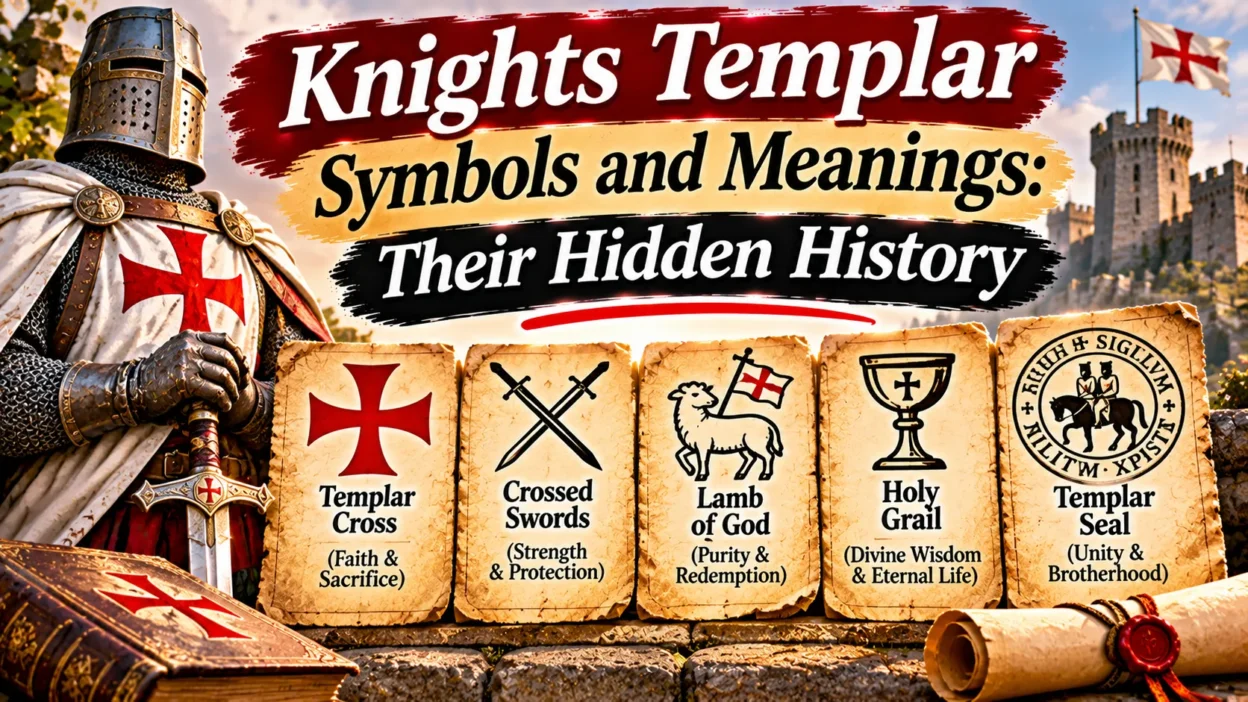
Knights Templar symbols have fascinated historians, researchers, and history enthusiasts for centuries. The Knights Templar were a medieval Christian military order known for their religious dedication, military discipline, and distinctive visual identity. Their crosses, seals, banners, and other designs reflected their beliefs, responsibilities, and traditions.
From the famous red cross to the mysterious image of two knights sharing one horse, each symbol tells a different story about medieval life. Some represent Christian faith, sacrifice, courage, and brotherhood, while others connect with military service and the history of the Crusades.
However, not every mysterious design associated with the Templars has a proven historical connection to the order. Understanding the difference between documented symbols and later legends makes their history even more interesting.
In this guide, we explore the most recognizable Knights Templar symbols, their traditional meanings, historical backgrounds, and influence on modern culture.
Who Were the Knights Templar? ⚔️
The Knights Templar were a medieval Catholic military order founded around 1119 in Jerusalem. Their original mission involved protecting Christian pilgrims traveling to important religious sites in the Holy Land.
The order received official recognition from the Catholic Church at the Council of Troyes in 1129. Over time, the Templars developed into a powerful organization with military, religious, financial, and administrative responsibilities across Europe and the eastern Mediterranean.
Members followed religious rules and took vows associated with poverty, chastity, and obedience. Their distinctive white mantles with red crosses became an important part of their identity.
The Templars also developed a recognizable visual culture through seals, banners, buildings, and religious imagery. Their symbols reflected their Christian beliefs, military responsibilities, and organizational structure.
In 1307, King Philip IV of France ordered the arrest of many Templars. Pope Clement V eventually dissolved the order in 1312. Despite its historical end, the Knights Templar continued to inspire legends, books, artwork, and modern organizations.
The Red Cross: The Most Famous Knights Templar Symbol ✝️
The red cross is the most recognizable symbol associated with the Knights Templar. It appeared on their clothing and represented their Christian religious identity.
Templar knights wore white mantles bearing a red cross. The white garment reflected their religious commitment, while the red cross represented Christian faith and the willingness to sacrifice their lives for their beliefs.
The order received permission to wear the red cross under Pope Eugene III in the 12th century. This distinctive mark helped identify Templar members during military campaigns and religious activities.
Traditional associations include:
- Christian faith and devotion
- Sacrifice and courage
- Religious commitment
- Military service
- Brotherhood and loyalty
The Templar cross should not be confused with every red cross design from medieval history. Different military and religious orders used crosses with distinct shapes and traditions.
The Knights Templar Seal: Two Knights on One Horse 🐎
One of the most distinctive Templar symbols shows two mounted knights sharing a single horse. The design appeared on an official seal associated with the order.
Historians often connect this image with the Templars’ early poverty and their commitment to a modest religious lifestyle. It also became an important representation of the order’s identity.
The exact meaning of the image remains open to interpretation. Some explanations connect it with brotherhood, shared resources, and the close relationship between members.
Common interpretations include:
- Brotherhood and unity
- Poverty and humility
- Shared responsibility
- Loyalty between fellow knights
- Religious dedication
The image became one of the most recognizable visual references to the historical Knights Templar.
The Beauceant: Knights Templar Battle Banner 🏴
The Beauceant was the distinctive battle banner associated with the Knights Templar. Historical descriptions connect it with black and white sections, although representations can vary.
The banner served as an important military standard. During campaigns, it helped members identify their forces and maintain their organization on the battlefield.
Some historical interpretations connect the contrasting colors with the order’s identity and its commitment to both religious and military responsibilities. However, popular explanations of the banner’s colors should not be treated as universally established historical facts.
The Beauceant commonly represents:
- Templar military identity
- Unity and discipline
- Loyalty to the order
- Organization during battle
- Brotherhood among knights
The banner remains an important symbol in historical illustrations and modern Templar-inspired designs.
The Lamb of God: Agnus Dei Symbol 🐑
The Lamb of God, known in Latin as Agnus Dei, is an important Christian religious symbol. It represents Jesus Christ and connects with themes of sacrifice, redemption, purity, and salvation.
The image traditionally depicts a lamb, sometimes carrying a cross or banner. Christian communities used this imagery long before the Knights Templar existed.
Although the Lamb of God appears in Christian art and has associations with medieval religious culture, it is not exclusively a Knights Templar symbol.
Its traditional meanings include:
- Sacrifice and redemption
- Purity and innocence
- Christian faith
- Spiritual devotion
- Salvation
The symbol helps explain the broader religious environment in which the Templars operated.
The Templar Cross Pattée: A Distinctive Cross Design 🔴
The cross pattée features arms that become wider toward their outer ends. It appears in several historical military and religious contexts, including designs associated with the Knights Templar.
The shape became particularly familiar in modern representations of medieval military orders.
However, not every cross pattée belonged to the Templars. Other organizations and traditions also used similar cross designs.
Common associations include:
- Christian identity
- Medieval military orders
- Faith and devotion
- Courage and sacrifice
- Historical Templar imagery
When researching Templar symbols, it helps to distinguish the general cross pattée design from the specific red cross historically associated with the order.
The Seal of Solomon: Historical Connections and Legends ⭐
The Seal of Solomon is a name commonly associated with a six-pointed star formed by two overlapping triangles. It appears in different religious, cultural, and historical traditions.
Some modern Templar-related discussions connect this symbol with the Knights Templar, often because of the order’s association with Jerusalem and later legends about hidden knowledge.
However, strong historical evidence does not establish the six-pointed star as an official or defining emblem of the medieval Knights Templar.
The symbol has a much wider history and appears in Jewish, Islamic, Christian, and other cultural contexts.
Common meanings associated with the symbol include:
- Spiritual protection
- Harmony and balance
- The relationship between opposing forces
- Religious identity in different traditions
- Unity between different elements
Its appearance in modern Templar-themed artwork often reflects later interpretations rather than a confirmed medieval Templar tradition.
The Knights Templar Sword: Courage and Military Duty 🗡️
The sword represents the military responsibilities of the Knights Templar. As a religious military order, the Templars trained for armed service and participated in campaigns during the Crusades.
A sword in Templar-inspired artwork often communicates courage, discipline, protection, and the responsibilities of a warrior.
However, the sword was a general medieval military object rather than an exclusive Templar emblem.
Its symbolic associations include:
- Courage and bravery
- Military service
- Protection and defense
- Discipline and responsibility
- Commitment to a cause
Templar swords also appear frequently in modern historical illustrations, reenactments, and decorative designs.
The Templar Shield: Defense and Brotherhood 🛡️
The shield represents the defensive role of medieval knights. It protected soldiers during combat and often carried heraldic designs that identified individuals or groups.
Templar-inspired shields frequently display crosses, geometric patterns, or other medieval Christian imagery.
Although the Knights Templar used military equipment, no single shield design served as a universal emblem for every member of the order.
Common symbolic meanings include:
- Protection and defense
- Courage under pressure
- Loyalty and duty
- Military identity
- Strength and resilience
The shield remains a popular feature in modern Templar-inspired artwork and historical illustrations.
The Templar Horse: Loyalty and Service 🐴
Horses played an essential role in medieval warfare and transportation. The Knights Templar depended on horses to travel, carry equipment, and participate in military campaigns.
The order also maintained systems for managing horses, supplies, and military resources.
In Templar-inspired imagery, a horse often represents service, loyalty, endurance, and the practical responsibilities of medieval military life.
Common associations include:
- Loyalty and dedication
- Strength and endurance
- Military service
- Travel and protection
- Discipline
The horse also connects with the famous seal showing two knights sharing one animal.
Knights Templar Symbols and Their Meanings: Quick Reference 📜
The following table summarizes some recognizable symbols associated with the Knights Templar and the wider Christian and medieval traditions surrounding them.
| Symbol | Meaning or Association | Historical Context |
|---|---|---|
| Red cross | Christian faith and sacrifice | Strong Templar association |
| Two knights on one horse | Brotherhood and poverty | Templar seal |
| Beauceant | Military identity and unity | Templar battle banner |
| Cross pattée | Christian military identity | Used by several groups |
| Lamb of God | Sacrifice and redemption | Wider Christian tradition |
| Sword | Courage and military duty | General medieval imagery |
| Shield | Defense and protection | General medieval imagery |
| Horse | Loyalty and military service | Medieval military life |
| Seal of Solomon | Spiritual and religious associations | Wider historical traditions; not a confirmed official Templar emblem |
Knights Templar Symbols on Clothing and Armor 🧥
The Templars used distinctive clothing to express their religious identity and separate their members from ordinary soldiers.
Their white mantles with red crosses became their best-known visual feature. The mantle was not simply decorative clothing; it reflected the religious character of the order.
Members also wore practical garments suitable for travel and military activities. Their equipment varied according to rank, responsibilities, and circumstances.
Important features included:
- White mantles bearing red crosses
- Practical military clothing
- Chain mail and protective armor
- Helmets and shields
- Religious and military insignia
The red cross on the white mantle remains the clearest visual representation of a medieval Templar knight.
Knights Templar Symbols in Architecture and Churches 🏰
The Knights Templar established buildings throughout Europe and the eastern Mediterranean. Their properties included churches, chapels, castles, administrative centers, and fortified sites.
Some Templar churches used circular architectural designs. Historians sometimes connect these structures with the Church of the Holy Sepulchre in Jerusalem, although circular churches were not exclusive to the Templars.
Templar buildings also featured Christian religious imagery, crosses, stone carvings, and architectural elements that reflected the period’s artistic traditions.
These structures helped the order establish a lasting presence across different regions. They also provide historians with valuable evidence about medieval religious life, construction techniques, and the Templars’ organizational reach.
Knights Templar Symbols and Their Connection to the Crusades 🏹
The Crusades shaped the history and identity of the Knights Templar. The order emerged in Jerusalem during a period when Christian and Muslim powers competed for control of important territories and religious sites.
Templar knights participated in military campaigns and protected routes used by Christian pilgrims. Their religious mission and military responsibilities influenced the symbols they adopted.
The red cross communicated their Christian identity, while their banners and seals helped distinguish the order from other military groups.
The Templars also developed relationships with European rulers, religious authorities, and wealthy supporters. Their growing influence helped spread their symbols across Europe and the eastern Mediterranean.
Myths and Legends About Knights Templar Symbols 🔮
The Knights Templar became the subject of numerous legends after the order’s dissolution. Stories about hidden treasures, secret rituals, forbidden knowledge, and mysterious religious objects continue to attract public attention.
Some popular theories connect the Templars with the Holy Grail, the Ark of the Covenant, secret societies, and ancient symbols.
However, historians distinguish documented medieval evidence from stories that appeared much later.
Popular Templar legends include:
- The Knights Templar discovered the Holy Grail.
- The order protected the Ark of the Covenant.
- Templars possessed secret spiritual knowledge.
- Their symbols contained hidden messages.
- The organization continued secretly after its dissolution.
These stories contribute to the Templars’ mysterious reputation, but researchers have not established many of their central claims through reliable historical evidence.
Understanding this difference helps readers appreciate the genuine history without treating every legend as fact.
Knights Templar Symbols in Modern Culture 🎭
The Knights Templar continue to influence modern books, films, video games, artwork, jewelry, clothing, and historical reenactments.
Their red cross, medieval seals, swords, shields, and banners appear frequently in designs inspired by medieval history.
Modern fraternal organizations also use Templar-related names and imagery. However, these organizations should not automatically be considered direct continuations of the medieval order.
Common modern uses include:
- Historical costumes and reenactments
- Medieval-inspired jewelry
- Decorative wall art
- Books and historical fiction
- Films and video games
- Fraternal organization insignia
- Educational projects about the Crusades
The popularity of these designs reflects continuing interest in medieval history, religious symbolism, and the mystery surrounding the Templars.
Frequently Asked Questions About Knights Templar Symbols ❓
What is the most famous Knights Templar symbol?
The red cross on a white mantle is the most recognizable symbol associated with the Knights Templar. It represented their Christian identity, religious commitment, and willingness to serve.
What does the Knights Templar red cross mean?
The red cross represents Christian faith, sacrifice, and devotion. The Templars wore it on their clothing to identify themselves as members of a religious military order.
Why did two Knights Templar share one horse?
The image appeared on an official Templar seal. Historians often associate it with the order’s early poverty and commitment to a modest lifestyle. It also inspires interpretations involving brotherhood and shared responsibility.
What is the Beauceant?
The Beauceant was the battle banner associated with the Knights Templar. Historical descriptions connect it with black and white sections, and it served as an important military standard.
What does the Templar cross pattée represent?
The cross pattée is a cross design with arms that widen toward their ends. It appears in medieval religious and military traditions, including imagery associated with the Templars.
Did the Knights Templar use the Seal of Solomon?
The six-pointed star known as the Seal of Solomon appears in various historical and religious traditions. However, historians have not established it as an official or defining emblem of the medieval Knights Templar.
What does the Knights Templar sword symbolize?
The sword represents military service, courage, discipline, and defense. It reflects the Templars’ responsibilities as a religious military order, although swords were common equipment among medieval knights.
What colors did the Knights Templar use?
The best-known Templar clothing featured a white mantle with a red cross. Historical descriptions also associate their battle banner, the Beauceant, with black and white.
Did the Knights Templar have secret symbols?
The order used official seals, religious imagery, banners, and recognizable clothing. Stories about hidden symbols and secret messages exist, but many popular claims lack reliable historical evidence.
Are the Knights Templar still active today?
The original medieval Knights Templar order ended in 1312. Several modern organizations use Templar-related names and traditions, but they do not represent the original medieval institution.
What happened to the Knights Templar?
King Philip IV of France ordered the arrest of many Templars in 1307. Pope Clement V dissolved the order in 1312. Its history later inspired numerous legends and cultural traditions.
Conclusion 🌟
Knights Templar symbols reveal the religious beliefs, military responsibilities, and organizational identity of one of the most famous medieval orders. The red cross represents Christian faith and sacrifice, while the two knights sharing one horse connect with the Templars’ early history and traditions of brotherhood. The Beauceant, seals, swords, and other designs provide further insight into their medieval world.
Some symbols have direct historical connections with the order, while others belong to wider Christian traditions or later legends. Recognizing this distinction helps separate historical evidence from popular speculation.
The Knights Templar may have disappeared as a medieval organization, but their symbols continue to capture people’s imagination. Their legacy remains visible in historical research, architecture, literature, art, and modern interpretations of medieval culture.

Jessica Morgan is a writer and content creator at Blesslume, dedicated to sharing meaningful blessings, heartfelt prayers, inspiring wishes, and uplifting messages. She is passionate about helping people find the right words to celebrate special moments, offer encouragement, and spread kindness. Through thoughtful and inspiring content, Jessica aims to bring hope, positivity, and connection to readers around the world.