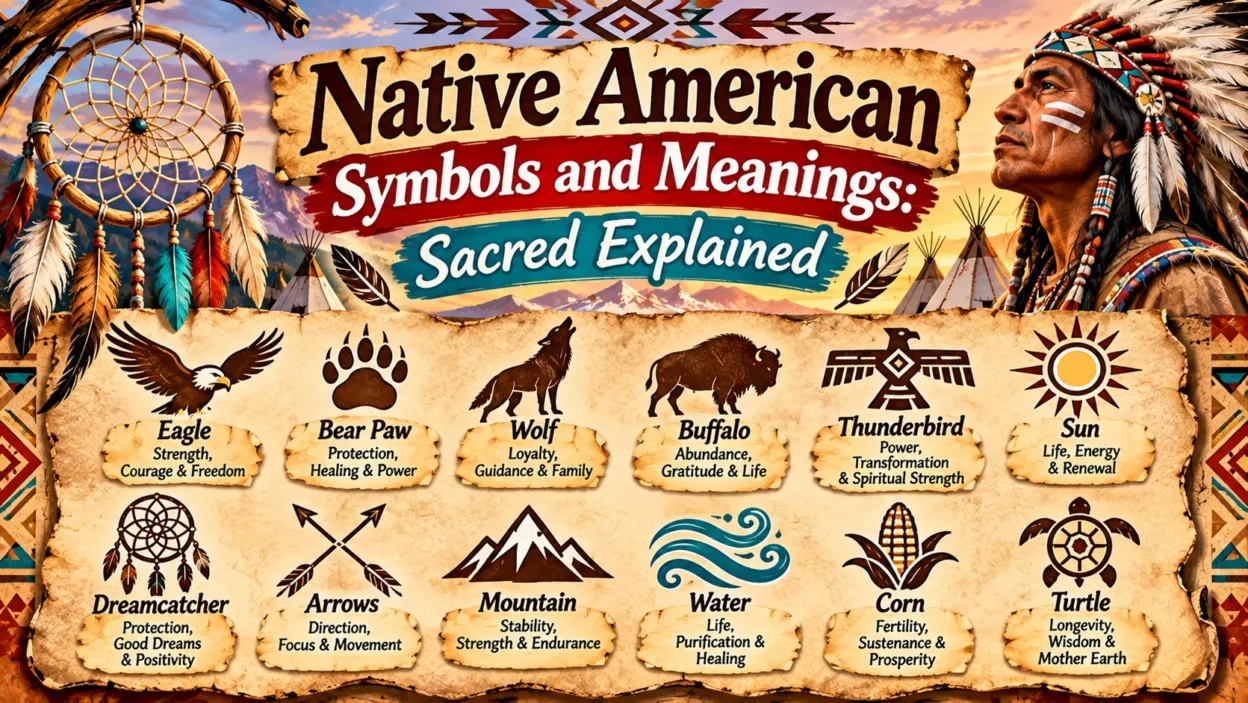
Native American symbols and meanings offer a fascinating look into the traditions, beliefs, stories, and artistic heritage of Indigenous peoples across North America. For thousands of years, Native American nations have used symbols in pottery, clothing, beadwork, basketry, rock art, ceremonial objects, architecture, and storytelling. These designs often communicate connections with nature, animals, ancestors, spirituality, family, and community. An eagle may represent strength and a connection with the sky in a particular tradition, while a turtle can be associated with the earth, creation, and the story of Turtle Island in several Indigenous cultures.
One important thing to understand is that Native American cultures are not all the same. Hundreds of distinct Indigenous nations have their own languages, histories, spiritual practices, and artistic traditions. A symbol that carries a particular meaning for the Lakota may have a different meaning for the Navajo, Hopi, Cherokee, or Haudenosaunee. Some symbols are widely recognized, while others are sacred or specific to certain communities. In this guide, you’ll explore more than 100 Native American symbols and their meanings, including animal symbols, nature designs, geometric patterns, spiritual imagery, and traditional motifs. You’ll also learn about their cultural backgrounds and how to appreciate Indigenous symbols respectfully.
🪶 What Are Native American Symbols?
Native American symbols are images, patterns, objects, and designs used by Indigenous peoples of North America to communicate ideas, preserve traditions, express beliefs, and represent relationships with the natural and spiritual worlds.
These symbols appear in many forms, including:
- Rock Art: Petroglyphs and pictographs created on stone surfaces.
- Pottery: Painted and carved designs that reflect regional artistic traditions.
- Beadwork: Geometric patterns, floral designs, and culturally meaningful motifs.
- Textiles: Woven patterns and decorative designs.
- Basketry: Repeated shapes and patterns used in traditional crafts.
- Clothing: Designs associated with identity, community, and ceremonial life.
- Ceremonial Objects: Items connected with particular spiritual traditions.
- Storytelling: Images that help communicate cultural histories and teachings.
Native American symbols do not have one universal dictionary of meanings. Their interpretations depend on the nation, language, historical period, and context in which they appear.
🦅 Native American Eagle Symbol and Its Meaning
The eagle holds an important place in many Indigenous North American traditions. Different nations associate the eagle with the sky, spiritual relationships, strength, courage, leadership, or communication with the Creator. Its feathers also have important ceremonial and cultural significance in certain communities.
Here are common eagle-related interpretations:
- Eagle: Spiritual connection, strength, and vision in various Indigenous traditions.
- Bald Eagle: A bird with important cultural and national significance, including in several Indigenous communities.
- Golden Eagle: A powerful bird associated with spiritual and ceremonial traditions in some nations.
- Eagle Feather: An honored object that may represent respect, achievement, responsibility, or spiritual connection.
- Eagle Wings: Freedom, strength, and the ability to rise above challenges in modern interpretations.
- Eagle in Flight: A connection with the sky and the natural world.
- Eagle Claws: Power and protection in some artistic interpretations.
- Eagle Head: A design representing the bird’s distinctive appearance and cultural importance.
- Eagle and Sun: A contemporary combination representing the sky and natural energy.
- Eagle and Mountain: A modern design connecting wildlife with the landscape.
Eagle feathers are not simply decorative objects in many Indigenous communities. Their use can involve specific cultural responsibilities, traditions, and protocols.
🐢 Native American Turtle Symbol and Its Meaning
The turtle is an important figure in several Indigenous North American creation stories. In some traditions, the earth is associated with a turtle’s back, giving rise to the name Turtle Island, which is used by some Indigenous peoples for North America.
Turtle symbolism varies across nations, but it can be connected with the earth, creation, longevity, patience, and protection.
Here are turtle-related symbols:
- Turtle: Earth, endurance, and longevity in several Indigenous traditions.
- Turtle Shell: Protection, shelter, and the natural world.
- Turtle Island: A name for North America in some Indigenous creation traditions.
- Turtle Tracks: A modern representation of life’s journey.
- Water Turtle: Connections with rivers, lakes, and aquatic environments.
- Land Turtle: A representation of the earth and terrestrial life.
- Turtle With a Circle: A contemporary design associated with wholeness.
- Turtle With Geometric Patterns: A modern artistic combination inspired by Indigenous visual traditions.
- Turtle and Water: The relationship between land and water.
- Turtle With a Sunrise: A contemporary symbol of renewal and life.
The turtle is especially important in Haudenosaunee and other Indigenous creation traditions, although the stories and interpretations differ.
🐺 Native American Wolf Symbol and Its Meaning
Wolves appear in the stories, art, and cultural traditions of many Indigenous nations. Depending on the community, wolves may be associated with family relationships, hunting, loyalty, intelligence, survival, or spiritual teachings.
Common wolf-related interpretations include:
- Wolf: A powerful animal associated with survival and the natural world.
- White Wolf: A modern design often associated with purity, mystery, or individuality.
- Black Wolf: A contemporary representation of strength and mystery.
- Wolf Pack: Family relationships, cooperation, and community.
- Howling Wolf: Communication and connection with the environment.
- Wolf Tracks: Movement, travel, and the animal’s presence.
- Wolf Eyes: Awareness and observation in modern designs.
- Wolf and Moon: A popular contemporary combination representing wilderness and nighttime.
- Wolf and Forest: A connection with nature and habitat.
- Wolf and Mountain: A modern representation of strength and the wilderness.
Wolf symbolism is not identical across Indigenous nations. It is best understood through the specific stories and teachings of the community being represented.
🐻 Native American Bear Symbol and Its Meaning
The bear is an important animal in many Indigenous North American traditions. Its strength, behavior, seasonal cycles, and relationship with the land have inspired stories, ceremonial practices, and artistic representations.
Here are bear-related symbols and interpretations:
- Bear: Strength, power, and the natural world.
- Grizzly Bear: A powerful animal associated with the wilderness.
- Black Bear: A representation of a familiar North American species.
- Bear Claw: Strength and the animal’s physical power.
- Bear Paw: A modern design associated with the bear and its presence.
- Bear Tracks: The animal’s journey through its habitat.
- Bear and Forest: A connection with woodland environments.
- Bear and Mountain: Wilderness and natural strength.
- Bear With Cub: Family relationships and animal care.
- Sleeping Bear: Seasonal rest and hibernation.
Bear imagery has different meanings depending on the nation, story, and artistic context.
🦋 Native American Butterfly Symbol and Its Meaning
Butterflies are found in many Indigenous stories and artistic traditions. Their appearance in nature has inspired associations with beauty, movement, seasonal change, and transformation. Some specific Indigenous communities have their own butterfly stories and designs.
Here are butterfly-inspired interpretations:
- Butterfly: Natural transformation and beauty.
- Monarch Butterfly: Migration and the natural world.
- Blue Butterfly: A contemporary design associated with calmness and individuality.
- White Butterfly: A modern interpretation of peace and renewal.
- Butterfly Wings: Movement and natural beauty.
- Butterfly and Flower: A connection with plants and pollination.
- Butterfly and Sun: A contemporary design celebrating nature.
- Butterfly Pattern: Decorative imagery inspired by the insect.
- Butterfly With Geometric Shapes: A modern artistic combination.
- Butterfly in Flight: Movement and freedom in contemporary interpretations.
Butterfly meanings should not be treated as universal Indigenous teachings. Specific stories belong to particular communities.
🦌 Native American Deer Symbol and Its Meaning
Deer have long been important animals in Indigenous North America. They provided food, materials, and inspiration for stories and artwork. Their behavior and place in the environment also made them important subjects in regional traditions.
Common deer-related motifs include:
- Deer: A representation of wildlife and the natural world.
- White-Tailed Deer: A familiar North American species.
- Deer Antlers: An identifying feature used in artistic designs.
- Deer Tracks: Movement and the animal’s presence.
- Deer and Forest: A connection with woodland habitats.
- Doe and Fawn: Family relationships and animal life.
- Deer Head: A recognizable wildlife motif.
- Deer With Flowers: A modern nature-inspired design.
- Deer and Moon: A contemporary artistic combination.
- Deer and Mountains: A representation of wilderness landscapes.
Deer are important in the foodways and cultural traditions of many Indigenous communities, but their specific symbolism differs from nation to nation.
🦉 Native American Owl Symbol and Its Meaning
Owls are nighttime birds that appear in the stories and traditions of several Indigenous nations. Their meanings vary considerably. Some communities associate particular owls with warnings or spiritual messages, while others have different stories and understandings.
Here are owl-related symbols:
- Owl: A nighttime bird with different cultural associations across Indigenous nations.
- Great Horned Owl: A familiar North American owl featured in regional wildlife traditions.
- Snowy Owl: A bird associated with northern environments.
- Owl Eyes: A modern artistic representation of observation.
- Owl Feathers: A reference to the bird’s appearance and natural features.
- Owl in Flight: Movement and nighttime wildlife.
- Owl on a Branch: A common nature-inspired design.
- Owl and Moon: A contemporary image of nighttime nature.
- Owl and Stars: A modern celestial design.
- Owl and Forest: A representation of woodland wildlife.
It is particularly important not to assume that owls always represent wisdom in Indigenous traditions. That interpretation is common in some modern popular culture, but Indigenous beliefs are more varied.
🐍 Native American Snake Symbol and Its Meaning
Snakes appear in Indigenous North American art, stories, and ceremonial traditions. Their meanings vary widely, with associations that may involve water, rain, healing, danger, renewal, or supernatural power.
Here are snake-related symbols:
- Snake: A powerful animal with different meanings in different nations.
- Rattlesnake: A North American species with important regional cultural associations.
- Water Serpent: A supernatural figure found in the traditions of some Indigenous communities.
- Horned Serpent: A powerful being appearing in several Eastern Woodlands and Southeastern Indigenous traditions.
- Snake Pattern: A decorative motif used in regional art.
- Coiled Snake: A representation of the animal’s defensive posture.
- Snake Tracks: A modern design associated with movement.
- Snake and Water: A contemporary image combining two natural elements.
- Snake and Sun: A modern artistic composition.
- Serpent Figure: An image whose meaning depends on its cultural and historical context.
Some Indigenous traditions include powerful water or horned serpent beings. These figures should not be treated as interchangeable across nations.
🌞 Native American Sun Symbol and Its Meaning
The sun is important in the cosmologies, ceremonies, and seasonal traditions of many Indigenous North American peoples. It provides warmth and light and plays a major role in agricultural and natural cycles.
Common sun-inspired motifs include:
- Sun Circle: A circular design associated with the sun.
- Sun Rays: Light and warmth.
- Rising Sun: A modern representation of a new day.
- Sun Face: A design found in several distinct artistic traditions, with different meanings.
- Sun and Moon: A contemporary representation of celestial cycles.
- Sunburst: A decorative image of radiating light.
- Sun Over Mountains: A landscape-inspired design.
- Sun and Earth: A modern composition connecting natural elements.
- Solar Disc: A circular representation of the sun.
- Sun With Geometric Lines: A contemporary design inspired by Indigenous-style patterns.
The sun has specific ceremonial importance in some nations. The meaning of a particular sun design should be checked against its cultural origin rather than assumed to be universal.
🌙 Native American Moon Symbol and Its Meaning
The moon has an important place in many Indigenous systems of seasonal knowledge and timekeeping. Lunar cycles can help communities observe changes in the natural environment, including plant growth, animal activity, and seasonal transitions.
Common moon-related motifs include:
- Crescent Moon: A lunar shape used in modern artistic designs.
- Full Moon: A representation of the complete lunar disc.
- Moon Phases: A series showing changes in the moon’s appearance.
- Moon and Stars: A nighttime celestial design.
- Moon and Water: A modern image connecting lunar cycles and aquatic environments.
- Moon Face: A decorative representation of the moon.
- Moon Over Mountains: A landscape-inspired composition.
- Moon and Tree: A contemporary nature design.
- Moon and Wolf: A popular modern combination.
- Lunar Circle: A design associated with the moon’s changing appearance.
Different Indigenous nations use their own systems of naming and understanding moons. There is no single universal Native American moon calendar.
🌈 Native American Rainbow Symbol and Its Meaning
Rainbows appear in the natural world and in stories from many Indigenous traditions. Their significance differs across nations, with some stories connecting rainbows to spiritual beings, weather, sacred places, or the relationship between earth and sky.
Common rainbow-inspired designs include:
- Rainbow: A natural phenomenon with different cultural meanings.
- Rainbow Arc: A curved design inspired by the sky.
- Rainbow and Mountains: A contemporary landscape image.
- Rainbow and Sun: A modern representation of weather and light.
- Rainbow With Clouds: A nature-inspired design.
- Rainbow Colors: A decorative use of color.
- Rainbow Circle: A contemporary artistic pattern.
- Rainbow and Water: A design connecting the sky and natural environment.
Rainbow symbolism should be connected to a specific Indigenous story or artistic tradition when making claims about its original meaning.
🪶 Native American Feather Symbols and Their Meanings
Feathers are among the most recognizable elements in Indigenous North American art and cultural traditions. They can be connected with particular birds, ceremonies, achievements, and relationships with the natural world.
However, feathers are not interchangeable decorations. Their cultural significance and appropriate use differ among Indigenous nations.
Here are feather-related motifs:
- Eagle Feather: An honored object with important ceremonial and cultural significance in several nations.
- Hawk Feather: A reference to a bird that appears in different Indigenous traditions.
- Owl Feather: A feather from a nighttime bird, with meanings that vary by community.
- Feather Pattern: A decorative motif inspired by bird plumage.
- Single Feather: A modern design representing nature or personal expression.
- Feather and Arrow: A contemporary combination.
- Feather and Circle: A modern decorative design.
- Feather With Beadwork: A design inspired by traditional craft techniques.
- Feathered Headdress: A culturally significant form of regalia in particular communities, not a generic Indigenous costume.
- Bird Wing: A representation of flight and the natural world.
If you are considering a feather tattoo or artwork, learn which bird and community the design is associated with.
🐦 Native American Bird Symbols and Their Meanings
Birds have important roles in the ecosystems, stories, and artistic traditions of Indigenous North America. Different birds can have specific cultural associations, but no single meaning applies to all Indigenous nations.
Here are common bird-related motifs:
- Eagle: A bird with important spiritual and ceremonial significance in many nations.
- Hawk: A bird associated with hunting and the natural world.
- Raven: A major figure in stories from several Northwest Coast and other Indigenous traditions.
- Crow: A bird that appears in different stories and cultural traditions.
- Owl: A nighttime bird with varied spiritual associations.
- Hummingbird: A small bird found in many parts of North America and represented in some regional art.
- Woodpecker: A bird connected with forest ecosystems.
- Swan: A water bird found in several Indigenous environments.
- Heron: A wetland bird and wildlife motif.
- Falcon: A bird of prey represented in nature-inspired designs.
- Turkey: An important bird in several Indigenous histories and food traditions.
- Quail: A bird associated with regional wildlife.
- Duck: A water bird that appears in different stories and artistic traditions.
- Goose: A migratory bird connected with seasonal changes.
- Blue Jay: A familiar North American bird.
Bird symbols should be researched in the context of the specific nation or artwork.
🌳 Native American Tree and Plant Symbols
Trees and plants are central to Indigenous North American life. They provide food, medicine, materials, shelter, and connections to the land. Their importance appears in stories, ecological knowledge, art, and ceremonial traditions.
Here are common plant-related motifs:
- Tree: A representation of the natural world and living ecosystems.
- Cedar: A plant with important uses and ceremonial associations in several Indigenous communities.
- Pine Tree: A tree found in many North American environments.
- Oak Tree: A source of food and materials in several regions.
- Willow: A plant used for baskets, tools, and other traditional crafts.
- Corn: A major crop with deep agricultural and ceremonial importance in many Indigenous nations.
- Three Sisters: Corn, beans, and squash, cultivated together in important agricultural traditions.
- Tobacco Plant: A plant with ceremonial significance in some Indigenous communities.
- Sweetgrass: A plant used in certain Indigenous cultural and ceremonial practices.
- Sage: A plant with different practical and ceremonial uses among Indigenous peoples.
- Sunflower: A plant with agricultural and cultural importance in parts of North America.
- Berry Branch: A representation of local food plants.
- Leaf: A simple nature-inspired motif.
- Root: A representation of plants and their connection with soil.
- Flower: A natural design whose cultural meaning depends on the flower and community.
Plant symbols should be connect to the actual traditions of the nation being represented.
🔺 Native American Geometric Symbols and Their Meanings
Geometric patterns are common in Indigenous North American art. They appear in weaving, beadwork, pottery, basketry, clothing, and other forms of craftsmanship.
Some patterns are strongly associate with specific regional traditions, while others are shared or independently developed across different communities.
Here are common geometric designs:
- Diamond Pattern: A geometric shape used in many weaving and decorative traditions.
- Triangle: A basic shape appearing in regional designs.
- Zigzag: A repeated angular pattern.
- Spiral: A curved design found in different Indigenous artistic traditions.
- Concentric Circles: Repeated circles arranged around a central point.
- Parallel Lines: A simple decorative arrangement.
- Step Pattern: A geometric design found in some Southwestern and other regional art.
- Cross Pattern: Intersecting lines used in decorative designs.
- Checkerboard: A repeated arrangement of squares.
- Wave Pattern: A flowing line design.
- Chevron: A repeated V-shaped pattern.
- Basket Pattern: A design created through traditional weaving techniques.
- Four-Part Pattern: A design organized into four sections.
- Radial Pattern: Shapes or lines extending from a central point.
- Floral Pattern: Decorative plant imagery used in some regional beadwork and textile traditions.
A pattern may have a technical, decorative, social, or ceremonial role. Do not assume that a geometric shape has one meaning across all Indigenous communities.
🧭 Native American Symbols of Direction and the Four Sacred Directions
The four directions have important roles in the teachings and ceremonies of some Indigenous nations. They may be associated with colors, seasons, stages of life, animals, or other concepts. However, the details vary considerably between communities.
Here are common ways four-direction designs are interpreted:
- East: In some traditions, associated with sunrise, beginnings, or the morning.
- South: May be associated with warmth, growth, or particular stages of life.
- West: May be connected with sunset, reflection, or other teachings.
- North: May be associated with cold weather, wisdom, or particular seasonal teachings.
- Four-Direction Circle: A modern design representing the four cardinal directions.
- Medicine Wheel: A term used for different circular teachings and structures in particular Indigenous traditions.
- Four-Color Design: A design using colors whose meanings depend on the nation.
- Crossed Directions: A visual arrangement of directional lines.
- Four-Part Circle: A circular design divided into four sections.
- Direction and Center: A design representing relationships between directions and a central place.
The term “Medicine Wheel” does not describe one universal Indigenous symbol. Its meaning, design, and use vary among communities, and some teachings are not intended for public or commercial use.
🪨 Native American Petroglyphs and Their Meanings
Petroglyphs are images carved or pecked into stone surfaces. They are among the oldest surviving forms of visual expression in North America. Indigenous communities created rock art for many different purposes, and some sites continue to hold cultural significance today.
Common forms of rock art include:
- Human Figure: A representation of a person or human-like being.
- Animal Figure: An image of wildlife.
- Handprint: A hand-shaped image.
- Footprint: A representation of a foot or track.
- Spiral: A geometric carving.
- Sun-Like Circle: A circular design that may resemble a celestial image.
- Concentric Circles: Repeated circular carvings.
- Serpent Figure: A snake-like image.
- Bird Figure: A carved bird or winged creature.
- Abstract Lines: Designs whose original meaning may be uncertain.
- Hunting Scene: An image that may represent animals or human activity.
- Human and Animal Combination: A figure combining different features.
Rock art should be interpreted through archaeological research and Indigenous knowledge. The appearance of a carving alone is not enough to establish its original meaning.
🏹 Native American Symbols of Strength, Courage, and Protection
Many Indigenous communities have traditions involving warriors, hunting, community defense, and relationships with powerful animals. Modern artwork often uses these themes to communicate courage, protection, and resilience.
Here are related symbols and motifs:
- Eagle: Strength and spiritual importance in many traditions.
- Bear: Power and the natural world.
- Wolf: An animal associated with different cultural stories and teachings.
- Buffalo: A central animal in the history and traditions of many Plains nations.
- Shield: Protection and defense.
- Bow and Arrow: Hunting, survival, and warfare in historical contexts.
- Arrowhead: A stone tool associated with hunting and craftsmanship.
- Warrior Figure: A representation of a particular historical or cultural role.
- Horse: An animal that became important to many Plains communities after its introduction to the Americas.
- Mountain: A landscape feature with cultural importance in particular traditions.
- Thunderbird: A powerful supernatural being in several Indigenous traditions, especially in parts of the Great Lakes and Northwest Coast.
- Bison Horns: An animal-related motif connected with the buffalo.
- Bear Claw: An image inspired by the bear.
- Falcon: A bird of prey associated with hunting and the natural environment.
- Protective Circle: A modern design representing safety and wholeness.
These motifs should not be presented as a universal Native American code. Their significance depends on their cultural and historical setting.
🪶 Native American Symbols and Their Meanings: Quick Reference Table
The following table summarizes commonly discussed symbols and the cultural context associated with them.
| Symbol | Common Association or Context |
|---|---|
| Eagle | Spiritual and ceremonial importance in many nations |
| Eagle Feather | Honored object with specific cultural responsibilities |
| Turtle | Earth and creation stories in several traditions |
| Wolf | Animal appearing in many Indigenous stories |
| Bear | Strength and the natural world |
| Buffalo | Foodways, history, and cultural life of Plains nations |
| Deer | Wildlife and traditional food systems |
| Owl | Nighttime animal with varied cultural associations |
| Raven | Important figure in several Northwest Coast stories |
| Thunderbird | Powerful supernatural being in several traditions |
| Snake | Animal and spiritual imagery with regional meanings |
| Sun | Natural cycles and spiritual traditions |
| Moon | Seasonal observation and timekeeping |
| Four Directions | Directional teachings in particular nations |
| Medicine Wheel | Different circular teachings and structures |
| Cedar | Plant with practical and ceremonial uses |
| Sweetgrass | Plant used in certain cultural practices |
| Corn | Agriculture and cultural traditions |
| Three Sisters | Corn, beans, and squash grown together |
| Petroglyph | Carved image on stone |
| Handprint | A form of rock art |
| Spiral | Geometric motif found in different traditions |
| Diamond Pattern | Decorative pattern in regional crafts |
| Arrowhead | Stone tool and craftsmanship |
| Shield | Defense and protection |
| Horse | Important animal in many post-contact Plains histories |
❓ Frequently Asked Questions About Native American Symbols and Meanings
What is the most famous Native American symbol?
There is no single symbol shared by every Indigenous nation. The eagle, turtle, buffalo, feather, and four-direction circle are widely recognized in discussions of Indigenous North American traditions, but their meanings vary by community.
What does the Native American eagle symbol mean?
The eagle has important spiritual and cultural significance in many Indigenous nations. It can be associated with the sky, spiritual relationships, strength, and ceremonial responsibilities. Specific meanings depend on the nation.
What does the turtle symbolize in Native American culture?
In several Indigenous creation traditions, the turtle is connected with the earth and the story of Turtle Island. Other communities have their own turtle stories and interpretations.
What does the wolf symbolize in Native American culture?
Wolf symbolism varies among Indigenous nations. Some stories connect wolves with family, hunting, survival, or spiritual relationships, while others give the animal different roles.
What does the bear symbolize?
The bear appears in many Indigenous stories and artistic traditions. It can be associated with strength and the natural world, but its deeper significance differs across communities.
What is the Native American Thunderbird symbol?
The Thunderbird is a powerful supernatural being found in the traditions of several Indigenous peoples, particularly in parts of the Great Lakes and Northwest Coast regions. Its stories and imagery are not identical across nations.
What does the four-direction symbol mean?
Four-direction designs can represent the cardinal directions and their relationships with seasons, colors, life stages, or other teachings. These associations vary among Indigenous nations.
What is a Native American Medicine Wheel?
Medicine Wheel is a term used for different circular structures and teachings in some Indigenous traditions. There is no single universal design or meaning, and some teachings are community-specific.
What do Native American geometric patterns mean?
Geometric patterns appear in beadwork, weaving, pottery, basketry, and other crafts. Their meaning can be decorative, cultural, technical, or ceremonial, depending on the community and design.
Can anyone use Native American symbols in tattoos?
People can study and appreciate Indigenous art, but some symbols and designs have sacred, community-specific, or restricted uses. Research the origin of a design, learn from reliable Indigenous sources, and avoid using ceremonial imagery without understanding its significance.
How can I identify the meaning of an authentic Native American symbol?
Start by identifying the nation, region, artifact, or artistic tradition connected with the image. Museum collections, archaeological research, and Indigenous cultural organizations can provide more reliable information than generic online symbol lists.
🌺 Conclusion: Understanding Native American Symbols and Their Meanings
Native American symbols reflect the remarkable cultural diversity, history, spirituality, and artistic achievements of Indigenous peoples across North America. From the eagle and turtle to the buffalo, Thunderbird, geometric patterns, and ancient petroglyphs, these images communicate relationships with nature, community, history, and spiritual traditions.
The most important thing to remember is that there is no single set of symbols share by every Native American nation. Each Indigenous community has its own stories, languages, artistic traditions, and cultural teachings. A symbol may have a particular meaning in one nation and a different interpretation elsewhere. Understanding its origin is essential before using it in artwork, jewelry, clothing, or tattoos.
Whether you’re researching Indigenous history, exploring cultural symbolism, or looking for meaningful design inspiration, approach these symbols with curiosity and respect. Learning directly from Indigenous artists, historians, and cultural organizations is one of the best ways to appreciate the traditions behind these powerful images.

Jessica Morgan is a writer and content creator at Blesslume, dedicated to sharing meaningful blessings, heartfelt prayers, inspiring wishes, and uplifting messages. She is passionate about helping people find the right words to celebrate special moments, offer encouragement, and spread kindness. Through thoughtful and inspiring content, Jessica aims to bring hope, positivity, and connection to readers around the world.