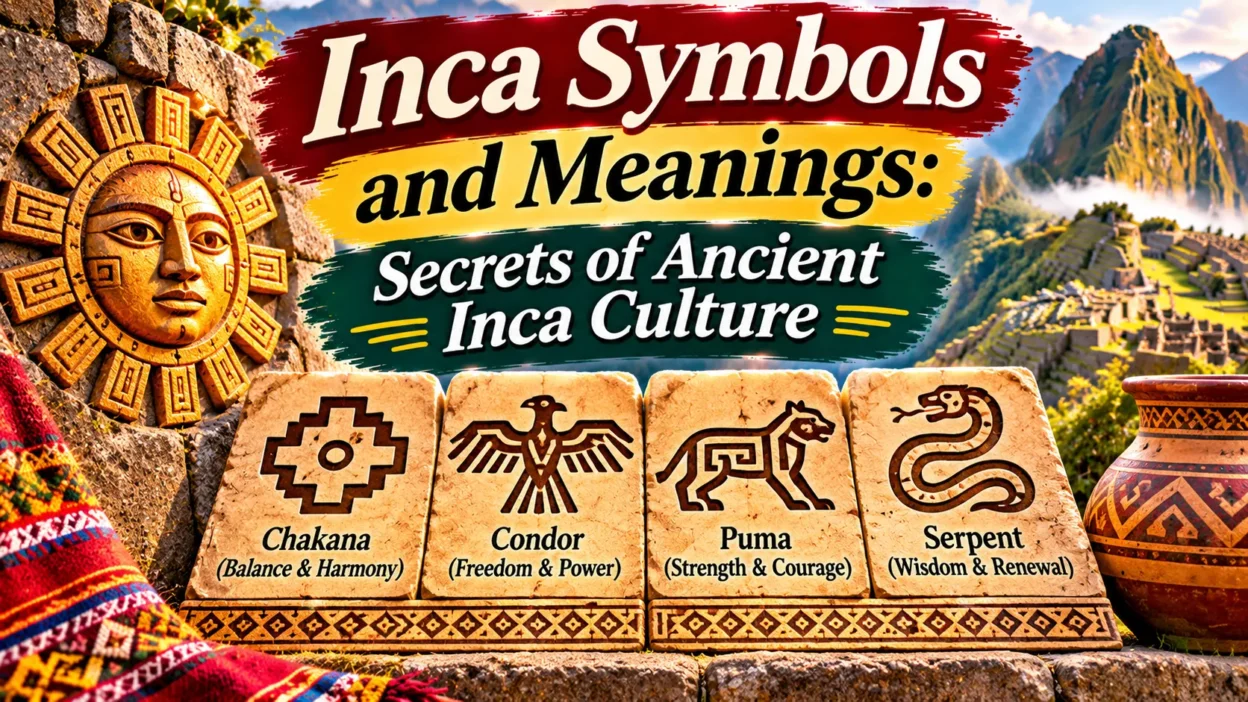
Inca symbols offer a fascinating look into one of the most remarkable civilizations in ancient history. The Inca Empire developed across the Andes of South America, creating an impressive culture built around nature, spirituality, agriculture, astronomy, and community life. Its people used meaningful designs, sacred objects, textiles, architecture, and artistic patterns to express their beliefs and understand the world around them.
From the powerful sun deity Inti to the sacred condor, puma, and serpent, many symbols held important places in Inca traditions. Mountains, rivers, animals, and celestial bodies also carried spiritual significance. These images helped people connect their everyday lives with the natural and supernatural worlds.
Whether you are researching ancient civilizations, exploring indigenous South American culture, looking for meaningful historical symbols, or studying traditional Andean artwork, understanding Inca symbolism reveals how deeply the Inca people valued nature, family, spirituality, and balance.
What Are Inca Symbols? 🏔️
Inca symbols are visual designs, sacred representations, and traditional motifs associated with the Inca civilization. They appeared in textiles, pottery, architecture, ceremonial objects, and other forms of artistic expression.
The Inca Empire, known as Tawantinsuyu, reached its greatest extent during the 15th and early 16th centuries. It covered large parts of modern-day Peru, Ecuador, Bolivia, Chile, Argentina, and Colombia. Its capital, Cusco, served as an important political, religious, and cultural center.
Unlike civilizations that developed extensive alphabetic writing systems, the Inca used several methods to preserve and communicate information. One important example was the quipu, a system of knotted cords that recorded numerical information and possibly other types of records.
Inca visual culture also featured geometric patterns, animal imagery, and representations of natural forces. However, not every design had a single universally accepted meaning. Some interpretations come from historical accounts, archaeological discoveries, and comparisons with wider Andean traditions.
The Three Sacred Animals of Inca Culture 🦅
Three animals hold a particularly important place in interpretations of Inca cosmology: the condor, puma, and serpent. Modern explanations often connect these animals with three different realms of existence.
Although people frequently describe this arrangement as a three-part Inca worldview, the exact symbolism varied across Andean communities and historical periods.
Condor – The Upper World
The Andean condor represents the sky and the upper world in many modern interpretations of Inca symbolism. As a large bird that flies high above the mountains, it provides a natural connection with the heavens.
The upper world is commonly called Hanan Pacha. It connects with celestial forces, spiritual beings, and the world above human life.
Common symbolic associations include:
- The heavens and sky
- Spiritual connection
- Freedom and elevation
- Wisdom and perspective
- Connection with the divine
The condor also holds cultural importance among several Andean communities today.
Puma – The Middle World
The puma represents the earthly world in many interpretations of the three sacred animals. It symbolizes strength, courage, protection, and the natural environment where people live.
This realm is often called Kay Pacha. It refers to the world of human experience, animals, plants, and everyday activities.
The puma’s strength and ability to move through mountainous environments make it a powerful animal in Andean symbolism.
Common associations include:
- Physical strength
- Courage and confidence
- Protection
- Leadership
- Life on Earth
Some popular interpretations connect the city of Cusco’s historic layout with the shape of a puma, although scholars discuss the extent and meaning of this association.
Serpent – The Lower World
The serpent, often represented by a snake, connects with the lower world in many explanations of Inca cosmology. This realm is known as Uku Pacha.
It can represent the underground, ancestral connections, fertility, and the hidden forces of nature.
Serpents also appear in broader Andean traditions, where their symbolism can vary depending on the community and context.
Common associations include:
- The underground world
- Transformation and renewal
- Ancestral connections
- Fertility
- Hidden knowledge
Together, the condor, puma, and serpent provide a popular introduction to the different levels of the Andean spiritual world.
Inti: The Inca Sun Symbol ☀️
Inti was the sun deity and one of the most important gods in the Inca religious system. The sun played a vital role in agriculture, seasonal cycles, and everyday survival, making it a powerful symbol throughout the empire.
Inca rulers, particularly the Sapa Inca, claimed a special relationship with Inti. This connection helped establish the ruler’s religious and political authority.
The sun also received attention through major ceremonies and sacred spaces. One important celebration was Inti Raymi, the Festival of the Sun, which honored the deity and marked an important point in the agricultural calendar.
The sun symbol commonly represents:
- Life and energy
- Agricultural fertility
- Divine power
- Light and warmth
- Leadership and authority
- The changing seasons
Today, Inti remains one of the most recognizable elements associated with ancient Inca religion and Andean heritage.
Mama Quilla: The Inca Moon Symbol 🌙
Mama Quilla was the moon deity in Inca religious traditions. She held an important place in the celestial world and had associations with timekeeping, calendars, and ceremonial life.
The moon’s changing phases helped people observe time and understand natural cycles. Its relationship with the sun also gave it an important place in Inca cosmology.
Historical accounts describe Mama Quilla as a significant divine figure, sometimes associated with the protection of women and marriage.
Traditional associations include:
- The moon and nighttime
- Time and lunar cycles
- Marriage and family
- Women’s protection
- Celestial balance
The sun and moon together represented important parts of the natural and spiritual order.
Pachamama: Mother Earth Symbol 🌎
Pachamama is one of the most important spiritual concepts in Andean traditions. The name combines pacha, which can refer to the world, time, or space, and mama, meaning mother.
People often translate Pachamama as Mother Earth. However, the concept carries a broader meaning than the physical ground. It represents the natural world, fertility, nourishment, and the relationship between people and their environment.
The Inca and other Andean communities recognized the importance of the land because agriculture supported their societies. Offerings and ceremonies expressed gratitude and respect for the natural forces that sustained life.
Pachamama commonly represents:
- Mother Earth
- Fertility and agriculture
- Nature and nourishment
- Gratitude and respect
- Balance between humans and the environment
Pachamama remains an important spiritual figure in several Andean communities today.
Chakana: The Andean Cross Symbol ✨
The Chakana, often called the Andean Cross, is a stepped cross-shaped design associated with Andean visual culture. It appears in archaeological objects, textiles, architecture, and modern representations of indigenous heritage.
Its geometric shape generally features four arms and a central opening or stepped arrangement. Some interpretations connect it with the four cardinal directions, the natural world, and different levels of existence.
Modern explanations frequently associate the Chakana with the relationship between the upper, earthly, and lower worlds. However, scholars continue to discuss its original meanings and historical development.
Common modern interpretations include:
- Balance and harmony
- The four directions
- Connection between different worlds
- Spiritual development
- The relationship between nature and humanity
The Chakana has become a widely recognized symbol of Andean identity and cultural heritage.
Quipu: The Inca Knot Symbol 🧶
The quipu, also spelled khipu, was an important recording system used by the Inca. It consisted of a main cord with several hanging cords containing knots.
Different knot types, positions, and cord arrangements helped communicate numerical information. Researchers have established that quipus played an important role in accounting, taxation, storage records, and administration.
Some scholars also investigate whether certain quipus recorded information beyond numbers, including narratives or other forms of communication. However, researchers have not fully decoded every aspect of the system.
The quipu represents:
- Knowledge and recordkeeping
- Organization and administration
- Mathematical ability
- Communication
- The complexity of Inca society
Unlike decorative symbols, quipus served a practical purpose in managing one of the largest empires in pre-Columbian America.
Inca Symbols for Strength and Power 🐆
Inca culture used animal imagery and sacred representations to communicate strength, authority, and protection. Powerful creatures such as the puma and condor appeared in important artistic and spiritual contexts.
These symbols reflected the close relationship between human society and the natural environment.
| Symbol | Traditional Association |
|---|---|
| Puma | Strength, courage, protection |
| Condor | Spiritual power and the heavens |
| Serpent | Transformation and the lower world |
| Sun | Divine authority and life |
| Mountain | Sacred landscape and stability |
| Stone | Permanence and endurance |
The puma is particularly important in modern explanations of Inca symbolism. Its strength and hunting abilities made it a meaningful representation of power.
Mountains also held spiritual importance because the Andes shaped the environment, economy, and religious life of the empire.
Inca Animal Symbols and Their Meanings 🦙
Animals played important roles in Inca life. Some provided food, clothing, transportation, and materials, while others appeared in religious traditions and artistic designs.
Here are several animals connected with Inca and wider Andean culture.
| Animal | Symbolic or Cultural Association |
|---|---|
| Condor | Sky, spiritual connection |
| Puma | Strength and protection |
| Serpent | Transformation and hidden worlds |
| Llama | Transportation, trade, and Andean life |
| Alpaca | Textiles, warmth, and livelihood |
| Jaguar | Power and associations with wider Andean traditions |
| Frog | Water and fertility in some Andean contexts |
| Eagle | Height, vision, and the natural world |
Llama – Wealth and Daily Life
Llamas were essential to the Inca economy. People used them to carry goods across mountainous routes, while their wool and meat provided important resources.
Their presence in Andean life made them meaningful symbols of transportation, livelihood, and the relationship between people and animals.
Alpaca – Warmth and Textiles
Alpacas provided soft fiber that people used to create clothing and other textiles. Fine fabrics held considerable importance in Inca society, especially in ceremonial and high-status settings.
The alpaca therefore connects with traditional craftsmanship, survival, and Andean identity.
Jaguar – Power and the Natural World
The jaguar held symbolic importance in several pre-Columbian South American cultures. Although it should not be treated as an exclusively Inca symbol, its appearance in broader Andean and neighboring traditions connects it with power and the natural world.
Inca Mountain Symbols and Their Meanings 🏞️
Mountains held extraordinary significance in the Inca world. The Andes provided water, fertile valleys, agricultural land, and natural routes through the empire.
Many mountains also carried sacred importance. People recognized powerful mountain beings known as apus, which they associated with protection, local identity, and the well-being of communities.
The relationship between people and mountains involved offerings, ceremonies, and respect for the natural environment.
Mountain symbolism can represent:
- Strength and stability
- Sacred natural forces
- Protection and guidance
- Connection with ancestors
- Life and agricultural resources
Some mountains continue to hold spiritual significance for Andean communities today.
Inca Symbols for Agriculture and Fertility 🌾
Agriculture supported the Inca Empire and shaped its religious practices, economy, and social organization. The people developed impressive farming systems that helped them grow crops in difficult mountain environments.
Terraces, irrigation channels, and careful land management allowed communities to cultivate different crops across changing elevations.
Because farming depended on seasonal patterns and natural conditions, agricultural symbols often connected with fertility, water, sunlight, and the earth.
| Symbol or Concept | Association |
|---|---|
| Maize | Food, agriculture, and prosperity |
| Potato | Survival and Andean farming |
| Pachamama | Earth and fertility |
| Inti | Sunlight and agricultural growth |
| Water | Irrigation and life |
| Llama | Agricultural transport and resources |
| Mountain | Water sources and sacred landscapes |
Maize held particular importance in Inca ceremonies and food traditions. Chicha, a fermented maize drink, also played a role in social and ceremonial activities.
Inca Geometric Symbols and Patterns 🎨
Inca artisans created detailed geometric patterns for textiles, pottery, stonework, and decorative objects. These designs often featured straight lines, stepped forms, diamonds, squares, and repeated shapes.
Geometric patterns could reflect local traditions, social identity, artistic preferences, and practical design choices. Some also appeared in textiles connected with status and political organization.
Unlike modern symbol dictionaries, archaeological designs do not always have one confirmed meaning. Researchers must consider the object, location, materials, and historical context before interpreting a pattern.
Common geometric designs include:
- Stepped patterns
- Diamond shapes
- Repeated squares
- Zigzag lines
- Checkerboard designs
- Repeating bands
- Symmetrical arrangements
These patterns demonstrate the technical skill and creativity of Inca artisans.
Inca Symbols in Textiles and Clothing 🧵
Textiles held great cultural and economic importance in Inca society. Skilled artisans produced fabrics using cotton and camelid fibers, including wool from llamas and alpacas.
Clothing could communicate social position, regional identity, and political relationships. Certain patterns and colors carried particular significance, especially in garments associated with elite groups.
The Inca government also organized textile production and distribution. Fine fabrics served as valuable gifts and important resources in political and ceremonial relationships.
Textile designs often featured:
- Geometric patterns
- Repeated diamond shapes
- Checkerboard arrangements
- Animal imagery
- Decorative borders
- Colorful woven bands
These designs provide valuable evidence of Inca craftsmanship and social organization.
Inca Symbols and the Four Regions of Tawantinsuyu 🧭
The Inca Empire used the name Tawantinsuyu, commonly understood as the Land of the Four Regions. Its territory consisted of four major administrative regions connected to the capital city of Cusco.
These regions were known as:
| Region | General Direction from Cusco |
|---|---|
| Chinchaysuyu | Northwest |
| Antisuyu | Northeast |
| Collasuyu | Southeast |
| Cuntisuyu | Southwest |
The four-region system helped the empire organize its territory, administration, labor, and resources.
The number four also appears in many modern explanations of Andean symbolism. It can represent directions, organization, and the structure of the imperial world.
However, the four regions were primarily an administrative and territorial system, not simply a decorative symbol.
Inca Symbols Compared With Other Ancient Symbols 🔍
Inca symbols often focus on relationships between humans, nature, animals, and celestial forces. Other ancient civilizations developed their own visual systems based on different religious traditions and historical experiences.
| Civilization | Well-Known Symbol | Common Association |
|---|---|---|
| Inca | Condor | Sky and spiritual connection |
| Inca | Puma | Strength and earthly life |
| Inca | Chakana | Andean geometric symbolism |
| Egyptian | Ankh | Life |
| Greek | Owl of Athena | Wisdom |
| Norse | Mjölnir | Thor’s hammer and protection |
| Chinese | Dragon | Power and good fortune |
| Aztec | Eagle | Warrior identity and sacred imagery |
These comparisons highlight how ancient societies used animals, objects, and geometric designs to express cultural values.
However, symbols from different civilizations should not be treated as interchangeable. Each developed within its own historical and cultural environment.
How to Use Inca Symbols in Modern Designs 🖼️
Inca-inspired designs appear in jewelry, clothing, home decorations, tattoos, artwork, and cultural products. Their geometric patterns and animal imagery attract people who appreciate Andean history and craftsmanship.
If you want to use these designs, understanding their cultural background can help you make a more thoughtful choice.
Here are a few ideas:
- Jewelry: Use historically inspired geometric patterns or animal motifs in pendants and bracelets.
- Home decorations: Incorporate traditional Andean textile patterns into cushions, rugs, or wall art.
- Artwork: Explore representations of the condor, puma, mountains, and sun.
- Clothing: Use geometric motifs inspired by traditional Andean weaving.
- Educational projects: Include historical images and explanations of the quipu, Chakana, and sacred animals.
- Tattoos: Research the design’s origin and meaning before choosing a permanent symbol.
Avoid presenting modern interpretations as proven ancient meanings. When possible, credit the indigenous communities and artists whose traditions inspire your design.
Frequently Asked Questions About Inca Symbols ❓
What are the three main Inca symbols?
The condor, puma, and serpent are three animals commonly associated with interpretations of the Inca worldview. Modern explanations connect them with the upper world, earthly world, and lower world.
What does the Inca sun symbol mean?
The sun connects with Inti, one of the most important deities in Inca religion. It represents light, life, agricultural energy, and divine authority.
What is the Chakana symbol?
The Chakana is a stepped cross-shaped design associated with Andean visual culture. Modern interpretations connect it with balance, directions, and relationships between different levels of existence.
What does the Inca condor symbolize?
The condor commonly represents the sky and spiritual connection. Its ability to fly high above the Andes makes it a powerful image in Andean traditions.
What does the Inca puma symbolize?
The puma represents strength, courage, protection, and earthly life in many interpretations of Inca symbolism.
What does the Inca serpent symbolize?
The serpent often connects with the lower world, transformation, and ancestral relationships in popular explanations of Andean cosmology.
What is Pachamama in Inca culture?
Pachamama is an important Andean spiritual figure commonly described as Mother Earth. She represents the natural world, fertility, nourishment, and the relationship between people and their environment.
What is a quipu in Inca history?
A quipu is a recording system made from knotted cords. The Inca used it to record numerical information and manage administrative activities across their empire.
Did the Inca have a written language?
The Inca did not use an alphabetic writing system like English. They used quipus for recording information, while visual designs, oral traditions, and other communication methods also played important roles.
What does the Inca cross represent?
The Chakana, often called the Andean Cross, is a stepped geometric design. Modern interpretations associate it with balance, directions, and the relationship between different worlds.
Are Inca symbols still used today?
Yes. Andean communities continue to preserve many traditional beliefs, artistic practices, and cultural designs. Inca-inspired imagery also appears in contemporary art, textiles, jewelry, and cultural celebrations.
What is the difference between Inca and Aztec symbols?
Inca and Aztec symbols developed in different regions and cultural traditions. The Inca civilization flourished in the Andes of South America, while the Aztec Empire developed in central Mexico. Their religious beliefs, animals, artistic designs, and historical contexts differed.
Conclusion 🌟
Inca symbols reveal the close relationship between ancient Andean communities and the natural world. The condor, puma, and serpent provide a popular way to understand different realms of existence, while Inti and Mama Quilla represent the importance of the sun and moon in Inca religious traditions.
Other elements, such as Pachamama, the Chakana, and the quipu, demonstrate the importance of nature, geometric design, and communication in the empire. Together, these symbols offer a deeper understanding of Inca beliefs, creativity, and social organization.
Although some interpretations remain debated, the cultural importance of Inca symbolism continues to inspire people around the world. Exploring these designs helps preserve appreciation for the history and living heritage of Andean communities.

Jessica Morgan is a writer and content creator at Blesslume, dedicated to sharing meaningful blessings, heartfelt prayers, inspiring wishes, and uplifting messages. She is passionate about helping people find the right words to celebrate special moments, offer encouragement, and spread kindness. Through thoughtful and inspiring content, Jessica aims to bring hope, positivity, and connection to readers around the world.