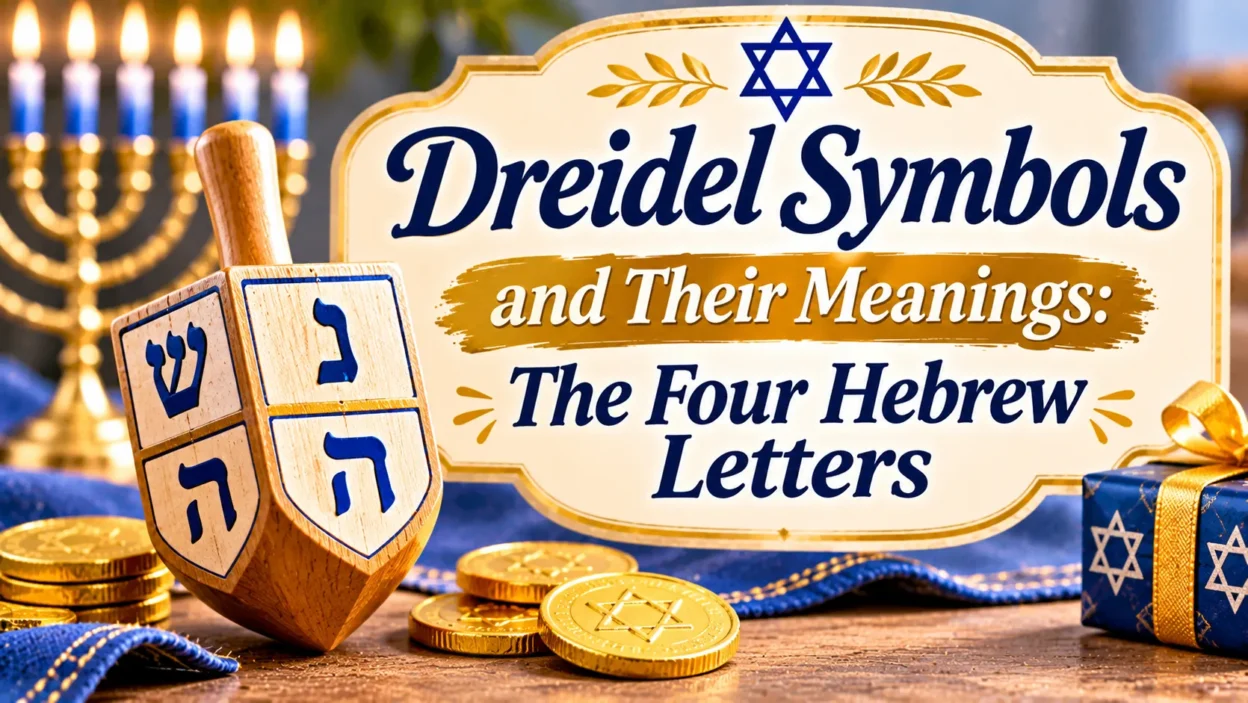
Dreidel symbols are an important part of Hanukkah, the Jewish Festival of Lights. A traditional dreidel is a four-sided spinning top featuring one Hebrew letter on each side: Nun (נ), Gimel (ג), Hey (ה), and Shin (ש). These four letters represent a famous Hebrew phrase connected with the Hanukkah miracle and also determine what happens during the traditional dreidel game.
Each dreidel symbol has a special meaning, making this small spinning toy more than just a holiday game. It represents Jewish history, cultural traditions, family celebrations, and the story of Hanukkah. Whether you are learning about Jewish symbols, researching Hanukkah traditions, or looking for the meanings of the four dreidel letters, this guide explains everything you need to know.
What Are the Four Dreidel Symbols? 🕎
A traditional dreidel contains four Hebrew letters, each printed on one of its four sides. These letters are Nun, Gimel, Hey, and Shin. Together, they form an abbreviation of the Hebrew phrase Nes Gadol Haya Sham, meaning “A great miracle happened there.”
The phrase refers to the miracle associated with Hanukkah and the rededication of the Second Temple in Jerusalem. In Israel, the traditional dreidel uses the letter Peh (פ) instead of Shin (ש), changing the phrase to Nes Gadol Haya Po, meaning “A great miracle happened here.”
Here are the four traditional dreidel symbols:
- Nun (נ): Represents the word Nes, meaning miracle.
- Gimel (ג): Represents Gadol, meaning great.
- Hey (ה): Represents Haya, meaning happened or was.
- Shin (ש): Represents Sham, meaning there.
Together, these Hebrew letters communicate the message of a great miracle that happened in the land of Israel.
Nun (נ): The Symbol of Miracle ✨
Nun is the first letter in the traditional dreidel phrase. It stands for the Hebrew word Nes, which means “miracle.” This letter connects the dreidel with the central theme of Hanukkah: remembering the miracle associated with the holiday.
According to the traditional Hanukkah story, a small amount of consecrated oil that should have lasted only one day continued burning for eight days in the rededicated Temple. This event is remembered through the lighting of the Hanukkah menorah.
In the dreidel game, Nun has a simple meaning. When a player spins the dreidel and it lands on Nun, nothing happens. The player neither wins nor loses any game pieces.
Meaning of Nun:
- Hebrew letter: נ
- Name: Nun
- Word represented: Nes
- English meaning: Miracle
- Dreidel game action: The player does nothing.
Nun reminds players of the miraculous events celebrated during Hanukkah and the importance of faith and hope in Jewish tradition.
Gimel (ג): The Symbol of Greatness 🎉
Gimel is the second letter in the dreidel phrase and represents the Hebrew word Gadol, meaning “great.” It helps complete the expression “A great miracle happened there.”
In the traditional dreidel game, Gimel is the winning symbol. When a player spins the dreidel and it lands on Gimel, that player takes everything from the central pot.
This makes Gimel one of the most exciting letters in the game. It represents good fortune and a major win during the Hanukkah celebration.
Meaning of Gimel:
- Hebrew letter: ג
- Name: Gimel
- Word represented: Gadol
- English meaning: Great
- Dreidel game action: The player takes the entire pot.
Gimel adds excitement to the dreidel game while reminding players of the greatness of the Hanukkah miracle.
Hey (ה): The Symbol of Happening or Being 🌟
Hey is the third letter of the traditional dreidel phrase. It represents the Hebrew word Haya, which means “happened” or “was.”
The letter helps connect the miracle with an actual event in Jewish history and tradition. It is an important part of the phrase that celebrates the miracle of Hanukkah.
In the dreidel game, Hey means that a player receives half of the pieces in the central pot. If the pot contains an odd number of pieces, players generally round up or follow the house rules agreed upon before the game.
Meaning of Hey:
- Hebrew letter: ה
- Name: Hey
- Word represented: Haya
- English meaning: Happened or was
- Dreidel game action: The player takes half of the pot.
Hey represents the historical and spiritual significance of the Hanukkah story.
Shin (ש): The Symbol of There 📍
Shin is the fourth letter on a traditional dreidel used outside Israel. It represents the Hebrew word Sham, meaning “there.”
Together with Nun, Gimel, and Hey, Shin completes the phrase Nes Gadol Haya Sham, meaning “A great miracle happened there.”
In the traditional dreidel game, Shin means that the player must put one game piece into the central pot. This makes it the opposite of Gimel, which allows a player to collect the entire pot.
Meaning of Shin:
- Hebrew letter: ש
- Name: Shin
- Word represented: Sham
- English meaning: There
- Dreidel game action: The player adds one piece to the pot.
Shin connects the Hanukkah miracle with the historical land of Israel and its religious significance.
Peh (פ): The Israeli Dreidel Symbol 🇮🇱
Peh is the letter used on Israeli dreidels instead of Shin. It represents the Hebrew word Po, meaning “here.”
This small difference changes the traditional phrase from Nes Gadol Haya Sham to Nes Gadol Haya Po. The Israeli version means “A great miracle happened here,” referring to the land of Israel.
The four letters on an Israeli dreidel are Nun, Gimel, Hey, and Peh.
Meaning of Peh:
- Hebrew letter: פ
- Name: Peh
- Word represented: Po
- English meaning: Here
- Dreidel game action: The player adds one piece to the pot, just like Shin.
The use of Peh highlights the connection between Hanukkah and the land where the historical events associated with the holiday took place.
What Does Nes Gadol Haya Sham Mean? 🕯️
Nes Gadol Haya Sham is a Hebrew phrase represented by the four letters on a traditional dreidel. Its English translation is “A great miracle happened there.”
Each word corresponds to one Hebrew letter:
| Hebrew letter | Hebrew word | English meaning |
|---|---|---|
| Nun (נ) | Nes | Miracle |
| Gimel (ג) | Gadol | Great |
| Hey (ה) | Haya | Happened or was |
| Shin (ש) | Sham | There |
The phrase refers to the Hanukkah miracle and is one of the most recognizable messages connected with the holiday.
Israeli dreidels replace Shin with Peh, producing Nes Gadol Haya Po, or “A great miracle happened here.”
Difference Between Israeli and Traditional Dreidel Symbols 🌍
The main difference between an Israeli dreidel and a traditional dreidel used outside Israel is the fourth Hebrew letter.
Most dreidels outside Israel display Shin (ש), while Israeli dreidels display Peh (פ). The other three letters remain the same.
| Feature | Traditional dreidel outside Israel | Israeli dreidel |
|---|---|---|
| First letter | Nun (נ) | Nun (נ) |
| Second letter | Gimel (ג) | Gimel (ג) |
| Third letter | Hey (ה) | Hey (ה) |
| Fourth letter | Shin (ש) | Peh (פ) |
| Phrase | Nes Gadol Haya Sham | Nes Gadol Haya Po |
| Translation | A great miracle happened there | A great miracle happened here |
Both versions celebrate Hanukkah and remember the miracle associated with the holiday. The difference reflects the location emphasized in the traditional phrase.
What Do the Dreidel Symbols Mean in the Hanukkah Game? 🎲
The four Hebrew letters also determine the actions players take during the dreidel game. Players usually begin with an equal number of game pieces, such as chocolate coins called gelt, candies, nuts, or tokens.
Everyone contributes one piece to the central pot before the game begins. Players then take turns spinning the dreidel and following the instruction represented by the letter facing upward.
Here is what each letter means during the game:
- Nun (נ): Do nothing. The player keeps their pieces and passes the turn.
- Gimel (ג): Take everything from the central pot.
- Hey (ה): Take half of the central pot.
- Shin (ש): Put one piece into the central pot.
- Peh (פ): Put one piece into the central pot on an Israeli dreidel.
If the central pot becomes empty, players generally contribute another piece according to the agreed game rules. The game continues until players decide to stop or one player collects all the pieces.
Why Are There Hebrew Letters on a Dreidel? 📖
The Hebrew letters on a dreidel connect the game with Jewish language, culture, and the Hanukkah story. Each character represents part of a traditional phrase that celebrates the miracle associated with the holiday.
The dreidel is also connected with Jewish history and the traditions surrounding Hanukkah. A popular traditional explanation links the game with Jewish learning during periods of religious restriction, when people allegedly used spinning tops to disguise their study gatherings. However, historians do not consider every detail of this popular story firmly established.
Today, the dreidel is mainly a joyful Hanukkah activity for families and children. It helps introduce young players to Hebrew letters, holiday traditions, and the meaning of the Hanukkah miracle.
What Does a Dreidel Symbolize in Jewish Culture? ❤️
A dreidel represents more than a spinning top or a children’s game. Its letters connect Jewish families with Hanukkah, cultural identity, religious history, and the celebration of miracles.
The four symbols communicate an important message about remembering the events associated with the holiday. They also make it easier for children to learn Hebrew letters while participating in a traditional family activity.
The dreidel can represent:
- Faith: Remembering the religious meaning of Hanukkah.
- Miracles: Celebrating the miracle associated with the holiday.
- Jewish identity: Connecting generations through cultural traditions.
- Family: Bringing relatives together through a shared game.
- Education: Teaching children Hebrew letters and holiday history.
- Celebration: Enjoying games, food, and Hanukkah activities.
For many families, spinning a dreidel is a simple way to keep holiday traditions alive and create meaningful memories.
Frequently Asked Questions About Dreidel Symbols ❓
What are the four symbols on a dreidel?
The four symbols on a traditional dreidel are Nun (נ), Gimel (ג), Hey (ה), and Shin (ש). They represent the Hebrew phrase Nes Gadol Haya Sham, meaning “A great miracle happened there.”
What does Nun mean on a dreidel?
Nun (נ) represents Nes, the Hebrew word for miracle. In the dreidel game, landing on Nun means the player does nothing.
What does Gimel mean on a dreidel?
Gimel (ג) represents Gadol, meaning great. In the game, a player who lands on Gimel collects everything in the central pot.
What does Hey mean on a dreidel?
Hey (ה) represents Haya, meaning happened or was. In the game, the player takes half of the central pot.
What does Shin mean on a dreidel?
Shin (ש) represents Sham, meaning there. In the game, the player adds one piece to the central pot.
Why does an Israeli dreidel have Peh instead of Shin?
An Israeli dreidel uses Peh (פ), meaning “here,” instead of Shin (ש), meaning “there.” This changes the phrase to Nes Gadol Haya Po, meaning “A great miracle happened here.”
What does Nes Gadol Haya Sham mean?
Nes Gadol Haya Sham is a Hebrew phrase that means “A great miracle happened there.” Its four words are represented by the letters Nun, Gimel, Hey, and Shin.
What is the meaning of a dreidel?
A dreidel is a four-sided spinning top traditionally played during Hanukkah. Its Hebrew letters represent a phrase celebrating the Hanukkah miracle and determine the actions players take during the game.
What is the difference between a dreidel and a menorah?
A dreidel is a spinning top used in a traditional Hanukkah game. A Hanukkah menorah, also called a hanukkiah, is a nine-branched candleholder used to light candles during the eight nights of Hanukkah.
Why do people play dreidel during Hanukkah?
People play dreidel as a traditional Hanukkah activity that brings families and children together. The game also introduces players to Hebrew letters and the holiday’s cultural and religious traditions.
Conclusion
Dreidel symbols carry an important message connected with Hanukkah, Jewish history, and family traditions. The four traditional letters—Nun, Gimel, Hey, and Shin—represent the Hebrew phrase Nes Gadol Haya Sham, meaning “A great miracle happened there.”
Each letter also has a special role in the dreidel game, making the spinning top both an educational activity and a source of holiday entertainment. Whether you are learning the Hebrew alphabet, exploring Jewish traditions, or teaching children how to play, understanding the four dreidel symbols helps you appreciate the meaning behind this beloved Hanukkah tradition.

Jessica Morgan is a writer and content creator at Blesslume, dedicated to sharing meaningful blessings, heartfelt prayers, inspiring wishes, and uplifting messages. She is passionate about helping people find the right words to celebrate special moments, offer encouragement, and spread kindness. Through thoughtful and inspiring content, Jessica aims to bring hope, positivity, and connection to readers around the world.