
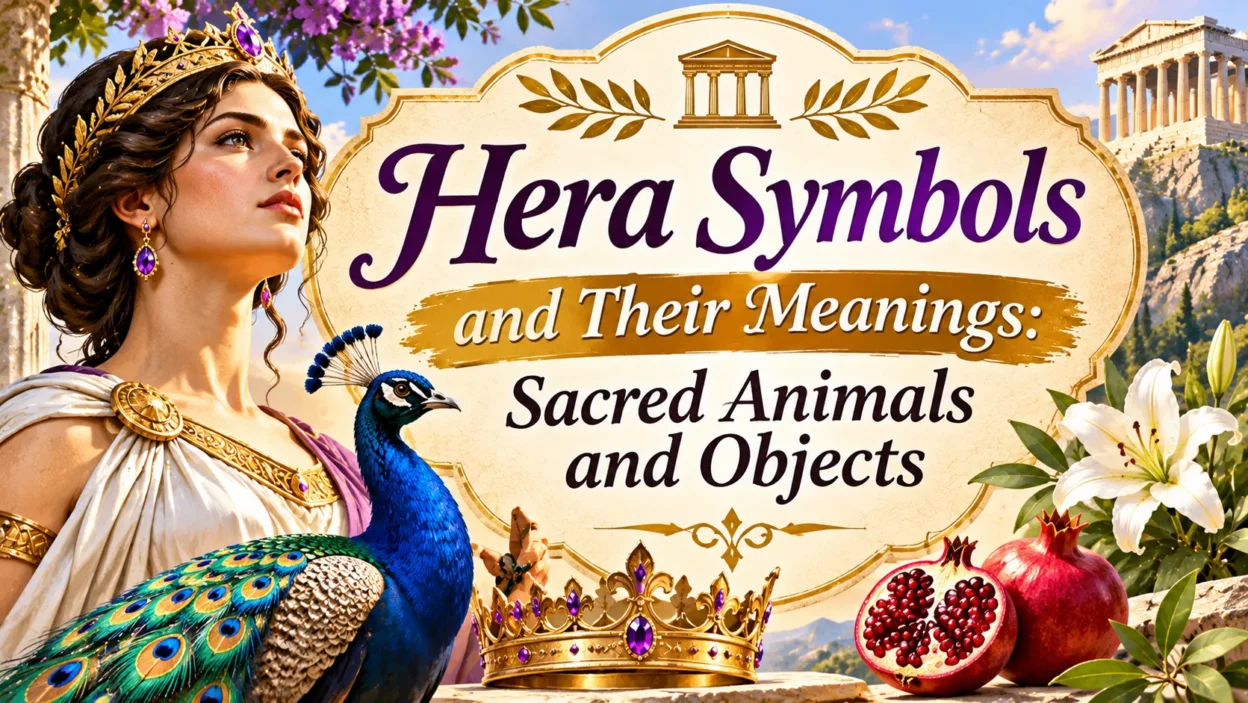
Hera is one of the most important goddesses in Greek mythology, known as the queen of the gods, wife of Zeus, and protector of marriage and married women. Her powerful presence appears throughout ancient Greek stories, sculptures, temples, and artwork. Several animals, plants, and royal objects are associated with her, each representing different aspects of her personality, divine authority, and sacred role.
The Hera symbols include the peacock, cow, cuckoo, pomegranate, crown, and scepter. These symbols represent beauty, loyalty, fertility, marriage, royalty, and divine power. Some have strong connections to ancient myths, while others became associated with Hera through artistic and religious traditions. Understanding their meanings provides a closer look at the goddess and her influence on Greek mythology.
Who Is Hera in Greek Mythology? 🏛️
Hera is the queen of the Olympian gods in ancient Greek mythology. She is the daughter of the Titans Cronus and Rhea and the sister and wife of Zeus. As a powerful Olympian goddess, she holds an important position among the Greek deities and is frequently portrayed as a majestic queen.
Hera is especially associated with marriage, married women, family life, and royal authority. Ancient Greeks worshipped her at important sanctuaries, including the famous Heraion at Argos and the sanctuary at Samos. Her stories also reveal a complex personality involving pride, jealousy, power, and determination.
Although Hera is often remembered for her conflicts with Zeus’s lovers and children, her religious importance goes beyond those myths. She represents the dignity and authority of marriage and the divine status of the queen of the gods.
What Are the Main Symbols of Hera? 👑
Hera’s symbols reflect her position as queen of the gods and her connection with marriage, fertility, and divine authority. Some are animals sacred to her, while others are objects that appear in ancient artwork and mythology.
Here are the most recognizable symbols associated with Hera:
- Peacock: Represents beauty, majesty, pride, and royal splendor.
- Cow: Symbolizes fertility, motherhood, and nurturing qualities.
- Cuckoo: Represents marriage and is connected with the myth of Zeus courting Hera.
- Pomegranate: Associated with fertility, marriage, and abundance.
- Crown or Diadem: Represents Hera’s position as queen of the gods.
- Scepter: Symbolizes divine authority and leadership.
- Throne: Represents her royal status and power among the Olympian gods.
- Veil: Represents marriage, dignity, and the traditional image of a married queen.
- Lion: Appears in some artistic and mythological associations with divine power.
- Lotus: Sometimes appears in broader discussions of ancient goddess imagery, although it is not among Hera’s most securely established personal symbols.
The peacock, cow, cuckoo, pomegranate, crown, and scepter are particularly useful symbols to recognize when studying Hera in Greek mythology.
Peacock: Hera’s Most Famous Symbol 🦚
The peacock is perhaps the most recognizable animal associated with Hera. Its colorful feathers, elegant appearance, and impressive display make it a fitting representation of the goddess’s beauty and royal status.
In Greek mythology, the peacock is connected with the story of Argus Panoptes, a giant famous for having many eyes. Hera assigned Argus to watch Io, a woman whom Zeus had transformed into a cow. After Argus died, Hera honored him by placing his eyes on the feathers of the peacock.
This myth explains the traditional association between the peacock’s eye-like feather patterns and Hera. The bird became a symbol of her majesty, pride, watchfulness, and divine power.
What the peacock represents:
- Beauty and elegance
- Royal dignity and authority
- Pride and majesty
- Watchfulness and protection
- Divine power and splendor
The peacock frequently appears in paintings, sculptures, and modern representations of Hera. It is an excellent choice for anyone researching Hera’s sacred animals or Greek goddess symbolism.
Cow: A Symbol of Fertility and Motherhood 🐄
The cow is another important animal associated with Hera. In ancient Greek literature, she is sometimes described using the epithet Boopis, commonly translated as “ox-eyed” or “cow-eyed.” The expression highlights her large, beautiful eyes and reflects the importance of cattle in ancient Greek culture.
Cattle were valuable animals in the ancient world because they represented wealth, agricultural prosperity, nourishment, and fertility. Their association with Hera also connects with her role as a goddess linked to marriage and women’s lives.
The cow appears in the myth of Io, whom Zeus transformed into a heifer. Hera requested the animal and placed it under the watch of Argus. This story further strengthened the connection between Hera and cattle.
What the cow symbolizes:
- Fertility and abundance
- Motherhood and nurturing
- Prosperity and wealth
- Strength and dignity
- Protection and feminine power
The cow is especially meaningful when exploring Hera’s maternal and fertility-related symbolism.
Cuckoo: A Symbol of Love and Marriage 🐦
The cuckoo is closely connected with one of the best-known stories about Hera and Zeus. According to mythology, Zeus approached Hera in the form of a cuckoo during a storm. Hera took pity on the cold, wet bird and sheltered it.
Zeus then revealed his true identity and pursued a relationship with her. Their eventual marriage established Hera as the queen of the gods.
The cuckoo therefore became associated with their courtship and marriage. Its presence in Hera’s symbolism reflects the complicated relationship between the two Olympian rulers.
What the cuckoo represents:
- Courtship and romantic pursuit
- Marriage and union
- Love and attraction
- New beginnings in relationships
- The connection between Hera and Zeus
The cuckoo is not as visually famous as the peacock, but its mythological story gives it a meaningful place among Hera’s symbols.
Pomegranate: A Symbol of Fertility and Abundance 🍎
The pomegranate is an ancient symbol associated with fertility, prosperity, abundance, and marriage. It appears in the religious and artistic traditions of several ancient Mediterranean cultures.
In representations of Hera, the pomegranate can reflect her association with married women, fertility, and family life. Its many seeds make it a natural symbol of abundance and the potential for new life.
The pomegranate also appears in other Greek mythological stories, particularly the myth of Persephone. However, its association with Hera should be understood within the broader symbolism of fertility and marriage rather than as an object belonging exclusively to her.
What the pomegranate symbolizes:
- Fertility and new life
- Marriage and commitment
- Abundance and prosperity
- Family and motherhood
- Growth and renewal
The pomegranate is a meaningful symbol for exploring Hera’s connection with family, relationships, and feminine power.
Crown and Diadem: Symbols of Royal Power 👑
Hera is the queen of the gods, so royal objects are important parts of her traditional imagery. Artists often portray her wearing a crown or diadem to communicate her position and authority.
A diadem is a decorative headband associated with royalty. In ancient Greek artwork, Hera’s regal appearance distinguishes her from many other goddesses and emphasizes her position beside Zeus.
The crown is more than a decorative object. It communicates her leadership, dignity, and status as one of the most powerful figures on Mount Olympus.
What the crown symbolizes:
- Royal authority
- Divine leadership
- Dignity and respect
- Power and prestige
- Queenly status
When identifying Hera in classical paintings or sculptures, look for a mature goddess wearing a crown or elaborate headpiece.
Scepter: A Symbol of Divine Authority 🪄
The scepter is a traditional symbol of kingship and authority in ancient Greek art. Because Hera holds the position of queen of the gods, artists sometimes portray her carrying one.
A scepter communicates her power to command, govern, and influence the divine world. It also emphasizes her connection with Zeus and her important place within the Olympian hierarchy.
In ancient representations, the scepter helps distinguish Hera as a ruler rather than simply a goddess associated with marriage.
What the scepter represents:
- Divine authority
- Leadership and command
- Royal power
- Status among the Olympian gods
- Respect and influence
The scepter is particularly important when studying Hera’s royal identity and her portrayal in ancient sculpture.
Throne: A Symbol of Hera’s Queenship 🪑
The throne represents Hera’s position as queen of Olympus. Ancient Greek gods and goddesses were often depicted seated on elaborate thrones to communicate their authority and importance.
Hera’s throne symbolizes her status as a divine ruler and her place beside Zeus. It also represents stability, dignity, and the power associated with her position.
In artwork, a seated Hera may appear with a crown, veil, or scepter. These details help viewers recognize her royal identity.
What the throne symbolizes:
- Queenship and divine status
- Leadership and authority
- Stability and dignity
- Royal influence
- Power within the Olympian family
The throne is a useful visual symbol for understanding how ancient artists represented Hera’s position among the gods.
Veil: A Symbol of Marriage and Dignity 👰
Hera’s connection with marriage makes the veil an important element in discussions of her traditional imagery. As the goddess associated with married women and marital union, she is sometimes portrayed with clothing and accessories that communicate dignity and royal femininity.
The veil can represent the social and religious importance of marriage in ancient Greek society. It also reflects Hera’s identity as Zeus’s wife and queen of Olympus.
Although the veil is not as distinctive as the peacock or scepter, it helps communicate her role as a goddess of marriage.
What the veil symbolizes:
- Marriage and commitment
- Feminine dignity
- Royal elegance
- Partnership and union
- Traditional marital identity
The veil is especially relevant when exploring Hera’s role in ancient Greek wedding traditions and artistic representations.
Lion: A Symbol of Strength and Divine Power 🦁
The lion is associated with strength, courage, authority, and royal power throughout ancient mythology and art. Although it is not as firmly established as Hera’s primary sacred animals, lion imagery can appear in broader discussions of powerful goddesses and ancient divine symbolism.
In Greek art, lions frequently represent strength and protection. Their powerful appearance makes them suitable companions or decorative elements in images of divine authority.
When connected with Hera, lion imagery can be interpreted as reflecting her strength and position as queen of the gods. However, it is important not to treat the lion as one of her universally recognized primary symbols.
What the lion represents:
- Strength and courage
- Royal authority
- Protection and guardianship
- Power and dominance
- Divine dignity
The lion offers a useful symbolic comparison when studying the broader visual language of ancient Greek goddesses.
Lotus: A Symbol Sometimes Discussed in Goddess Imagery 🌸
The lotus is associated with beauty, renewal, and spiritual significance in several ancient cultures. However, it is not one of the most securely established symbols specifically connected with Hera in Greek mythology.
Some modern symbolic lists include lotus imagery when discussing ancient goddesses because flowers can communicate femininity, fertility, and renewal. Nevertheless, the lotus should not be presented as a major sacred flower of Hera without a specific historical source.
For a more accurate representation of Hera, the peacock, cow, cuckoo, and pomegranate are stronger choices.
What the lotus can represent in broader symbolism:
- Beauty and purity
- Renewal and growth
- Spiritual significance
- Femininity
- Transformation
It is useful to distinguish broader goddess symbolism from the specific attributes traditionally associated with Hera.
Hera’s Sacred Animals and Their Meanings 🦚
Animals are an important part of Greek mythology because they help identify gods and communicate their characteristics. Hera’s most recognizable animal associations are the peacock, cow, and cuckoo.
| Animal | Symbolic meaning |
|---|---|
| Peacock | Beauty, majesty, and royal pride |
| Cow | Fertility, motherhood, and abundance |
| Cuckoo | Courtship, marriage, and love |
| Lion | Strength, authority, and protection in broader imagery |
The peacock is the strongest visual identifier of Hera, especially in paintings and modern illustrations. The cow connects her with fertility and ancient Greek descriptions of her appearance, while the cuckoo recalls the myth of Zeus’s courtship.
These animal symbols provide a deeper understanding of Hera’s personality and her place in Greek religious traditions.
Hera’s Symbols in Ancient Greek Art and Sculptures 🏺
Artists in ancient Greece used recognizable objects, clothing, and animals to represent the gods. Hera’s appearance often communicates her royal position, maturity, and divine dignity.
She is commonly depicted as a majestic woman wearing a crown or diadem. Some representations show her holding a scepter, while others portray her seated on a throne. The peacock became an especially recognizable companion in later artistic traditions.
Her appearance differs from that of other Greek goddesses. Athena is commonly identified through her helmet and shield, while Aphrodite is associated with beauty and love. Hera’s royal clothing and regal posture emphasize her identity as queen of the gods.
When studying ancient artwork, consider the complete image rather than relying on one object alone. A crown, scepter, and peacock together provide stronger clues that a figure represents Hera.
What Is Hera the Goddess Of? 💍
Hera is primarily known as the Greek goddess of marriage, married women, and queenship. Her influence also extends to women’s lives, family relationships, and aspects of fertility and childbirth in ancient religious traditions.
Her divine responsibilities reflect the importance of marriage and family structures in ancient Greek society. People worshipped her through temples, sacrifices, festivals, and local religious ceremonies.
Hera is also the protector of legitimate marriage in many interpretations of her mythology. Her stories frequently explore loyalty, marital conflict, jealousy, and the responsibilities connected with divine relationships.
Although popular stories often focus on her anger toward Zeus’s lovers, her religious identity is much broader. She was a respected goddess with major sanctuaries and an important position in Greek worship.
What Is the Roman Name for Hera? 🏛️
Hera’s Roman equivalent is Juno, one of the most important goddesses in ancient Roman religion. Like Hera, Juno was associated with marriage, women, and royal authority.
Juno also held an important place in Roman state religion and was worshipped as a protector of the Roman community. Her identity developed within Roman traditions, so her stories and responsibilities were not always identical to Hera’s Greek mythology.
The similarities between the two goddesses help explain why their names and symbols are sometimes discussed together.
| Greek mythology | Roman mythology |
|---|---|
| Hera | Juno |
| Wife of Zeus | Wife of Jupiter |
| Queen of the Olympian gods | Queen of the Roman gods |
| Goddess associated with marriage | Goddess associated with marriage and women |
| Associated with the peacock and cow | Also connected with the peacock and royal imagery |
Frequently Asked Questions About Hera Symbols ❓
What is Hera’s main symbol?
The peacock is one of Hera’s most recognizable symbols. It represents beauty, majesty, pride, and royal authority. The cow, cuckoo, pomegranate, crown, and scepter are also associated with her.
What animal represents Hera?
The peacock is the animal most commonly associated with Hera. The cow and cuckoo are also important animals in her mythology and traditional symbolism.
Why is the peacock sacred to Hera?
According to Greek mythology, Hera connected the eyes of Argus Panoptes with the peacock’s feathers after his death. This story explains the bird’s association with her and its eye-like feather patterns.
What flower represents Hera?
The pomegranate is a better-established plant-related symbol associated with Hera because of its connections with fertility and abundance. The lotus is sometimes included in broader modern goddess symbolism, but it is not one of Hera’s primary traditional symbols.
What does Hera’s crown symbolize?
Hera’s crown or diadem represents her position as queen of the gods. It communicates divine authority, dignity, leadership, and royal status.
What does Hera’s scepter represent?
The scepter represents divine authority, leadership, and power. It emphasizes Hera’s position as one of the principal rulers of Mount Olympus.
Is the cow a symbol of Hera?
Yes. The cow is associated with Hera through ancient descriptions of her appearance and the myth of Io. It can symbolize fertility, abundance, motherhood, and nurturing qualities.
What is Hera’s sacred bird?
The peacock is Hera’s most famous sacred bird. The cuckoo is also associated with her through the myth of Zeus approaching her in the form of a bird.
What is Hera’s Roman equivalent?
Hera’s Roman equivalent is Juno. Both goddesses are associated with marriage, women, and royal authority, although their roles developed within different religious traditions.
What do Hera’s symbols mean together?
Together, Hera’s symbols communicate royal authority, beauty, marriage, fertility, dignity, and divine power. The peacock highlights her majesty, the cow represents fertility, and the crown and scepter emphasize her queenship.
Conclusion
Hera’s symbols offer a fascinating look into her identity as the queen of the Greek gods and goddess associated with marriage. The peacock, cow, cuckoo, pomegranate, crown, scepter, and throne each communicate a different part of her divine character.
Among these symbols, the peacock remains her most recognizable animal companion, while the crown and scepter emphasize her royal authority. Whether you are exploring Greek mythology, researching goddess symbolism, or looking for inspiration for artwork and tattoos, understanding these symbols makes Hera’s stories and cultural importance easier to appreciate.

Jessica Morgan is a writer and content creator at Blesslume, dedicated to sharing meaningful blessings, heartfelt prayers, inspiring wishes, and uplifting messages. She is passionate about helping people find the right words to celebrate special moments, offer encouragement, and spread kindness. Through thoughtful and inspiring content, Jessica aims to bring hope, positivity, and connection to readers around the world.