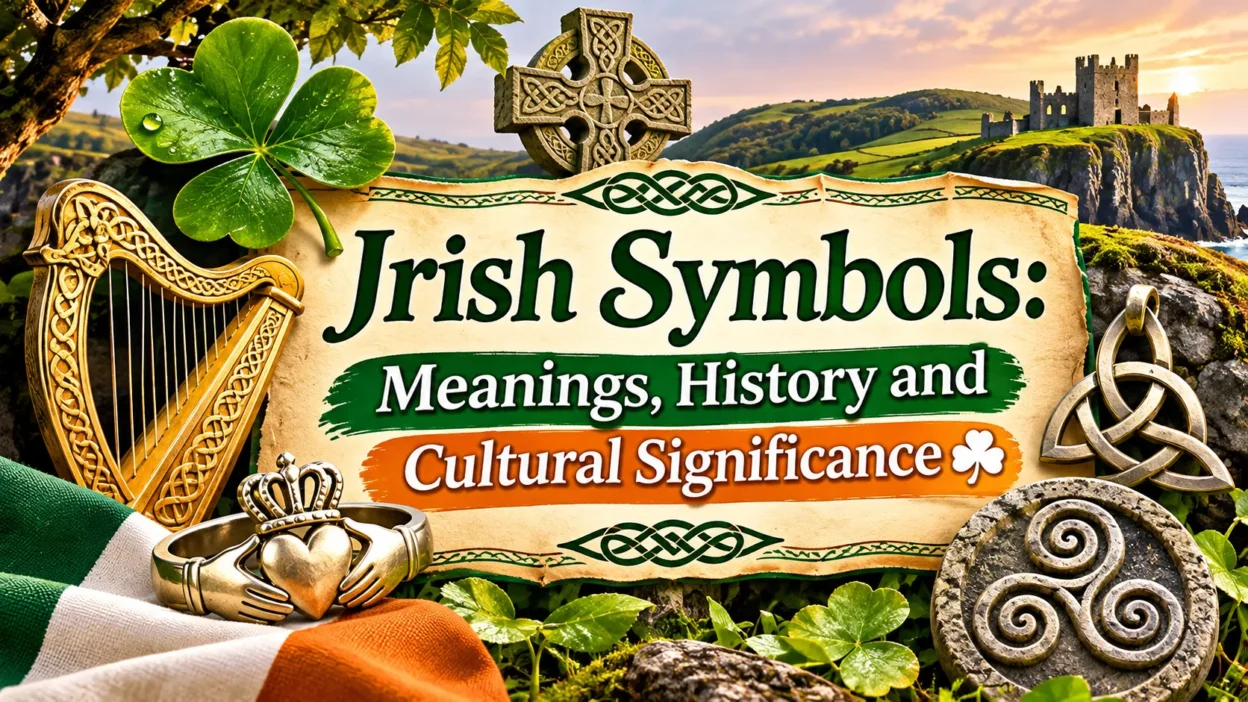
Irish symbols tell fascinating stories about Ireland’s history, culture, spirituality, and traditions. From the famous shamrock and Celtic knots to the Claddagh ring and Irish harp, these symbols represent ideas such as love, loyalty, friendship, faith, protection, and national identity. Some have roots in ancient Celtic art, while others became important through Irish Christian traditions, folklore, and later cultural movements.
Whether you are researching Irish symbols and their meanings, looking for traditional Irish designs, exploring Celtic symbolism, or choosing an Irish symbol for jewelry, a tattoo, or artwork, understanding their backgrounds can help you appreciate what they represent. Not every symbol has one universally accepted meaning. Interpretations can vary across historical periods, regions, and modern traditions, so it helps to distinguish documented history from popular symbolism.
The Shamrock: A Symbol of Ireland and Good Fortune ☘️
The shamrock is one of the most recognizable Irish symbols. This small, three-leaf plant has a strong connection to Irish identity, St. Patrick’s Day, and traditional Irish culture. People often associate it with good luck, faith, and the arrival of spring.
According to Christian tradition, St. Patrick used the shamrock’s three leaves to explain the Holy Trinity: the Father, the Son, and the Holy Spirit. Historians cannot confirm every detail of this popular story, but the association has remained an important part of Irish tradition.
Today, people wear shamrock badges, display shamrock decorations, and use the three-leaf design in clothing, jewelry, and artwork. The shamrock also represents Irish heritage for people living outside Ireland.
The Celtic Knot: Eternal Love and Connection ♾️
Celtic knots feature interwoven lines that create continuous patterns without obvious beginnings or endings. These designs appear in Irish manuscripts, stone carvings, metalwork, and religious artwork. Their intricate shapes make them some of the most recognizable designs associated with Celtic art.
Modern interpretations often connect Celtic knots with eternity, everlasting love, unity, loyalty, and the interconnectedness of life. The continuous lines make these meanings easy to understand, although specific meanings were not consistently assigned to every historical knot pattern.
Different knot designs create different visual effects. Some form triangular patterns, while others create square, circular, or woven shapes. Today, Celtic knots appear in wedding rings, necklaces, tattoos, wedding decorations, and family keepsakes.
The Claddagh Ring: Love, Loyalty, and Friendship 💍
The Claddagh ring is a traditional Irish ring design featuring two hands holding a heart topped with a crown. Each element represents a different quality:
- Heart: Love and affection.
- Hands: Friendship and trust.
- Crown: Loyalty and commitment.
The design takes its name from Claddagh, a historic fishing village near Galway, Ireland. The ring became especially popular as a meaningful gift between romantic partners, friends, and family members.
People also use different ways of wearing the ring to communicate relationship status. Customs vary, but a common tradition places the ring on the right hand with the heart facing outward when someone is single and inward when someone is in a relationship. On the left hand, the inward-facing heart commonly represents marriage or a committed partnership.
The Claddagh ring remains one of the most meaningful Irish gifts because it combines three powerful values in one design.
The Irish Harp: A Symbol of National Identity 🎵
The Irish harp is one of Ireland’s oldest and most important national symbols. It represents Irish music, heritage, artistic expression, and national identity. Its distinctive shape appears on Irish coins, official documents, government emblems, and the country’s coat of arms.
The harp has a long history in Ireland, where professional harpists traditionally performed at royal courts and important gatherings. Irish harp music became closely connected with storytelling, poetry, and cultural traditions.
The instrument also appears on the Guinness logo, although the company’s harp design faces in the opposite direction from the official Irish state harp. This recognizable instrument continues to represent Ireland around the world.
The Celtic Cross: Faith and Heritage ✝️
The Celtic cross combines a traditional Christian cross with a circular ring around the intersection of its arms. It is strongly associated with Ireland’s early Christian heritage and medieval stone-carving traditions.
Many historic examples stand in churchyards, monasteries, and religious sites throughout Ireland. These crosses often feature detailed carvings, including biblical scenes, geometric patterns, and interlaced designs.
People commonly connect the Celtic cross with Christianity, faith, spiritual strength, and Irish heritage. The circle is sometimes interpreted as a symbol of eternity or divine love, although interpretations differ and should not be treated as a single proven historical explanation.
Today, the Celtic cross appears in religious artwork, memorials, jewelry, and decorative designs.
The Triquetra: The Three-Cornered Celtic Knot 🔺
The Triquetra is a three-pointed knot formed by three connected loops. Its name comes from Latin and refers to a three-cornered shape. The design appears in historical European art and later became strongly associated with Celtic-inspired decoration.
Modern interpretations often connect the Triquetra with three-part relationships, such as mind, body, and spirit; past, present, and future; or life, death, and rebirth. In some Christian contexts, people use it to represent the Holy Trinity.
The symbol also became popular through modern Celtic jewelry, tattoos, and spiritual artwork. Although people frequently call it an ancient Irish symbol, its historical use extends beyond Ireland, and its exact original meaning remains uncertain.
The Triskelion: Movement and Threefold Balance 🌀
The Triskelion, also called the triskele, features three connected spirals or curved arms extending from a central point. It is an ancient symbol found in several European cultures, including prehistoric sites in Ireland.
One of the best-known Irish examples appears at Newgrange, a prehistoric passage tomb in County Meath. The carved triple spiral is part of the monument’s remarkable ancient artwork.
Modern interpretations associate the Triskelion with movement, progress, cycles, transformation, and the relationship between three connected forces. Some people also connect it with the cycles of life and nature.
Because the design appears in different cultures and periods, its original meaning is not completely established. Nevertheless, it remains a popular choice for people interested in Irish and broader Celtic heritage.
The Tree of Life: Family, Growth, and Connection 🌳
The Tree of Life is a widespread symbolic design featuring a tree with branches reaching upward and roots spreading downward. It represents the connection between the natural world, family history, growth, and the cycles of life.
In modern Celtic-inspired artwork, people often use the Tree of Life to express the relationship between heaven and earth, the importance of family roots, and the balance between different parts of existence.
The design also makes a meaningful gift for parents, grandparents, and family members. Tree of Life pendants, wall decorations, and tattoos often represent strength, stability, personal growth, and lasting family connections.
Although the Tree of Life appears in many cultures and religious traditions, its Celtic-inspired version has become especially popular in Irish-themed jewelry and decorative art.
The Celtic Shield Knot: Protection and Strength 🛡️
The Celtic Shield Knot is a geometric interlaced design that people commonly associate with protection, courage, and strength. Its repeated lines form a compact pattern that resembles a shield or protective structure.
Modern interpretations connect the design with safety, resilience, and the protection of loved ones. This makes it a popular choice for pendants, tattoos, decorative carvings, and personal keepsakes.
Historical interlaced patterns appear throughout Celtic and early medieval artwork. However, the specific protective meaning often assigned to the modern Celtic Shield Knot should be understood as a contemporary interpretation rather than a universally documented ancient belief.
The Awen Symbol: Inspiration and Creativity ✨
The Awen symbol consists of three rays extending upward from three points or circles. It is associated with inspiration, creativity, and poetic expression.
Awen comes from Welsh tradition rather than being an exclusively Irish symbol. The word is commonly translated as inspiration or poetic inspiration, and it has a connection with Welsh literary and spiritual traditions.
Some modern Celtic-inspired designs include Awen because of its visual connection to creativity and artistic energy. Writers, musicians, poets, and artists may choose it to represent imagination and inspiration.
Although it sometimes appears in collections of Celtic symbols, identifying it accurately as Welsh helps preserve its cultural background.
St. Brigid’s Cross: Protection and Blessings 🕊️
St. Brigid’s Cross is a traditional Irish cross made by weaving rushes or straw into a distinctive four-armed shape. It is associated with St. Brigid of Kildare and the Irish celebration of Imbolc, which takes place at the beginning of February.
Irish families traditionally made these crosses and placed them above doorways or inside homes. Many people believed they brought protection and blessings to the household.
The cross remains connected with Irish folk traditions, St. Brigid’s Day, and the arrival of spring. Schools, community groups, and families still make St. Brigid’s Crosses as part of cultural celebrations.
Its simple woven construction makes it different from the stone Celtic crosses found at historic religious sites.
The Irish Tricolour: Peace and National Unity 🇮🇪
The Irish national flag features three vertical stripes: green, white, and orange. Each color carries an important meaning in the flag’s traditional interpretation.
- Green: Represents the Irish nationalist and Gaelic tradition.
- Orange: Represents the Protestant tradition associated historically with William of Orange.
- White: Represents peace and the hope for lasting unity between the two traditions.
The flag first appeared in the nineteenth century and later became an important symbol of Irish independence and national identity.
Today, the Irish tricolour represents the Republic of Ireland at international events, sporting competitions, cultural celebrations, and official ceremonies. It is one of the most recognizable symbols of modern Ireland.
The Celtic Spiral: Growth and the Cycles of Life 🌀
Celtic spiral designs appear in ancient Irish stone carvings and prehistoric monuments. They include single spirals, double spirals, and triple spirals, often arranged in elaborate patterns.
People today interpret these designs as symbols of growth, energy, movement, transformation, and the cycles of nature. Their flowing shapes can suggest the passage of time and the connection between different stages of life.
Spirals at ancient Irish monuments demonstrate that these designs held artistic or cultural importance thousands of years ago. However, researchers cannot always determine exactly what the people who carved them intended to communicate.
Celtic spirals remain popular in jewelry, tattoos, artwork, and home decorations because of their simple yet meaningful appearance.
The Four-Leaf Clover: Luck and Good Fortune 🍀
The four-leaf clover is a rare variation of the common three-leaf clover. Its unusual appearance has made it a popular symbol of luck and good fortune.
A familiar modern tradition assigns a different meaning to each leaf:
- First leaf: Hope.
- Second leaf: Faith.
- Third leaf: Love.
- Fourth leaf: Luck.
These meanings come from popular folklore rather than a single established historical Irish tradition.
People often connect the four-leaf clover with Ireland because of the country’s association with shamrocks and St. Patrick’s Day. However, the four-leaf clover and the three-leaf shamrock are different things.
The four-leaf clover is popular on greeting cards, lucky charms, clothing, jewelry, and decorative items.
The Celtic Serpent: Renewal and Transformation 🐍
Serpent imagery appears in several ancient European cultures and later became part of different artistic and symbolic traditions. Modern Celtic-inspired artwork sometimes uses intertwined snakes or serpent-like creatures to represent renewal, transformation, protection, and the cycle of life.
Ireland also has a famous legend about St. Patrick driving snakes out of the country. However, historians generally explain that Ireland’s lack of native snakes is related to its geographical and environmental history rather than a literal event involving the saint.
Serpent designs can appear in Celtic-style metalwork, illustrations, and contemporary tattoos. Their meaning depends on the particular artwork and cultural context.
The Irish Stag: Strength and the Natural World 🦌
The stag is a powerful animal in Irish folklore and broader Celtic-inspired storytelling. Its impressive antlers and presence in woodland landscapes make it a natural symbol of strength, dignity, and the natural world.
In modern interpretations, people associate the stag with leadership, independence, resilience, and connection with nature. Its antlers can also represent growth and renewal because they shed and regrow over time.
Stags appear in Irish-inspired artwork, traditional storytelling, decorative carvings, and contemporary tattoo designs. Their meaning can vary depending on the story or artistic tradition.
The Raven: Mystery and Wisdom 🐦⬛
Ravens appear in Irish mythology and folklore, where they can be connected with battle, prophecy, transformation, and supernatural events.
One important figure associated with raven imagery is the Morrígan, a powerful figure in Irish mythology linked with war, fate, sovereignty, and prophecy. She is sometimes depicted or associated with a crow or raven.
In modern symbolic interpretations, ravens may represent intelligence, mystery, change, and spiritual awareness. Their dark appearance and remarkable intelligence have also made them popular in literature and artwork.
It is worth remembering that raven symbolism differs across cultures, so not every modern meaning comes directly from ancient Irish tradition.
The Salmon of Knowledge: Wisdom and Learning 🐟
The Salmon of Knowledge comes from the Irish legend of Fionn mac Cumhaill. According to the story, a special salmon gained all the world’s knowledge after eating magical hazelnuts that fell into a sacred well.
The poet Finegas spent years trying to catch the salmon. When he finally succeeded, Fionn accidentally tasted its cooking juices and received the salmon’s knowledge.
The story connects the salmon with wisdom, learning, insight, and the search for understanding. It remains an important part of Irish mythological storytelling.
Modern artwork sometimes uses the Salmon of Knowledge to represent education, intelligence, and the pursuit of truth.
The Green Man: Nature and Rebirth 🌿
The Green Man is a face surrounded by or formed from leaves, vines, and other plant growth. Similar images appear in medieval European architecture, including churches and decorative stonework.
Modern interpretations often connect the Green Man with nature, seasonal renewal, fertility, and the relationship between humans and the natural environment.
Although people sometimes include the Green Man in Celtic symbol collections, it is not exclusively Irish. Its appearance across European buildings and artwork makes it a broader historical motif.
Today, the Green Man appears in garden decorations, nature-inspired artwork, festivals, and contemporary spiritual designs.
The Celtic Love Knot: Everlasting Affection ❤️
The Celtic Love Knot is a modern name commonly used for interlaced knot designs that people associate with romance and lasting relationships. Its continuous lines make it a popular representation of love without an obvious beginning or end.
Couples often choose Celtic-inspired love knot jewelry for anniversaries, engagements, weddings, and meaningful gifts. The design can also represent friendship, family bonds, and commitment.
There is no single ancient knot pattern with a universally established meaning of everlasting romantic love. The modern interpretation comes largely from the way the continuous design suggests an unbroken connection.
The Celtic Motherhood Knot: Family and Maternal Love 🤱
The Celtic Motherhood Knot is a modern design inspired by interlaced Celtic patterns. It commonly features one or more heart-like shapes woven into a continuous knot.
People use it to represent the bond between a mother and child, unconditional love, family unity, and the lasting connection between generations.
Some versions include additional shapes to represent multiple children or family members. These designs are popular in necklaces, bracelets, tattoos, and personalized gifts.
The motherhood knot is best understood as a contemporary symbolic design rather than a specific ancient Irish emblem with a documented historical meaning.
The Irish Wolfhound: Loyalty and Companionship 🐕
The Irish Wolfhound is one of Ireland’s best-known dog breeds. Historically, these large dogs were used for hunting and guarding, and they became associated with Irish nobility and tradition.
Today, the breed often symbolizes loyalty, courage, companionship, and strength. Its calm appearance and impressive size make it a recognizable part of Irish cultural imagery.
Irish Wolfhounds appear in modern artwork, family crests, decorative pieces, and Irish-themed gifts. Although the dog is not an ancient symbolic emblem in the same way as the harp or shamrock, it remains an important part of Ireland’s cultural heritage.
The Ogham Alphabet: Ancient Irish Writing ᚛ᚑᚌᚐᚋ᚜
Ogham is an early medieval writing system associated primarily with Ireland and parts of western Britain. It uses groups of strokes arranged along a central line or edge to represent letters.
Many surviving Ogham inscriptions appear on standing stones, especially in Ireland. These inscriptions often record personal names or family connections.
Modern audiences sometimes associate Ogham with nature, ancestry, and ancient Celtic spirituality. However, the historical evidence shows that it functioned primarily as a writing system.
Ogham characters are popular in contemporary jewelry and tattoos, especially among people who want to represent a name, family connection, or Irish heritage. Anyone choosing an Ogham inscription should check the spelling and direction carefully because the writing system differs from the modern English alphabet.
The Irish Wolf and Hound Imagery: Courage and Guardianship 🐺
Wolves and hounds appear in Irish mythology, folklore, and traditional storytelling. Dogs could represent protection, loyalty, hunting ability, and companionship, while wolves often carried more complex associations with wilderness and danger.
Modern Celtic-inspired artwork sometimes uses wolf imagery to express independence, courage, resilience, and a connection with nature.
It is important to distinguish modern wolf symbolism from specific historical Irish beliefs. The meanings people assign to wolf tattoos and decorative designs today do not necessarily reflect a single traditional Irish interpretation.
The Celtic Knotwork Cross: Spirituality and Artistic Heritage ✝️
Celtic knotwork crosses combine Christian cross shapes with intricate interlaced patterns. They reflect the meeting of Christian religious imagery and the decorative traditions of early medieval Ireland.
Artists carved these patterns into high crosses, manuscripts, and other religious objects. The designs often include repeated lines, spirals, and geometric arrangements.
Modern interpretations connect knotwork crosses with faith, continuity, heritage, and spiritual commitment. They remain popular in Irish-inspired jewelry, memorial designs, and religious decorations.
The Irish Crown: Royalty and Leadership 👑
The crown appears in Irish history, heraldry, and cultural artwork, although it is not one single national symbol with a universal meaning. Different crowns have represented different royal families, political traditions, and historical periods.
In modern Irish-inspired designs, crowns can symbolize leadership, dignity, responsibility, and authority. The crown in the Claddagh ring has a more specific popular meaning: loyalty.
When exploring Irish crown imagery, it helps to identify the particular historical or artistic context rather than assuming every crown represents the same tradition.
Irish Symbols and Their Meanings: Quick Reference 📖
The following table summarizes common interpretations of well-known Irish and Celtic-inspired symbols.
| Symbol | Common modern meaning |
|---|---|
| Shamrock | Ireland, faith, good fortune |
| Celtic Knot | Eternity, unity, connection |
| Claddagh Ring | Love, loyalty, friendship |
| Irish Harp | National identity, music, heritage |
| Celtic Cross | Christianity, faith, Irish heritage |
| Triquetra | Threefold unity, interconnectedness |
| Triskelion | Movement, transformation, cycles |
| Tree of Life | Family, growth, connection |
| Celtic Shield Knot | Protection, strength |
| Awen | Inspiration, creativity |
| St. Brigid’s Cross | Protection, blessings |
| Irish Tricolour | Peace, national unity |
| Celtic Spiral | Growth, movement, transformation |
| Four-Leaf Clover | Luck, hope, faith, love |
| Salmon of Knowledge | Wisdom, learning |
| Raven | Mystery, prophecy, intelligence |
| Stag | Strength, dignity, nature |
| Ogham | Ancient writing, ancestry |
| Green Man | Nature, renewal |
| Celtic Love Knot | Everlasting affection |
How to Choose an Irish Symbol for a Tattoo 🎨
Irish symbols make meaningful tattoo designs because many represent personal values, family connections, and cultural heritage. Choosing the right one depends on the message you want your tattoo to express.
Consider these popular options:
- For love and commitment: Choose a Claddagh ring or Celtic-inspired love knot.
- For family connections: Consider the Tree of Life or a modern motherhood knot.
- For faith: A Celtic cross may represent Christian belief and Irish heritage.
- For good fortune: The shamrock or four-leaf clover offers a recognizable design.
- For personal growth: A Celtic spiral or Triskelion can represent change and progress.
- For creativity: The Awen symbol is a popular choice, particularly when its Welsh background is meaningful to you.
- For ancestry: An accurately written Ogham inscription can represent a name or family connection.
Before getting a tattoo, verify the design’s cultural background and any lettering. This is especially important with Ogham because incorrect character arrangements can change the intended inscription.
Popular Irish Symbols for Jewelry and Gifts 💎
Irish symbols are common in necklaces, bracelets, rings, pendants, and other keepsakes. Their visual designs and personal meanings make them suitable for birthdays, anniversaries, weddings, and family celebrations.
A Claddagh ring makes a thoughtful gift for someone you love because it represents friendship, loyalty, and affection. A shamrock pendant can celebrate Irish heritage or serve as a traditional good-luck charm.
Celtic knot necklaces appeal to people who appreciate intricate designs and the idea of lasting connections. The Tree of Life is another popular option for parents, grandparents, and family members because it represents roots, growth, and family relationships.
When choosing a gift, consider the recipient’s personal connection to Ireland and the meaning behind the design. A symbol becomes more special when its story matches the occasion.
Are Irish Symbols and Celtic Symbols the Same? 🍀
Irish symbols and Celtic symbols overlap, but the terms do not mean exactly the same thing. Irish symbols specifically relate to Ireland’s history, culture, language, folklore, and national identity. Celtic symbols can refer to artistic and cultural traditions associated with several Celtic-speaking peoples and regions.
For example, the Irish harp, shamrock, Claddagh ring, and St. Brigid’s Cross have strong connections with Ireland. Celtic knotwork, on the other hand, appears in a wider range of historical and cultural settings.
Some designs commonly described as Celtic symbols have connections to Wales, Scotland, Britain, or broader European traditions. The Awen symbol, for instance, has a Welsh background rather than an exclusively Irish one.
Understanding this distinction helps you explore these designs accurately and appreciate the different cultures behind them.
Frequently Asked Questions About Irish Symbols ❓
What is the most famous Irish symbol?
The shamrock is one of the most famous Irish symbols. It represents Ireland, St. Patrick’s Day, and, in Christian tradition, the Holy Trinity. The Irish harp is another major national symbol.
What symbol represents Irish love?
The Claddagh ring is one of the best-known symbols of Irish love. Its heart represents love, its hands represent friendship, and its crown represents loyalty.
What is the Irish symbol for good luck?
The shamrock and four-leaf clover are popular symbols of good luck. People commonly associate the four-leaf clover with fortune, while the shamrock has a stronger connection with Irish identity and St. Patrick’s Day.
What does the Celtic knot mean?
Celtic knots commonly represent eternity, unity, connection, and continuity in modern interpretations. Their interwoven lines create patterns that appear to have no clear beginning or end.
What does the Celtic cross represent?
The Celtic cross is associated with Christianity, faith, and Irish Christian heritage. Its circular design is sometimes interpreted as a representation of eternity.
What is the Irish symbol for family?
The Tree of Life is a popular modern symbol for family, roots, growth, and connection. Celtic-inspired motherhood knots also represent the bond between parents and children.
What is the Irish symbol for protection?
St. Brigid’s Cross has a traditional association with household protection and blessings. Modern Celtic Shield Knot designs are also commonly interpreted as symbols of protection and strength.
What is the Irish symbol for strength?
The stag, Irish Wolfhound, and Celtic Shield Knot are popular modern choices for representing strength and courage. Their meanings depend on the cultural or artistic context.
What is the difference between a shamrock and a four-leaf clover?
A shamrock traditionally has three leaves and is associated with Ireland and St. Patrick. A four-leaf clover has four leaves and is popularly considered a lucky find.
Is the Triquetra an Irish symbol?
The Triquetra appears in broader European and Celtic-inspired art and is often associated with Irish designs. It has several modern interpretations, including unity and the connection between three elements.
What is the ancient Irish alphabet?
Ogham is an early medieval writing system associated primarily with Ireland. It uses groups of strokes to represent letters and appears on ancient standing stones.
What Irish symbol represents eternal love?
The Claddagh ring and Celtic-inspired love knot are popular choices for representing lasting love. The Claddagh has particularly recognizable meanings connected with love, friendship, and loyalty.
Conclusion ☘️
Irish symbols offer a fascinating way to explore Ireland’s history, folklore, spirituality, and national identity. The shamrock represents Irish heritage, the Claddagh ring expresses love and loyalty, and the Irish harp stands for music and national pride. Celtic knots, spirals, crosses, and other designs reveal the artistic traditions that have influenced Irish culture for centuries.
Whether you are choosing a symbol for a tattoo, searching for meaningful jewelry, learning about Irish ancestry, or simply exploring Celtic art, each design has a story worth understanding. Remember that some meanings come from documented history, while others reflect modern interpretations and popular traditions. Learning the difference makes these symbols even more interesting and meaningful.
Jessica Morgan is a writer and content creator at Blesslume, dedicated to sharing meaningful blessings, heartfelt prayers, inspiring wishes, and uplifting messages. She is passionate about helping people find the right words to celebrate special moments, offer encouragement, and spread kindness. Through thoughtful and inspiring content, Jessica aims to bring hope, positivity, and connection to readers around the world.