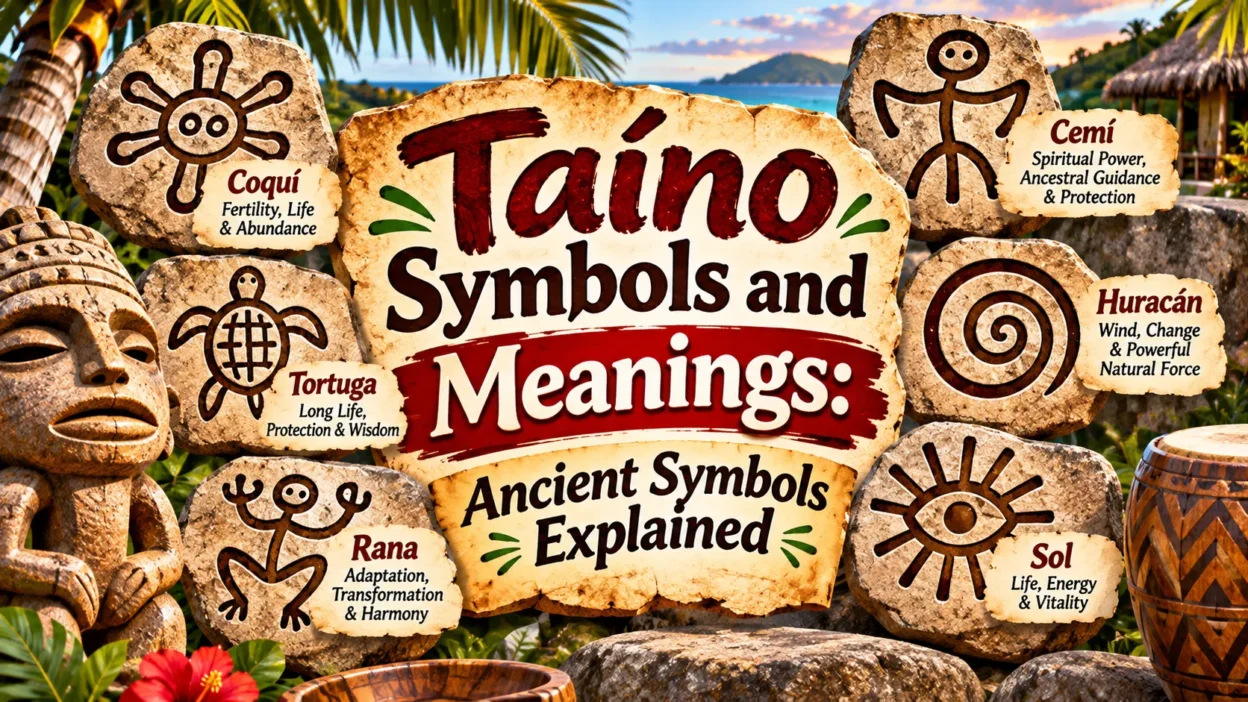
Taíno symbols and meanings offer a fascinating glimpse into the spiritual beliefs, artistic traditions, and everyday life of the Indigenous people who lived throughout the Caribbean before and during European colonization. The Taíno were among the major Indigenous peoples of the Greater Antilles, including present-day Puerto Rico, the Dominican Republic, Haiti, Cuba, and Jamaica. Their artwork featured distinctive geometric patterns, animal figures, human-like faces, and images connected with nature and spiritual beings. These designs appeared on pottery, ceremonial objects, stone carvings, wooden sculptures, and cave walls.
Many Taíno symbols were connected with the natural world and the spiritual forces believed to influence human life. The sun, moon, water, birds, frogs, and other animals held important places in Taíno stories and traditions. Some images represented zemís, powerful spiritual beings or sacred presences associated with ancestors, nature, and supernatural forces. Today, Taíno-inspired designs appear in jewelry, tattoos, artwork, and cultural celebrations, particularly among people exploring their Caribbean Indigenous heritage. In this guide, you’ll discover more than 50 Taíno symbols and their meanings, including the sun, coquí, frog, birds, zemís, geometric patterns, and ancient petroglyphs. You’ll also learn about their historical background and how to approach these symbols respectfully.
🌴 Who Were the Taíno People?
The Taíno were Indigenous Arawakan-speaking peoples who inhabited much of the Caribbean when Europeans arrived in the late 15th century. Their communities were especially prominent in the Greater Antilles, including Hispaniola, Puerto Rico, Cuba, and Jamaica.
Taíno communities developed rich traditions involving agriculture, fishing, pottery, storytelling, music, spirituality, and artistic expression. They cultivated crops such as cassava, sweet potatoes, maize, and other plants. Their villages often centered around communal spaces where people gathered for ceremonies, games, and important social activities.
Taíno culture included:
- Spiritual beliefs: Relationships with zemís, ancestors, and natural forces.
- Nature: Respect for the sun, moon, water, animals, and plants.
- Art: Petroglyphs, pottery designs, carved objects, and wooden sculptures.
- Community: Shared traditions, leadership, family relationships, and ceremonies.
- Agriculture: Farming practices that supported village life.
- Storytelling: Oral traditions explaining creation, nature, and spiritual beings.
Although colonization caused enormous disruption and loss, Taíno descendants and Indigenous Caribbean communities continue to preserve, explore, and renew their cultural heritage.
☀️ Taíno Sun Symbol and Its Meaning
The sun was an important part of the Taíno worldview because it provided warmth, light, and energy for life. Solar imagery appears in Caribbean Indigenous art, including designs that resemble faces, rays, and circular patterns.
The sun is often interpreted in modern Taíno-inspired artwork as a symbol of life, energy, renewal, and connection with nature. However, not every circular or ray-shaped carving can be confidently identified as a specific sun symbol.
Common sun-inspired motifs include:
- Sun Face: A circular face design often interpreted as a representation of the sun or a spiritual presence.
- Sun Rays: Lines extending outward to represent light and energy.
- Radiating Circle: A circular motif associated in modern interpretations with life and vitality.
- Sun With a Face: A human-like solar image found in some Caribbean Indigenous-inspired artwork.
- Rising Sun: A modern interpretation representing new beginnings and renewal.
- Sun and Moon: A paired design representing natural cycles and complementary forces.
- Circular Sun Pattern: A design often used to express continuity and wholeness.
- Sunburst: A decorative pattern associated with light and energy.
Sun-inspired Taíno designs are popular in contemporary Caribbean art and jewelry. Their precise historical meaning should be considered in relation to the specific artifact or archaeological context.
🌙 Taíno Moon Symbol and Its Meaning
The moon was an important part of Indigenous Caribbean understandings of the natural world. Lunar cycles influenced the observation of seasons, tides, and nighttime conditions.
Modern Taíno-inspired artwork often uses moon imagery to communicate femininity, cycles, mystery, renewal, and balance. These associations should not automatically be treated as fixed historical Taíno meanings.
Common moon-inspired designs include:
- Crescent Moon: A modern symbol of change and natural cycles.
- Full Moon: Often interpreted as completeness and wholeness.
- Moon Face: A human-like lunar image in contemporary Indigenous-inspired art.
- Moon and Sun: A design representing the relationship between day and night.
- Moon With Stars: A celestial pattern associated with mystery and the night sky.
- Lunar Circle: A circular design used to represent cycles and continuity.
- Moon Rays: A decorative interpretation of lunar energy.
- Moon and Water: A modern design connecting lunar cycles with the sea.
When researching a historical Taíno lunar image, look for the specific archaeological source rather than assuming every crescent or circle has an established traditional meaning.
🐸 Taíno Coquí Symbol and Its Meaning
The coquí is a small tree frog native to Puerto Rico and one of the island’s most recognizable natural and cultural symbols. Its distinctive nighttime call has become closely associated with Puerto Rican identity.
The coquí is especially meaningful in modern Puerto Rican culture, where it can represent home, belonging, cultural pride, and connection with the island’s natural environment.
Coquí-inspired symbols include:
- Coquí Frog: Puerto Rican identity and connection with nature.
- Frog Silhouette: A simple design celebrating Caribbean wildlife.
- Coquí With Leaves: Nature, environmental connection, and island life.
- Coquí on a Branch: The frog’s natural habitat.
- Coquí With a Moon: Nighttime, nature, and the familiar sound of the frog.
- Coquí With a Heart: Love for Puerto Rico and cultural identity.
- Coquí With a Flag: Puerto Rican heritage and pride.
- Coquí Petroglyph-Inspired Design: A contemporary combination of frog imagery and Indigenous-inspired visual art.
The coquí is a strong choice for someone who wants a design connected with Puerto Rican heritage. It is important to distinguish modern cultural symbolism from specific ancient Taíno petroglyphs.
🌀 Taíno Spiral Symbol and Its Meaning
Spiral designs appear in many ancient artistic traditions, including Caribbean Indigenous art. Their interpretation depends on where they appear, how they were carved, and what other imagery surrounds them.
In modern Taíno-inspired designs, spirals are often associated with movement, cycles, growth, continuity, and the natural world.
Common spiral-inspired motifs include:
- Single Spiral: Movement, development, and continuity in modern interpretations.
- Double Spiral: Complementary movement and balance.
- Concentric Spiral: Repeated cycles and interconnectedness.
- Spiral With a Face: A contemporary combination of human and geometric imagery.
- Spiral Petroglyph: A carved design found in some Caribbean archaeological sites.
- Wave Spiral: A modern representation of flowing water.
- Plant Spiral: Growth and natural development.
- Circular Spiral: A decorative design associated with continuity.
Spirals are visually important, but their precise meaning cannot always be determined from the shape alone.
🗿 Taíno Zemí Symbols and Their Meanings
One of the most important concepts in Taíno spirituality is the zemí (also written cemí). Zemís were spiritual beings, powers, or sacred presences associated with ancestors, natural forces, and the world around the Taíno.
The word can also refer to physical representations of these spiritual beings. Such objects were made from different materials, including wood, stone, bone, and other substances.
Important aspects of zemí symbolism include:
- Zemí Figure: A representation of a spiritual being or sacred presence.
- Three-Pointed Stone: A distinctive type of Taíno object often called a trigonolith, associated with zemí traditions and agricultural fertility.
- Anthropomorphic Zemí: A figure with human-like features.
- Zoomorphic Zemí: A representation incorporating animal features.
- Ancestor Zemí: A sacred representation associated with ancestral presence.
- Wooden Zemí: A carved spiritual object.
- Stone Zemí: A stone representation associated with Taíno ceremonial practices.
- Zemí With a Face: A figure featuring recognizable facial characteristics.
- Zemí With a Frog-Like Form: A design incorporating animal features.
- Ceremonial Zemí: An object associated with ritual and spiritual practices.
Zemís did not all have the same meaning or purpose. Their identities and associations depended on the community, object, and historical context.
🐦 Taíno Bird Symbols and Their Meanings
Birds were important in the Caribbean environment and appear in Indigenous art and storytelling. They could be represented through carved figures, decorative patterns, and images connected with the natural world.
Bird imagery in modern Taíno-inspired designs is often used to express freedom, nature, movement, and connection with the Caribbean landscape.
Common bird-inspired designs include:
- Bird Figure: A representation of wildlife and the natural world.
- Bird in Flight: Freedom and movement in modern interpretations.
- Parrot: Tropical nature and Caribbean biodiversity.
- Hummingbird: Energy, agility, and natural beauty.
- Pelican: Coastal environments and marine life.
- Owl: Nighttime wildlife and observation.
- Bird With Wings Spread: Movement and freedom.
- Bird and Sun: A modern design connecting wildlife with daylight.
- Bird and Tree: Nature and habitat.
- Bird Petroglyph: A carved image whose specific meaning depends on its archaeological context.
Birds also held a place in broader Indigenous American storytelling, but the meaning of an individual bird image should not be assumed without supporting evidence.
🌊 Taíno Water Symbols and Their Meanings
Water was essential to Taíno life. The Caribbean environment provided rivers, coastal waters, lagoons, and the sea, supporting fishing, travel, agriculture, and community life.
Water-inspired designs are common in modern Taíno artwork because they connect Caribbean identity with the islands’ natural environment.
Here are water-related motifs:
- Wave Pattern: Movement and the sea.
- Water Lines: Flowing water and natural movement.
- River Motif: Freshwater and the landscape.
- Spiral Wave: A contemporary design inspired by ocean movement.
- Fish Figure: Marine life and fishing traditions.
- Shell Design: Coastal environments and marine resources.
- Sea Turtle: Caribbean wildlife and ocean life.
- Water and Sun: The relationship between sea and sky.
- Ocean Circle: A modern representation of the sea’s continuity.
- Water Petroglyph: A carved image whose meaning requires archaeological context.
Water designs are especially meaningful for people with a personal connection to the Caribbean.
🐢 Taíno Animal Symbols and Their Meanings
Animals played important roles in Taíno life, spirituality, food systems, and artistic expression. Some were represented in carvings and pottery, while others appeared in stories and ceremonial imagery.
Here are animals commonly associated with Taíno-inspired art:
- Frog: Caribbean wildlife and, in modern Puerto Rican culture, the coquí and island identity.
- Turtle: Marine life and the Caribbean environment.
- Bird: Nature, movement, and wildlife.
- Fish: Ocean resources and fishing.
- Bat: A nocturnal animal represented in some Caribbean Indigenous artistic traditions.
- Owl: Nighttime wildlife and observation.
- Parrot: Tropical nature and colorful birdlife.
- Lizard: Caribbean biodiversity and the natural environment.
- Snake: An animal found in Caribbean ecosystems and Indigenous visual traditions.
- Crab: Coastal environments and marine life.
- Shell: Ocean resources and ceremonial or decorative uses.
- Dog: An animal known in Taíno communities, including the small dog described in early historical accounts.
- Manatee: Marine wildlife and the Caribbean environment.
- Hummingbird: A small bird associated with the region’s biodiversity.
- Iguana: A distinctive Caribbean reptile.
- Bat Figure: A motif found in some Indigenous Caribbean objects and imagery.
The presence of an animal in a modern design does not automatically mean it had a specific spiritual meaning in ancient Taíno culture.
🌿 Taíno Symbols of Nature and Fertility
Nature was central to Taíno life. Plants, crops, trees, animals, water, and weather supported communities and influenced their spiritual worldview.
Modern Taíno-inspired artwork often uses natural imagery to celebrate the relationship between people and the environment.
Common nature-related motifs include:
- Cassava Plant: An important crop in Taíno agriculture.
- Yuca Root: Food, nourishment, and agricultural heritage.
- Maize: Agriculture and food traditions.
- Tree: Nature, growth, and continuity in modern interpretations.
- Leaf: Plant life and the environment.
- Flower: Beauty and natural growth.
- Seed: Potential and new life.
- Cactus: Caribbean landscapes and plant diversity.
- Palm Leaf: Tropical environments and island life.
- Mountain: The natural landscape.
- Rain: Water and agricultural nourishment.
- Sun and Plant: A contemporary representation of natural growth.
- Root Pattern: Connection to land and heritage.
- Fruit: Food, abundance, and agriculture.
Cassava was particularly important to Taíno communities. It was processed into cassava bread, which played a major role in everyday food traditions.
🪨 Taíno Petroglyphs and Their Meanings
Taíno petroglyphs are images carved or engraved into stone surfaces. They are among the most recognizable forms of surviving Indigenous Caribbean visual art.
Petroglyphs can be found at archaeological sites throughout the Caribbean, including caves, river areas, and rock shelters. They often feature human-like faces, animal forms, geometric patterns, and other designs.
Common types of petroglyph imagery include:
- Human Face: A carved face that may represent a spiritual figure, ancestor, or other being.
- Circular Face: A round design featuring facial characteristics.
- Three-Pointed Figure: A distinctive form connected with Taíno stone objects and zemí traditions.
- Spiral Carving: A geometric motif with context-dependent meaning.
- Animal Figure: A carved representation of an animal.
- Human-Like Figure: An image with a body or recognizable human features.
- Geometric Pattern: Repeated shapes and lines.
- Eye Motif: A facial feature that appears in some carved designs.
- Mouth Motif: A facial feature that may be part of a larger figure.
- Combined Face and Spiral: A design combining geometric and anthropomorphic imagery.
Petroglyphs should be interpreted carefully. Archaeologists may identify an image’s shape without being able to establish exactly what the original artist intended it to represent.
🔺 Taíno Geometric Symbols and Their Meanings
Geometric designs are a recognizable part of Taíno-inspired visual art. They appear in contemporary artwork, textiles, jewelry, pottery reproductions, and tattoos.
Here are common geometric motifs:
- Circle: A basic geometric shape used in many designs.
- Spiral: A recurring pattern found in various ancient artistic traditions.
- Three-Pointed Shape: A distinctive motif associated with Taíno three-pointed stones.
- Triangle: A geometric form used in decorative patterns.
- Zigzag: A repeated angular design.
- Parallel Lines: A simple pattern used in decorative art.
- Concentric Circles: Circles arranged around a shared center.
- Wave Pattern: A repeated flowing line.
- Diamond Pattern: A geometric decorative motif.
- Crossed Lines: An intersecting pattern.
- Radial Pattern: Lines or shapes extending outward from a center.
- Repeated Dots: A decorative pattern found in different artistic traditions.
- Grid Pattern: An organized arrangement of lines.
- Curved Lines: Flowing decorative forms.
- Symmetrical Pattern: A design with balanced repeated elements.
These shapes can look striking in tattoos, but a geometric pattern should not be assigned a specific ancient meaning unless historical evidence supports it.
🏝️ Taíno Symbols of Puerto Rican Heritage
Taíno heritage is an important part of Puerto Rico’s history and cultural identity. Many Puerto Ricans explore Indigenous ancestry through family traditions, historical research, language, art, and cultural education.
Some Taíno-inspired designs have become recognizable expressions of Puerto Rican heritage.
Popular examples include:
- Coquí: A beloved symbol of Puerto Rican wildlife and cultural identity.
- Three-Pointed Stone: A recognizable object associated with Taíno archaeology.
- Sun Face: A popular contemporary design inspired by Caribbean Indigenous imagery.
- Petroglyph Face: A design based on carved Indigenous figures.
- Cassava Plant: A connection with traditional agriculture and food.
- Indigenous Bird: A celebration of Caribbean wildlife.
- Caribbean Wave: A connection with the sea and island life.
- Zemí Figure: A reference to Taíno spiritual traditions.
- Taíno-Inspired Geometric Border: A contemporary decorative design based on Indigenous visual patterns.
- Puerto Rican Flag With Indigenous Motif: A modern expression combining national identity and Indigenous heritage.
Taíno identity is not simply a thing of the past. Many people in Puerto Rico and across the Caribbean continue to explore and affirm Indigenous ancestry and cultural connections.
🖤 Taíno Tattoo Symbols and Their Meanings
Taíno-inspired tattoos are popular among people who want to express Caribbean heritage, family connections, cultural pride, or appreciation for Indigenous art.
Some choose historically documented designs, while others select modern interpretations inspired by traditional visual motifs.
Here are popular Taíno-inspired tattoo ideas:
- Coquí Tattoo: Puerto Rican identity and love for the island.
- Sun Face Tattoo: A modern design associated with life and energy.
- Three-Pointed Stone Tattoo: A reference to Taíno archaeological heritage.
- Zemí Tattoo: A representation inspired by Taíno spiritual objects.
- Petroglyph Face Tattoo: A design based on Indigenous stone carvings.
- Spiral Tattoo: Movement and continuity in contemporary interpretations.
- Taíno Bird Tattoo: Caribbean wildlife and freedom.
- Frog Tattoo: Nature and the coquí tradition.
- Wave Tattoo: Connection with the Caribbean Sea.
- Cassava Plant Tattoo: Agricultural and cultural heritage.
- Turtle Tattoo: Caribbean nature and marine life.
- Geometric Band Tattoo: A decorative design inspired by Indigenous patterns.
- Sun and Moon Tattoo: A modern celestial composition.
- Zemí and Nature Tattoo: A combination of spiritual and natural imagery.
- Caribbean Map Tattoo: A personal connection with the islands.
Before choosing a Taíno-inspired tattoo, learn about the source of the design. Some images are modern interpretations rather than verified ancient symbols, and some sacred objects deserve particular care and respect.
🎨 Taíno Symbols and Their Meanings: Quick Reference Table
The following table provides a simple overview of recognizable Taíno and Taíno-inspired motifs.
| Symbol or Motif | Common Interpretation or Context |
|---|---|
| Sun Face | Modern interpretation of solar imagery |
| Crescent Moon | Lunar cycles in contemporary designs |
| Coquí | Puerto Rican identity and wildlife |
| Frog | Caribbean wildlife |
| Zemí | Spiritual being or sacred presence |
| Three-Pointed Stone | Taíno ceremonial and archaeological tradition |
| Petroglyph Face | Indigenous Caribbean rock art |
| Spiral | Geometric motif found in ancient art |
| Bird | Caribbean wildlife and nature |
| Fish | Marine life and fishing |
| Turtle | Caribbean marine environment |
| Cassava Plant | Agriculture and food heritage |
| Wave | Caribbean Sea and coastal life |
| Shell | Marine resources and ceremonial contexts |
| Tree | Nature and growth in modern interpretations |
| Leaf | Plant life and natural environment |
| Animal Figure | Wildlife and artistic representation |
| Human Figure | Anthropomorphic imagery |
| Geometric Border | Decorative Indigenous-inspired design |
| Sun and Moon | Contemporary representation of celestial cycles |
❓ Frequently Asked Questions About Taíno Symbols and Meanings
What is the most famous Taíno symbol?
The three-pointed stone, often called a trigonolith, is one of the most recognizable objects associated with Taíno archaeology. The coquí and various sun-face and petroglyph-inspired designs are also widely recognized in contemporary Taíno-inspired art.
What does the Taíno sun symbol mean?
Sun imagery is commonly interpreted in contemporary Taíno-inspired artwork as representing life, energy, warmth, and renewal. However, the meaning of an individual historical carving depends on its archaeological context.
What does the Taíno coquí symbolize?
The coquí is a small frog native to Puerto Rico. Today, it represents Puerto Rican identity, cultural pride, and a connection with the island’s natural environment.
What does a Taíno zemí represent?
A zemí refers to a spiritual being, power, or sacred presence in Taíno belief. The term can also describe physical representations of these beings, including carved stone and wooden objects.
What does the three-pointed Taíno symbol mean?
Three-pointed stones are distinctive Taíno archaeological objects often associated with zemí traditions and agricultural fertility. Their precise meanings and uses varied, and scholars continue to study them.
What does a Taíno spiral mean?
Spiral patterns appear in various Caribbean Indigenous artistic traditions. Modern interpretations often connect them with movement, cycles, and continuity, but there is no single meaning that applies to every historical spiral carving.
Are Taíno symbols still used today?
Yes. Taíno-inspired symbols appear in contemporary tattoos, jewelry, art, clothing, educational projects, and cultural celebrations. They are particularly important to people exploring Caribbean Indigenous heritage.
Are Taíno symbols the same as Mayan or Aztec symbols?
No. The Taíno, Maya, and Aztec peoples belonged to different cultural and historical traditions. Their artwork and religious systems should not be treated as interchangeable, even though some broad visual similarities may occur.
Can anyone get a Taíno tattoo?
People can appreciate and learn about Taíno art, but it is important to understand the history and cultural significance of a design. Research its origin, avoid misrepresenting sacred objects, and consider learning from Taíno descendants and Indigenous Caribbean cultural organizations.
Where can I see authentic Taíno symbols?
You can explore Taíno artifacts and Indigenous Caribbean collections through museums, archaeological publications, and cultural institutions in Puerto Rico and other Caribbean locations. Museum records and archaeological research are especially useful for distinguishing historical objects from modern interpretations.
🌺 Conclusion: Understanding Taíno Symbols and Their Meanings
Taíno symbols provide a meaningful connection to the Indigenous history, spirituality, and artistic traditions of the Caribbean. From zemí figures and three-pointed stones to animal imagery, petroglyphs, and geometric patterns, these designs reveal how closely Taíno communities were connected with nature, spirituality, and their surroundings.
Today, Taíno-inspired artwork continues to appear in tattoos, jewelry, cultural celebrations, and contemporary Caribbean design. Symbols such as the coquí and three-pointed stone are especially recognizable, while other motifs require careful historical interpretation. Not every modern design has a confirmed ancient meaning, so understanding its origin is an important part of appreciating it.
Whether you’re researching Caribbean history, exploring your heritage, or looking for meaningful tattoo inspiration, Taíno symbols offer a fascinating starting point. Learning about their history helps keep Indigenous Caribbean culture visible and encourages respect for the communities whose traditions continue to live on.

Jessica Morgan is a writer and content creator at Blesslume, dedicated to sharing meaningful blessings, heartfelt prayers, inspiring wishes, and uplifting messages. She is passionate about helping people find the right words to celebrate special moments, offer encouragement, and spread kindness. Through thoughtful and inspiring content, Jessica aims to bring hope, positivity, and connection to readers around the world.