
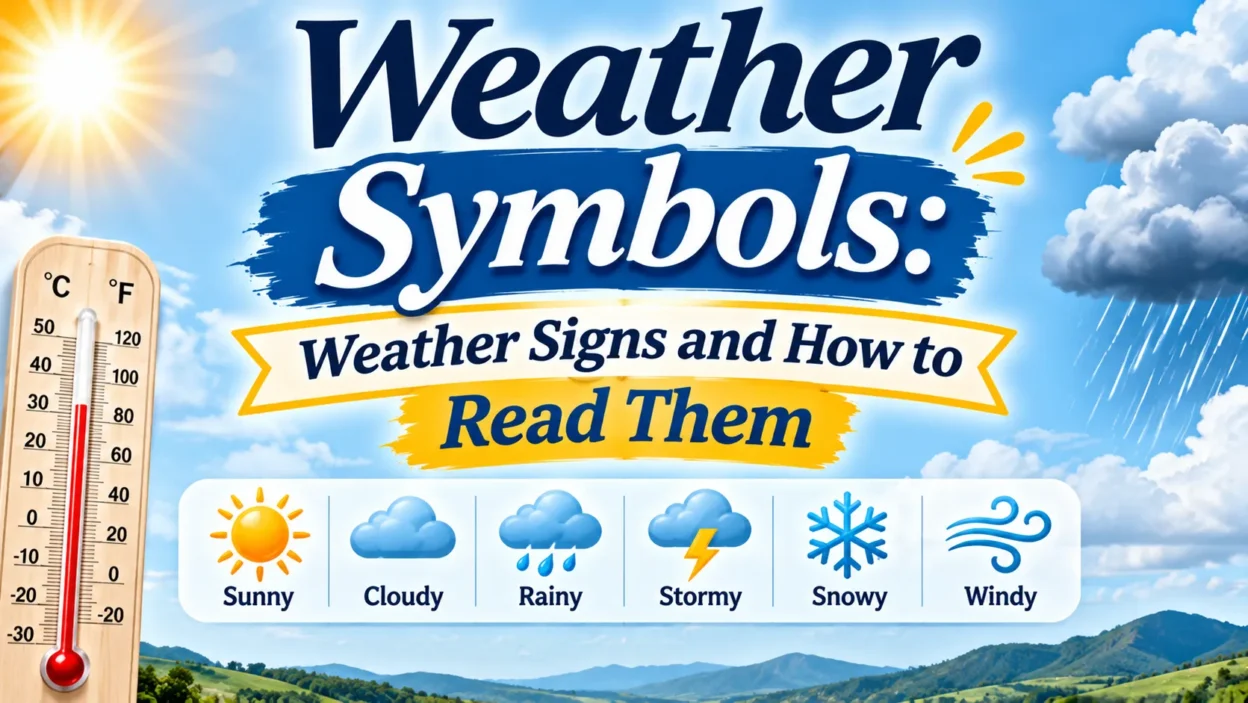
Weather symbols make forecasts easier to understand by turning complicated atmospheric information into simple visual signs. A sun icon tells you to expect sunshine, a cloud with raindrops warns about precipitation, and a lightning symbol signals a thunderstorm. These small signs help people understand changing weather conditions without reading lengthy descriptions.
However, weather symbols communicate much more than sunny or rainy conditions. Forecast apps, television weather reports, meteorological maps, and weather websites use different icons to represent temperature, wind speed, cloud cover, humidity, snowfall, fog, and severe weather. Some symbols describe current conditions, while others predict what might happen during the next few hours or days.
In this guide, you will explore more than 50 weather symbols and their meanings, including sunshine, rain, thunderstorms, snow, wind, and atmospheric conditions. You will also learn how to understand weather maps, interpret common forecast icons, recognize severe weather warnings, and distinguish between similar-looking signs.
🌤️ What Are Weather Symbols?
Weather symbols are visual signs that represent atmospheric conditions, weather events, and forecast information. Meteorologists and weather services use them to communicate information quickly through maps, apps, television graphics, and printed forecasts.
Instead of writing “partly cloudy with occasional showers,” a weather app might display a sun, a cloud, and several raindrops. This combination helps you recognize the expected conditions at a glance.
Weather symbols generally fall into several categories:
- Sunshine symbols: Represent clear skies, sunny weather, and changing cloud cover.
- Cloud symbols: Show cloudy, overcast, or partly cloudy conditions.
- Rain symbols: Indicate light showers, moderate rainfall, or heavy precipitation.
- Snow symbols: Represent snowfall, flurries, and wintry conditions.
- Storm symbols: Warn about thunderstorms, lightning, and severe weather.
- Wind symbols: Communicate wind direction, speed, and gusts.
- Temperature symbols: Display heat, cold, and temperature measurements.
- Weather map symbols: Show atmospheric pressure, fronts, and other meteorological features.
Different weather providers sometimes use slightly different designs, so always check the legend when reading an unfamiliar forecast.
☀️ Sunny and Clear Weather Symbols
Sunny weather symbols represent conditions with little cloud cover and plenty of sunshine. Weather apps often use a bright sun icon to indicate clear skies, warm afternoons, or generally pleasant conditions.
These symbols help you identify days that may offer good conditions for outdoor activities, travel, and recreation.
| Symbol | Weather Name | Meaning |
|---|---|---|
| ☀️ | Sunny | Bright sunshine with little or no cloud cover |
| 🌞 | Bright sunshine | Sunny conditions with a decorative sun face |
| 🌅 | Sunrise | The sun appears above the horizon in the morning |
| 🌄 | Sunset or sunrise scenery | A sun near a mountain horizon |
| 🌡️ | Temperature | Displays or represents air temperature |
| 🌤️ | Mostly sunny | Sunshine with a few clouds |
| 🔆 | Brightness | Represents brightness or strong light; not a standard forecast icon |
Example: If your weather app displays ☀️, expect mostly clear conditions during the forecast period.
One important distinction: a sunny icon does not always mean high temperatures. A winter morning can bring bright sunshine and freezing air at the same time.
☁️ Cloudy Weather Symbols and Their Meanings
Cloud symbols help describe how much of the sky clouds cover. Some forecasts show a few scattered clouds, while others indicate thick cloud cover that may block most sunlight.
Understanding these differences helps you recognize the expected sky conditions.
| Symbol | Weather Name | Meaning |
|---|---|---|
| ☁️ | Cloudy | Clouds cover much or most of the sky |
| 🌤️ | Mostly sunny | Sunshine dominates with a few clouds |
| ⛅ | Partly cloudy | A mixture of sunshine and clouds |
| 🌥️ | Mostly cloudy | Clouds dominate, with some sunshine possible |
| 🌫️ | Foggy or misty | Reduced visibility due to tiny water droplets or particles |
| 🌁 | Fog or haze | A foggy or hazy atmospheric appearance |
Partly Cloudy vs. Mostly Cloudy
These two forecast descriptions can look similar, but they suggest different sky conditions.
- Partly cloudy: Clouds cover only part of the sky, leaving room for sunshine.
- Mostly cloudy: Clouds cover a larger portion of the sky, although occasional sunshine may appear.
- Overcast: A thick cloud layer covers nearly the entire sky.
Weather providers may use slightly different cloud-cover thresholds, so the wording and icon design can vary between apps.
🌧️ Rain and Shower Symbols
Rain symbols help you understand when precipitation may occur and how intense it might become. Weather apps commonly use clouds with one or more raindrops to communicate different rainfall conditions.
| Symbol | Weather Name | Meaning |
|---|---|---|
| 🌦️ | Sun and rain | Sunshine and rain may occur during the same forecast period |
| 🌧️ | Rain | Rainfall or rainy conditions |
| 🌦️ | Scattered showers | Intermittent rain with possible sunny breaks |
| 🌧️ | Heavy rain | Rainfall with greater intensity; some apps add more drops |
| ☔ | Umbrella | Rainy conditions or a reminder to carry an umbrella |
| 💧 | Water droplet | Moisture, precipitation, or humidity in some interfaces |
| 🌂 | Closed umbrella | An umbrella-related decorative sign, not a standard forecast icon |
Different Types of Rain
Rain forecasts often use words such as drizzle, showers, and downpour. These terms describe different rainfall patterns.
- Drizzle: Very light precipitation with tiny water droplets.
- Light rain: Gentle rainfall that usually creates limited accumulation.
- Moderate rain: Steady rainfall with a noticeable amount of water.
- Heavy rain: Intense rainfall that may cause poor visibility and localized flooding.
- Showers: Rain that starts and stops rather than falling continuously.
- Downpour: A sudden period of very heavy rainfall.
Example: A cloud with raindrops usually indicates rain, while a sun-and-rain icon suggests changing conditions with both sunshine and showers.
❄️ Snow and Winter Weather Symbols
Snow symbols help people recognize freezing conditions, snowfall, and other winter weather events. They are particularly useful when checking travel conditions, preparing for cold temperatures, or planning outdoor activities.
| Symbol | Weather Name | Meaning |
|---|---|---|
| ❄️ | Snow | Snowfall or snowy conditions |
| 🌨️ | Snow showers | Snow falling from a cloud |
| ☃️ | Snowman | Decorative representation of snowy weather |
| ⛄ | Snowman without snowflakes | Winter or snow-related decoration |
| 🌬️ | Cold wind | Windy conditions that may increase discomfort |
| 🧊 | Ice | Icy surfaces or freezing conditions |
| 🌨️ | Heavy snow | Snowfall that may reduce visibility or affect travel |
Common Types of Snowfall
Not every snow forecast describes the same conditions. The following terms help explain the differences.
- Snow flurries: Light snowfall that usually produces little accumulation.
- Light snow: Gentle snowfall with limited accumulation.
- Moderate snow: More consistent snowfall that can cover roads and surfaces.
- Heavy snow: Intense snowfall that can create hazardous travel conditions.
- Snow showers: Intermittent snowfall that may start and stop.
- Blizzard: A severe winter storm with strong winds, blowing snow, and very low visibility.
A snowflake icon tells you about snowfall, but it does not automatically indicate a blizzard. Always check local winter weather alerts for information about dangerous conditions.
⛈️ Thunderstorm and Severe Weather Symbols
Thunderstorm symbols warn about unstable atmospheric conditions, lightning, heavy rainfall, and strong winds. Some weather apps use a cloud with a lightning bolt, while others combine lightning with rain.
These signs deserve special attention because thunderstorms can create dangerous conditions.
| Symbol | Weather Name | Meaning |
|---|---|---|
| ⛈️ | Thunderstorm | Thunder, lightning, and possible rainfall |
| 🌩️ | Lightning | Lightning activity or thunderstorm conditions |
| 🌪️ | Tornado or cyclone symbol | A rotating air column or storm-related imagery |
| ⚡ | Lightning bolt | Electrical discharge or lightning hazard |
| 🌧️ | Heavy rain | Intense rainfall that may accompany a storm |
| 🌬️ | Strong wind | Windy conditions that may occur during storms |
| 🌩️ | Lightning storm | Electrical storm activity |
Understanding Severe Weather Conditions
A thunderstorm can bring several weather hazards at once. Understanding these terms helps you recognize the risks.
- Thunderstorm: A storm that produces thunder and lightning.
- Lightning: An electrical discharge in the atmosphere.
- Hailstorm: A storm that produces balls or lumps of ice.
- Tornado: A violently rotating column of air that extends from a thunderstorm toward the ground.
- Squall: A sudden increase in wind speed, sometimes accompanied by rain.
- Severe thunderstorm: A storm that meets official criteria for hazards such as damaging winds, large hail, or other significant threats.
Do not rely on an icon alone when severe weather threatens. Follow official local warnings and safety instructions.
🌪️ Wind and Air Movement Symbols
Wind symbols communicate how air moves through an area. Some weather apps show simple wind arrows, while meteorological maps use specialized markings to describe direction and speed.
Wind information matters for boating, aviation, outdoor activities, agriculture, and everyday travel.
| Symbol or Sign | Weather Term | Meaning |
|---|---|---|
| 🌬️ | Windy | Air moves at noticeable speeds |
| ↗ | Northeastward movement | Arrow points toward the northeast |
| ↘ | Southeastward movement | Arrow points toward the southeast |
| ↙ | Southwestward movement | Arrow points toward the southwest |
| ↖ | Northwestward movement | Arrow points toward the northwest |
| ↑ | Northward movement | Arrow points upward |
| ↓ | Southward movement | Arrow points downward |
| → | Eastward movement | Arrow points right |
| ← | Westward movement | Arrow points left |
Important: Weather services often describe wind direction by the direction the wind comes from, not where it travels. A north wind comes from the north and blows toward the south.
What Does Wind Speed Mean?
Wind speed describes how quickly air moves. Forecasts may express it in miles per hour (mph), kilometers per hour (km/h), meters per second (m/s), or knots.
| Wind Description | General Meaning |
|---|---|
| Calm | Very little air movement |
| Light breeze | Gentle wind |
| Moderate breeze | Noticeable but manageable wind |
| Fresh breeze | Stronger wind that moves small branches |
| Strong wind | Wind that may affect outdoor activities |
| Gale | Very strong wind |
| Storm-force wind | Extremely strong wind that can cause damage |
These descriptions provide general guidance. Official weather services use defined wind-speed ranges when issuing warnings.
🌡️ Temperature and Atmospheric Condition Symbols
Temperature symbols help you understand how hot or cold the air feels. Weather services also use other measurements to describe atmospheric conditions, including humidity, pressure, and visibility.
| Symbol | Name | Meaning |
|---|---|---|
| 🌡️ | Thermometer | Air temperature |
| 🔥 | Heat | Hot conditions or heat-related warnings in some interfaces |
| 🧊 | Ice | Freezing or icy conditions |
| 💧 | Humidity or moisture | Water vapor or moisture-related information |
| ☀️ | Heat and sunshine | Sunny conditions that may accompany high temperatures |
| 🌫️ | Fog or haze | Reduced visibility |
| 🌬️ | Wind | Air movement |
| ☁️ | Cloud cover | Amount of cloud in the sky |
Understanding Temperature Units
Weather apps commonly display temperature using two measurement systems.
- Celsius (°C): Commonly used in most countries around the world.
- Fahrenheit (°F): Commonly used in the United States.
For reference:
| Celsius | Fahrenheit | General Description |
|---|---|---|
| -10°C | 14°F | Very cold |
| 0°C | 32°F | Freezing point of water |
| 10°C | 50°F | Cool |
| 20°C | 68°F | Mild |
| 25°C | 77°F | Warm |
| 30°C | 86°F | Hot |
| 35°C | 95°F | Very hot |
| 40°C | 104°F | Extremely hot |
These descriptions are general. Humidity, wind, sunlight, and personal comfort can change how a particular temperature feels.
🗺️ Weather Map Symbols and Their Meanings
Weather maps use special symbols to show atmospheric pressure, wind patterns, temperature boundaries, and storm systems. Unlike simple weather app icons, these signs help meteorologists understand large-scale weather patterns.
Learning a few common map symbols makes weather reports much easier to follow.
High-Pressure and Low-Pressure Symbols
| Symbol | Name | Meaning |
|---|---|---|
| H | High pressure | An area where atmospheric pressure exceeds surrounding areas |
| L | Low pressure | An area where atmospheric pressure falls below surrounding areas |
High pressure (H): High-pressure systems often bring sinking air and more stable conditions. They frequently produce clear or settled weather, although local conditions can vary.
Low pressure (L): Low-pressure systems often encourage rising air, cloud formation, and unsettled weather. They can bring rain, wind, and storms.
Weather Front Symbols
Weather fronts mark boundaries between air masses with different temperatures and characteristics.
| Symbol or Map Marking | Front Name | Meaning |
|---|---|---|
| Blue line with triangles | Cold front | Cold air advances and pushes beneath warmer air |
| Red line with semicircles | Warm front | Warm air advances over cooler air |
| Alternating blue triangles and red semicircles on opposite sides | Stationary front | Two air masses meet with little movement |
| Purple line with triangles and semicircles on the same side | Occluded front | A cold front catches up with a warm front |
Map conventions may vary slightly by weather service, but these are widely used meteorological markings.
Isobars and Weather Map Lines
Isobars are lines that connect locations with equal atmospheric pressure. Meteorologists use them to study pressure patterns and wind behavior.
- Closely spaced isobars: Usually indicate stronger pressure gradients and potentially stronger winds.
- Widely spaced isobars: Usually indicate weaker pressure gradients and lighter winds.
- Closed isobars around L: Often show a low-pressure system.
- Closed isobars around H: Often show a high-pressure system.
These lines help explain why some areas experience stronger winds than others.
🌫️ Fog, Mist, and Visibility Symbols
Fog and mist reduce visibility when tiny water droplets collect near the ground. Weather apps may use a fog icon or horizontal lines to represent these conditions.
| Symbol | Weather Condition | Meaning |
|---|---|---|
| 🌫️ | Fog | Dense moisture near the ground reduces visibility |
| ≋ | Mist or haze | A general decorative representation of reduced clarity |
| ☁️ | Low clouds | Clouds near the ground or lower atmosphere |
| 🌁 | Foggy conditions | A fog-related decorative symbol |
| 🌬️ | Wind | Air movement that may affect fog development |
Fog vs. Mist
Fog and mist both involve tiny suspended water droplets, but meteorologists distinguish them by visibility.
- Fog: Reduces horizontal visibility to less than 1 kilometer.
- Mist: Allows visibility of at least 1 kilometer but still creates a hazy appearance.
So Fog can make driving dangerous, especially during early mornings and overnight hours. Slow down and use appropriate vehicle lights when visibility drops.
📱 Common Weather App Symbols and What They Mean
Weather apps often combine multiple visual elements to describe expected conditions. Understanding these combinations helps you interpret a forecast more accurately.
| Weather Icon | Forecast Description |
|---|---|
| ☀️ | Clear and sunny |
| 🌤️ | Mostly sunny |
| ⛅ | Partly cloudy |
| 🌥️ | Mostly cloudy |
| ☁️ | Cloudy |
| 🌦️ | Scattered rain with sunshine |
| 🌧️ | Rainy conditions |
| 🌨️ | Snowfall |
| ⛈️ | Thunderstorms |
| 🌩️ | Lightning or electrical storms |
| 🌫️ | Fog or haze |
| 🌪️ | Tornado or rotating storm imagery |
| 🌬️ | Windy conditions |
| 🌡️ | Temperature information |
Why Do Different Weather Apps Use Different Icons?
Weather providers design their own interfaces, so the same forecast may appear with slightly different icons. One app might use three raindrops for heavy rain, while another might use a darker cloud or a different background.
The icon alone does not always explain the full forecast. Check the accompanying description, precipitation probability, temperature, and weather alerts for a clearer picture.
🌦️ How to Read Weather Symbols Correctly
Reading weather symbols becomes easier when you understand what each visual element represents. A combination of sun, clouds, raindrops, or lightning can communicate several conditions at once.
Follow these simple steps:
- Identify the main symbol: Look for the sun, cloud, snowflake, or storm icon.
- Check additional elements: Notice raindrops, lightning bolts, or wind markings.
- Read the forecast description: Confirm what the app means by its icon.
- Check the forecast time: An icon may describe morning, afternoon, evening, or an entire day.
- Review temperature: Sunny conditions can still bring cold air.
- Check precipitation chances: A rain icon and a precipitation percentage communicate different information.
- Review local alerts: Look for official warnings during severe weather.
What Does a 40% Chance of Rain Mean?
A 40% chance of rain generally represents the probability of measurable precipitation at a particular forecast location during a specified period. It does not necessarily mean that rain will cover 40% of your city or continue for 40% of the day.
Always read the forecast period alongside the percentage because the probability applies to a particular location and time window.
⚠️ Weather Warning Symbols You Should Recognize
Weather warnings alert people to conditions that may threaten safety, property, or travel. Official warning systems use different colors and signs depending on the country and weather authority.
Some common warning categories include:
| Warning Category | What It Communicates |
|---|---|
| Thunderstorm warning | Potentially dangerous thunderstorm conditions |
| Tornado warning | A tornado has been observed or detected by radar |
| Flood warning | Flooding threatens an area or has started |
| Flash flood warning | Rapid flooding creates an immediate danger |
| Heat advisory | High temperatures may create health risks |
| Extreme cold warning | Dangerous cold conditions threaten safety |
| Winter storm warning | Significant snow, ice, or winter weather threatens an area |
| High wind warning | Strong winds may cause damage or disruption |
| Dense fog advisory | Poor visibility may affect travel |
Never assume that a weather icon replaces an official warning. Check your local meteorological department or emergency management authority for reliable safety information.
🔄 Weather Symbols vs. Weather Icons: What’s the Difference?
People often use the terms weather symbols and weather icons interchangeably, but they can describe slightly different things.
| Feature | Weather Symbols | Weather Icons |
|---|---|---|
| Main purpose | Communicate meteorological information | Make forecasts easier to understand visually |
| Common use | Weather maps and scientific charts | Weather apps and websites |
| Appearance | Standardized or technical markings | Illustrations and graphic designs |
| Examples | H, L, cold-front line | ☀️, 🌧️, ⛈️ |
| Audience | Meteorologists and weather readers | General users and forecast viewers |
Weather maps often use technical symbols, while mobile apps usually favor simple pictures. Both help people understand atmospheric conditions.
💡 Why Are Weather Symbols Important?
Weather symbols make forecasting more accessible and help people make practical decisions. Instead of reading a detailed meteorological report, you can quickly identify sunshine, rain, snow, wind, or possible storms.
Here are some important benefits:
- Quick understanding: Recognize expected weather conditions at a glance.
- Better planning: Choose suitable times for travel and outdoor activities.
- Travel safety: Recognize fog, snow, strong winds, and heavy rainfall.
- Agricultural planning: Monitor rainfall, temperature, and frost conditions.
- Emergency awareness: Identify severe weather warnings and dangerous conditions.
- Educational value: Learn basic meteorological concepts through visual signs.
- Clear communication: Understand weather information across different media platforms.
Weather symbols also help people with different language backgrounds understand basic forecasts more easily.
❓ Frequently Asked Questions About Weather Symbols
These common questions explain how weather signs work and how you can interpret the symbols that appear in weather forecasts, apps, and meteorological maps.
1. What are the most common weather symbols?
The most common weather symbols include ☀️ for sunny conditions, ☁️ for clouds, 🌧️ for rain, ❄️ for snow, ⛈️ for thunderstorms, 🌫️ for fog, and 🌬️ for wind.
2. What does the sun behind a cloud symbol mean?
The sun behind a cloud usually represents partly cloudy or partly sunny conditions. The exact meaning depends on the forecast provider and the amount of expected cloud cover.
3. What does the cloud with raindrops symbol mean?
A cloud with raindrops represents rainy conditions or expected precipitation. Some apps use the number of drops or other visual details to distinguish rainfall intensity.
4. What does the lightning symbol mean in a weather forecast?
The lightning symbol usually indicates thunderstorms or electrical storm activity. It can warn about lightning, thunder, heavy rain, and potentially strong winds.
5. What does H mean on a weather map?
H represents a high-pressure system. These systems often encourage stable atmospheric conditions and can bring clear skies, although they do not guarantee sunny weather.
6. What does L mean on a weather map?
L represents a low-pressure system. Low pressure often encourages rising air and cloud formation, which can produce rain, wind, or unsettled weather.
7. What do blue triangles and red semicircles mean on weather maps?
Blue triangles represent a cold front, while red semicircles represent a warm front. These markings show the movement and position of boundaries between air masses.
8. What does a percentage of rain mean?
A precipitation percentage communicates the probability of measurable rain or other precipitation at a particular location during a specified forecast period. It does not directly represent the percentage of time that it will rain.
9. What symbol represents strong wind?
Weather apps commonly use 🌬️ or directional arrows to represent wind. Technical weather maps may use wind barbs to show wind direction and speed.
10. Are weather symbols the same worldwide?
Many meteorological map symbols follow widely used conventions, but weather apps and forecast providers can use different icon designs. Always check the legend or description when you encounter an unfamiliar symbol.
11. What is the symbol for fog?
Weather interfaces commonly use 🌫️ to represent fog or haze. Meteorological maps may use specialized visibility and present-weather markings.
12. What is the symbol for a tornado?
The 🌪️ emoji commonly represents a tornado or rotating storm in digital communication. Official weather agencies use their own warning graphics and text alerts to communicate tornado threats.
🌈 Final Thoughts
Weather symbols turn complex atmospheric information into simple signs that anyone can understand. From sunshine and clouds to heavy rain, snowfall, wind, and thunderstorms, each icon helps communicate a particular condition or forecast.
Learning the difference between ☀️, 🌤️, ⛅, 🌧️, and ⛈️ can make everyday forecasts easier to read. Understanding technical markings such as H, L, cold fronts, warm fronts, and isobars can also help you interpret professional weather maps.
Remember that weather icons provide a quick overview rather than a complete forecast. For accurate planning, always check temperatures, precipitation chances, forecast times, and official weather warnings alongside the symbols.

Jessica Morgan is a writer and content creator at Blesslume, dedicated to sharing meaningful blessings, heartfelt prayers, inspiring wishes, and uplifting messages. She is passionate about helping people find the right words to celebrate special moments, offer encouragement, and spread kindness. Through thoughtful and inspiring content, Jessica aims to bring hope, positivity, and connection to readers around the world.