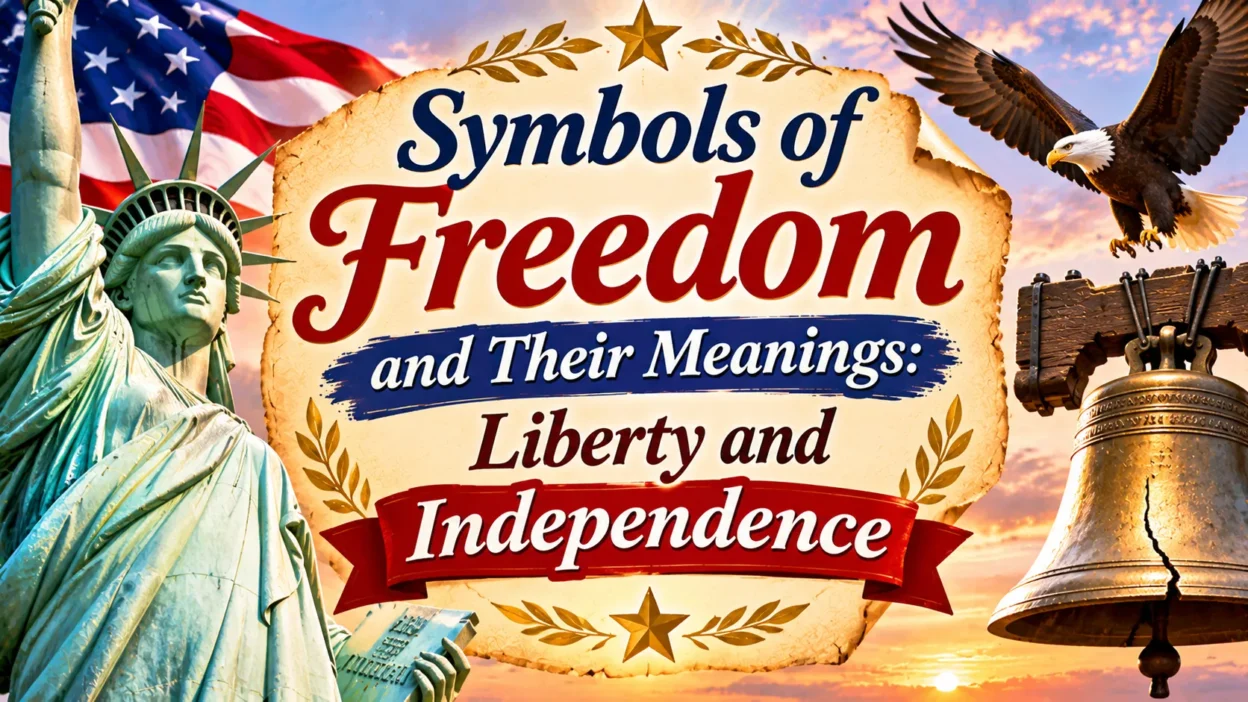
Freedom is one of the most meaningful ideas in human life. It represents the ability to make choices, express opinions, follow personal beliefs, and live without unnecessary oppression or restrictions. Throughout history, people have used powerful images, objects, animals, and natural elements to communicate the importance of liberty, independence, equality, and human rights.
The symbols of freedom include the dove, broken chains, raised fist, Statue of Liberty, open wings, torch, and olive branch. Each symbol carries a unique message about hope, peace, courage, and the desire to live freely. Some have become internationally recognized through historical movements, while others represent freedom in particular cultures, nations, and artistic traditions.
Whether you are researching symbols of liberty, looking for freedom tattoo ideas, exploring historical meanings, or searching for creative inspiration, this guide explains 40 powerful symbols of freedom and what they represent.
What Are the Most Recognized Symbols of Freedom? 🕊️
Symbols of freedom communicate the ideas of independence, equality, peace, and the right to make personal choices. They appear in national monuments, flags, historical movements, paintings, literature, tattoos, and public celebrations. Some represent freedom from oppression, while others express the emotional experience of living without fear.
Here are some of the most recognizable symbols of freedom:
- Dove: Represents peace, hope, and harmony.
- Broken Chains: Symbolize liberation from oppression and restrictions.
- Statue of Liberty: Represents liberty, democracy, and welcoming freedom.
- Raised Fist: Represents resistance, solidarity, and collective strength.
- Olive Branch: Symbolizes peace and reconciliation.
- Open Bird Wings: Represent independence and the ability to move freely.
- Torch: Represents enlightenment, knowledge, and hope.
- Eagle: Often symbolizes strength, independence, and national freedom.
- Open Door: Represents new opportunities and freedom of choice.
- Flying Bird: Symbolizes independence and liberation.
These symbols can have different interpretations depending on their historical and cultural backgrounds. Their shared message often revolves around the human desire to live with dignity, peace, and independence.
Broken Chains: A Powerful Symbol of Liberation ⛓️
Broken chains are among the strongest visual representations of freedom. A chain traditionally represents control, imprisonment, slavery, or restrictions. When the links break, they communicate the end of those limitations and the beginning of independence.
Throughout history, broken chains have appeared in political artwork, monuments, protest imagery, and human rights movements. They represent the struggle of individuals and communities seeking freedom from oppression.
This symbol can also represent personal liberation. Someone overcoming an unhealthy situation, leaving behind a difficult past, or gaining independence may use broken chains as a reminder of personal strength.
What broken chains symbolize:
- Freedom from oppression
- Liberation from slavery
- Independence and self-determination
- Overcoming restrictions
- Personal transformation
- Resistance against injustice
Broken chains are especially meaningful in artwork and tattoos because they communicate a powerful message without requiring words.
Dove: A Symbol of Peace and Freedom 🕊️
The dove is one of the world’s most recognizable symbols of peace. Its gentle appearance and association with peaceful imagery make it a popular representation of hope, harmony, and freedom from violence.
In many artistic and cultural traditions, a white dove carrying an olive branch represents peace and reconciliation. The image also appears in religious artwork and international peace campaigns.
Although the dove does not exclusively represent political freedom, peace is an important condition for people to enjoy their rights and live independently. For this reason, it often appears alongside other symbols of liberty.
What the dove represents:
- Peace and harmony
- Hope and renewal
- Freedom from violence
- Reconciliation
- Unity and understanding
- A peaceful future
A flying dove can also communicate the idea of leaving conflict behind and moving toward a more hopeful life.
Statue of Liberty: A Symbol of Liberty and Democracy 🗽
The Statue of Liberty is one of the most famous symbols of freedom in the world. Located in New York Harbor in the United States, this monument was a gift from France to the United States and was dedicated in 1886.
The statue represents liberty, democracy, and the ideals of freedom. Its raised torch symbolizes enlightenment, while the tablet in its left hand bears the date July 4, 1776, associated with American independence.
The broken chain near the statue’s feet represents liberation from oppression and tyranny. The monument also became closely associated with welcoming immigrants seeking new opportunities and a better future.
What the Statue of Liberty symbolizes:
- Liberty and independence
- Democracy and human rights
- Freedom from oppression
- Hope and new opportunities
- Welcoming immigrants
- Enlightenment and progress
Today, the Statue of Liberty remains an internationally recognized image of American ideals and the broader human desire for freedom.
Raised Fist: A Symbol of Resistance and Solidarity ✊
The raised fist is a powerful symbol used in social movements, protests, and campaigns for equality. It represents resistance against injustice and the collective strength of people working toward change.
Throughout modern history, activists and communities have used the raised fist to communicate unity, determination, and the refusal to accept oppression. Its meaning can vary depending on the movement and historical context.
The symbol is especially associated with civil rights campaigns, labor movements, and struggles for social equality.
What the raised fist represents:
- Resistance against oppression
- Strength and determination
- Unity and solidarity
- Equality and justice
- Courage to speak out
- Collective action
The raised fist reminds people that freedom is not always achieved individually. Sometimes, it requires communities to stand together and demand their rights.
Olive Branch: A Symbol of Peace and Reconciliation 🫒
The olive branch has represented peace and reconciliation in several ancient and modern traditions. In ancient Greek culture, olive branches were associated with peace, victory, and honor. The image later became widely recognized in international peace symbolism.
An olive branch often appears in the beaks of doves and in official emblems. It communicates the idea of ending conflict and choosing understanding over violence.
Freedom and peace are closely connected because people need safety and stability to enjoy their rights and opportunities.
What the olive branch symbolizes:
- Peace and reconciliation
- The end of conflict
- Friendship and understanding
- Hope for a better future
- Unity between communities
- Freedom from violence
The olive branch is a meaningful symbol for artwork focused on peaceful independence and a world without oppression.
Birds in Flight: A Symbol of Independence 🦅
Birds flying freely across the sky are natural symbols of independence and liberation. Their ability to travel without visible boundaries makes them powerful representations of freedom in literature, poetry, paintings, and tattoos.
Different birds carry different symbolic meanings. Eagles often represent strength and independence, while doves communicate peace and hope. Swallows can symbolize journeys, homecoming, and new beginnings.
A bird escaping an open cage can communicate the experience of breaking free from restrictions and discovering new possibilities.
What birds in flight represent:
- Personal independence
- Freedom of movement
- New beginnings
- Courage to explore
- Breaking limitations
- Self-discovery
A flying bird is especially popular in freedom-inspired artwork because its meaning is simple, beautiful, and easy to recognize.
Torch: A Symbol of Enlightenment and Freedom 🔥
A torch represents light, knowledge, and the ability to overcome darkness. In freedom symbolism, it often communicates enlightenment and the power of education to help people understand their rights.
The torch is also an important feature of the Statue of Liberty. Its raised flame represents the light of liberty and the ideals of freedom.
Beyond political symbolism, a torch can represent personal awareness and the courage to discover one’s own path.
What the torch symbolizes:
- Enlightenment and knowledge
- Hope during difficult times
- Freedom through education
- Truth and awareness
- Courage and determination
- A brighter future
The torch reminds people that knowledge can help individuals recognize injustice and make informed decisions.
Open Wings: A Symbol of Personal Liberation 🪽
Open wings represent the ability to move freely, explore new possibilities, and rise above limitations. They are commonly used in paintings, tattoos, jewelry, and inspirational designs.
Unlike a bird in a cage, an image of fully extended wings communicates independence and unrestricted movement. It can also represent emotional freedom after a difficult experience.
Open wings are often associated with transformation because they suggest the courage to leave familiar surroundings and pursue a new direction.
What open wings represent:
- Freedom and independence
- Personal growth
- Courage to change
- New opportunities
- Emotional liberation
- Confidence and self-expression
This symbol is especially meaningful for people who associate freedom with personal development and the ability to live authentically.
The Eagle: A Symbol of Strength and National Freedom 🦅
The eagle is a powerful bird associated with strength, courage, independence, and leadership. Its impressive flight and commanding appearance have made it an important symbol in several national and cultural traditions.
In the United States, the bald eagle is the national bird and appears on the Great Seal. It represents strength, freedom, and national identity.
Eagles also appear in the symbolism of other countries and historical civilizations. Their meanings are not identical everywhere, but they frequently communicate power and independence.
What the eagle symbolizes:
- Strength and courage
- Independence and freedom
- Leadership and authority
- National identity
- Vision and determination
- The ability to rise above challenges
The eagle is a popular choice for freedom-themed artwork because it combines natural beauty with powerful symbolic meaning.
Open Door: A Symbol of Opportunity and Choice 🚪
An open door represents new possibilities, personal choices, and the freedom to decide what direction to take in life. Unlike a locked door, which can symbolize restriction or exclusion, an open doorway communicates access and opportunity.
This symbol frequently appears in literature, photography, inspirational artwork, and personal development themes. It can represent leaving behind a difficult chapter and beginning something new.
An open door also reflects the importance of equal opportunities. Freedom becomes more meaningful when people have the ability to pursue education, employment, relationships, and personal goals.
What an open door represents:
- New beginnings
- Freedom of choice
- Opportunity and possibility
- Independence
- Personal growth
- A fresh start
Other Powerful Symbols of Freedom and Their Meanings 🌍
Freedom has inspired countless symbols throughout history. Some represent independence from political control, while others communicate emotional liberation, human rights, equality, and the courage to live without fear.
Here are additional symbols associated with freedom:
- Open Cage: Represents liberation from confinement and restrictions.
- Butterfly: Symbolizes transformation, personal growth, and freedom.
- Flying Kite: Represents independence, imagination, and unrestricted movement.
- Sunrise: Symbolizes hope, renewal, and the beginning of a new chapter.
- Open Window: Represents fresh opportunities and freedom of thought.
- Unfolding Wings: Communicate courage, self-discovery, and independence.
- Mountain Peak: Represents achievement, overcoming obstacles, and personal freedom.
- Sailing Ship: Symbolizes exploration, independence, and the freedom to choose a journey.
- Compass: Represents direction, self-determination, and choosing one’s own path.
- Burning Flame: Symbolizes passion, courage, and the desire to remain free.
- Rainbow: Can represent hope, inclusion, diversity, and equality.
- Dandelion Seeds: Represent letting go, new possibilities, and freedom to grow.
- Open Hands: Symbolize generosity, peace, and freedom from control.
- Broken Lock: Represents the removal of restrictions and access to new opportunities.
- Unchained Bird: Represents liberation and independence.
- A Flag of Independence: Represents national identity, sovereignty, and self-government.
- The Liberty Bell: Represents American independence and the ideals of liberty.
- The Constitution: Can symbolize protected rights, freedom, and democratic government.
- The Sun: Represents light, hope, and the possibility of a new beginning.
- The Horizon: Symbolizes unlimited possibilities and the freedom to explore.
These symbols can be used individually or combined to create artwork that communicates a deeper message about freedom.
Symbols of Freedom in Different Cultures and Countries 🌎
Freedom has different meanings across cultures, and communities use their own historical symbols to express independence and national identity. Some symbols represent the liberation of an entire nation, while others communicate personal rights and cultural values.
Here are several well-known examples:
United States: The Statue of Liberty, bald eagle, Liberty Bell, and American flag are widely associated with freedom, independence, and democratic ideals.
France: Marianne is a national personification of the French Republic and represents liberty, reason, and republican values. She frequently appears in French public artwork and official imagery.
South Africa: Nelson Mandela and the country’s freedom struggle are powerful parts of its modern history. The national flag adopted in 1994 represents unity and the transition to democracy rather than one simple, fixed meaning of freedom.
India: The Indian national flag, the Ashoka Chakra, and the history of the independence movement are closely connected with national freedom and self-government.
Ancient Greece: The olive branch was associated with peace and honor, while ideas of liberty and citizenship appeared in Greek political thought.
These examples demonstrate that freedom is a shared human ideal, but its symbols develop through each country’s history, struggles, and cultural experiences.
Symbols of Freedom for Tattoos and Artwork 🖋️
Freedom-inspired tattoos and artwork allow people to express personal experiences, beliefs, and important life changes. Some choose symbols that represent political liberty, while others prefer designs connected with emotional independence or overcoming personal challenges.
Popular freedom tattoo ideas include:
- Broken Chain Tattoo: Represents overcoming restrictions and difficult circumstances.
- Flying Bird Tattoo: Symbolizes independence and the freedom to follow personal dreams.
- Dove Tattoo: Represents peace, hope, and freedom from conflict.
- Butterfly Tattoo: Communicates transformation and a new beginning.
- Open Wings Tattoo: Represents personal liberation and confidence.
- Compass Tattoo: Symbolizes choosing your own direction in life.
- Eagle Tattoo: Represents courage, strength, and independence.
- Olive Branch Tattoo: Communicates peace and reconciliation.
- Sunrise Tattoo: Represents hope and a fresh start.
- Open Cage Tattoo: Symbolizes escaping limitations and discovering freedom.
Before choosing a design, consider what freedom means to you. A symbol connected with independence may communicate something different from one representing peace, equality, or emotional healing.
What Is the Difference Between Freedom and Liberty? ⚖️
Freedom and liberty are closely related concepts, and people often use the words interchangeably. Both refer to the ability to live without unnecessary restrictions, but they can carry slightly different meanings depending on the context.
Freedom generally describes the ability to make choices, express yourself, and act according to your own decisions. Liberty often refers to rights and protections that allow people to enjoy freedom within a society.
For example, freedom of expression means being able to communicate ideas and opinions. Civil liberty refers to legal protections that help safeguard that right.
Both concepts are essential to democratic societies and human dignity. Symbols such as the Statue of Liberty, broken chains, and raised fist communicate different aspects of these ideals.
Frequently Asked Questions About Symbols of Freedom ❓
What is the most recognized symbol of freedom?
The Statue of Liberty is one of the world’s most recognized symbols of freedom. It represents liberty, democracy, independence, and hope. Broken chains and the dove are also widely recognized symbols.
What animal symbolizes freedom?
Birds are among the most common animal symbols of freedom. Eagles represent strength and independence, while doves symbolize peace and hope. Butterflies can represent personal transformation and liberation.
What flower symbolizes freedom?
The butterfly pea flower, dandelion, and lotus are sometimes used in modern artwork to communicate freedom, growth, and transformation. However, no single flower has a universal historical meaning of freedom. Dandelion seeds are particularly popular in creative designs because they spread freely in the wind.
What does a broken chain symbolize?
A broken chain represents liberation from oppression, slavery, imprisonment, or personal restrictions. It communicates the idea of escaping control and gaining independence.
What does a dove symbolize in freedom imagery?
A dove commonly represents peace, hope, and reconciliation. In freedom-related artwork, it can communicate the desire to live without violence or conflict.
What color represents freedom?
Blue is often associated with freedom, openness, and possibility, while white can represent peace and hope. However, colors do not have universal meanings, and their symbolism depends on cultural and historical context.
What symbol represents freedom and independence?
The Statue of Liberty, flying eagle, broken chains, and open wings are popular symbols of freedom and independence. Each communicates the idea of living without unnecessary restrictions.
What does a butterfly symbolize in freedom?
A butterfly often represents transformation, personal growth, and the ability to move beyond limitations. Its journey from caterpillar to butterfly makes it a popular symbol of change and new beginnings.
What symbol represents freedom from oppression?
Broken chains are one of the clearest symbols of freedom from oppression. They represent the removal of restrictions and the struggle for independence, dignity, and human rights.
What is a good symbol for personal freedom?
Open wings, flying birds, butterflies, open doors, and broken chains are meaningful symbols of personal freedom. The best choice depends on whether you want to express independence, transformation, courage, or a fresh start.
Conclusion
Symbols of freedom communicate some of humanity’s most important ideals, including independence, equality, peace, courage, and self-determination. From the broken chains and raised fist to the dove, eagle, torch, and Statue of Liberty, each symbol tells a different story about the desire to live freely.
Some represent the struggle against oppression, while others celebrate hope, personal growth, and new opportunities. Understanding their meanings can help you appreciate how different cultures and historical movements have expressed the value of liberty.
Whether you are exploring freedom symbols for a tattoo, creative project, educational article, or personal inspiration, these powerful signs remind us that freedom is not simply the absence of restrictions. It is also the opportunity to live with dignity, make meaningful choices, and build a better future.

Jessica Morgan is a writer and content creator at Blesslume, dedicated to sharing meaningful blessings, heartfelt prayers, inspiring wishes, and uplifting messages. She is passionate about helping people find the right words to celebrate special moments, offer encouragement, and spread kindness. Through thoughtful and inspiring content, Jessica aims to bring hope, positivity, and connection to readers around the world.