Texas is known for its rich history, independent spirit, diverse landscapes, and strong cultural identity. From the famous Lone Star flag to the bluebonnet flower, the state has many symbols that represent its natural beauty, wildlife, traditions, and heritage. These symbols help tell the story of Texas and explain why the state is often called the Lone Star State.
Official Texas symbols include the state bird, flower, tree, animal, fish, reptile, and more. Some represent the state’s natural environment, while others reflect its history, music, agriculture, and cultural traditions. Whether you are researching Texas for a school project, learning about state history, or simply curious about its identity, this guide covers the most important Texas symbols and what they mean.
⭐ What Are the Official Symbols of Texas?
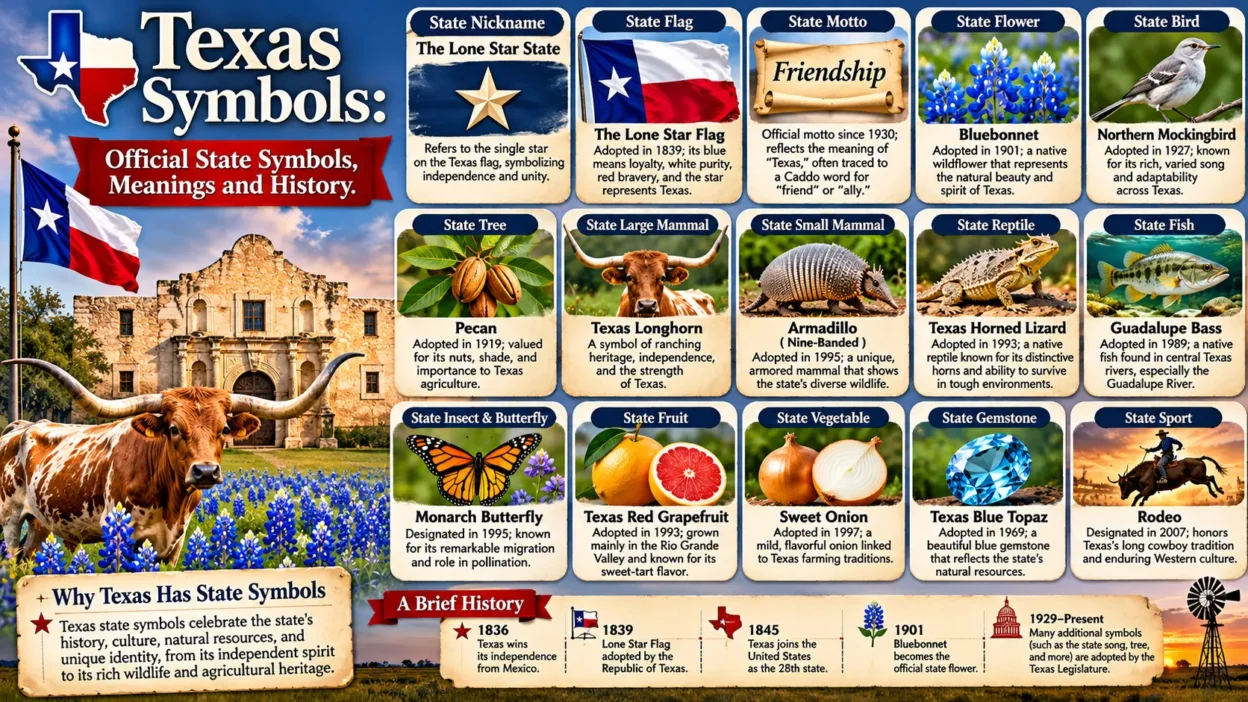
Texas has a wide range of official state symbols selected to represent its history, culture, wildlife, and natural resources. The Lone Star is perhaps the most recognizable, but many other symbols are equally important to the state’s identity.
Here is a quick overview of well-known Texas state symbols:
| Category | Official Texas Symbol |
|---|---|
| State nickname | The Lone Star State |
| State flag | Lone Star Flag |
| State motto | Friendship |
| State flower | Bluebonnet |
| State bird | Northern Mockingbird |
| State tree | Pecan |
| State large mammal | Texas Longhorn |
| State small mammal | Armadillo |
| State flying mammal | Mexican Free-Tailed Bat |
| State fish | Guadalupe Bass |
| State reptile | Texas Horned Lizard |
| State amphibian | Texas Toad |
| State insect | Monarch Butterfly |
| State butterfly | Monarch Butterfly |
| State fruit | Texas Red Grapefruit |
| State vegetable | Sweet Onion |
| State grass | Sideoats Grama |
| State gemstone | Texas Blue Topaz |
| State stone | Petrified Palmwood |
| State sport | Rodeo |
| State dance | Square Dance |
| State dish | Chili |
Note: Texas has many additional official symbols. The table highlights prominent examples rather than every designation.
🏴 The Lone Star Flag: The Most Recognizable Texas Symbol
The Texas flag is one of the most famous symbols of the state. Often called the Lone Star Flag, it features a single white star alongside blue, white, and red sections. The design reflects Texas independence, unity, and its historical identity.
The flag was officially adopted in 1839 by the Republic of Texas and continued as the state flag after Texas joined the United States in 1845.
Its colors are commonly interpreted as follows:
- Blue: Loyalty.
- White: Purity.
- Red: Bravery.
- Single star: Unity and the independent identity of Texas.
The Lone Star became so closely associated with Texas that it inspired the state’s nickname, the Lone Star State.
🌼 Texas State Flower: Bluebonnet
The bluebonnet is the official state flower of Texas and one of its most beloved natural symbols. Its bright blue petals create beautiful fields of color during the spring, especially along roadsides and open countryside.
Texas officially adopted the bluebonnet as its state flower in 1901. The designation originally referred to Lupinus subcarnosus, and later legislation recognized additional bluebonnet species.
The flower represents:
- Natural beauty and springtime
- Texas landscapes and wildflowers
- State pride and local identity
- The distinctive environment of the region
Bluebonnets are especially popular in Texas photography, artwork, and seasonal celebrations.
🐦 Texas State Bird: Northern Mockingbird
The northern mockingbird is the official state bird of Texas. Known for its ability to imitate the songs and calls of other birds, it is admired for its intelligence, adaptability, and distinctive singing.
Texas selected the mockingbird as its state bird in 1927. It is commonly found in neighborhoods, gardens, parks, and open landscapes throughout the state.
The mockingbird symbolizes:
- Adaptability and intelligence
- Communication and creativity
- Natural diversity
- Resilience and determination
Its ability to mimic different sounds makes it one of the most recognizable birds in North America.
🌳 Texas State Tree: Pecan Tree
The pecan tree is the official state tree of Texas. It is valued for its delicious nuts, attractive appearance, and importance to the state’s agricultural traditions.
Texas adopted the pecan tree as its official state tree in 1919. It grows across many parts of the state and has long been associated with farms, gardens, and family traditions.
The pecan tree represents:
- Agricultural heritage
- Natural abundance
- Strength and longevity
- Food and economic importance
Pecans are also widely used in Texas cooking, particularly in desserts such as pecan pie.
🤠 Texas State Large Mammal: Texas Longhorn
The Texas Longhorn is the official state large mammal and one of the strongest symbols of Texas history. Recognized by its distinctive long, curved horns, this cattle breed is closely connected with ranching and the American West.
Longhorn cattle played an important role in the development of the cattle industry in Texas. Their ability to survive challenging conditions helped make them valuable to ranchers.
The Texas Longhorn represents:
- Ranching and cowboy culture
- Independence and toughness
- Agricultural history
- Strength and endurance
Today, the Longhorn is a familiar symbol of Texas sports, universities, businesses, and Western traditions.
🦔 Texas State Small Mammal: Nine-Banded Armadillo
The nine-banded armadillo is the official state small mammal of Texas. Its distinctive armored body makes it easy to recognize, while its digging behavior helps it search for insects and other food.
The armadillo became an official Texas symbol in 1995. It is frequently associated with the state’s wildlife and rural landscapes.
The animal represents:
- Adaptability
- Unique wildlife
- Survival in different environments
- Texas’ natural diversity
Although armadillos are often seen near roads and open areas, they are wild animals and should be observed from a safe distance.
🦇 Texas State Flying Mammal: Mexican Free-Tailed Bat
The Mexican free-tailed bat is the official state flying mammal of Texas. Large colonies of these bats live in caves, bridges, and other sheltered locations across the state.
One of the most famous bat-watching locations is the Congress Avenue Bridge in Austin, where enormous numbers of bats emerge around sunset during the warmer months.
The Mexican free-tailed bat represents:
- Wildlife conservation
- Natural balance
- Insect control
- The ecological importance of bats
These bats play a valuable role in the environment by consuming large quantities of insects.
🎣 Texas State Fish: Guadalupe Bass
The Guadalupe bass is the official state fish of Texas. It is native to the clear streams and rivers of central Texas and is particularly associated with the Guadalupe River system.
This fish is important because of its connection to Texas’ freshwater ecosystems. It is also a popular target for anglers interested in native sport fish.
The Guadalupe bass symbolizes:
- Freshwater biodiversity
- Conservation of native species
- Texas rivers and streams
- Outdoor recreation and fishing
Protecting its natural habitat helps preserve an important part of the state’s aquatic wildlife.
🦎 Texas State Reptile: Texas Horned Lizard
The Texas horned lizard is the official state reptile. Sometimes called the horny toad, it has a flattened body, small horns, and a distinctive appearance.
The lizard is adapted to dry environments and is commonly associated with the grasslands and open areas of Texas.
It represents:
- Native wildlife
- Adaptation to challenging environments
- The uniqueness of Texas ecosystems
- Conservation and environmental awareness
Despite its intimidating appearance, the Texas horned lizard is generally harmless to people.
🐸 Texas State Amphibian: Texas Toad
The Texas toad is the official state amphibian. It is native to parts of the southern Great Plains and is adapted to the state’s changing weather conditions.
Like other amphibians, it depends on suitable moisture and breeding habitats. Rainfall can bring these toads out in large numbers, particularly during warmer periods.
The Texas toad represents:
- Wetland and grassland ecosystems
- Native amphibian diversity
- Adaptability
- Environmental balance
🦋 Texas State Insect and Butterfly: Monarch Butterfly
The monarch butterfly is officially recognized as both the state insect and state butterfly of Texas. Known for its orange-and-black wings, it is famous for its remarkable seasonal migration.
Texas is an important part of the monarch butterfly’s migration route. The state’s wildflowers provide nectar that helps these butterflies during their journey.
The monarch symbolizes:
- Transformation and renewal
- Migration and movement
- Natural beauty
- Environmental conservation
Its migration also highlights the importance of protecting native plants and suitable habitats.
🌵 Texas State Plant: Prickly Pear Cactus
The prickly pear cactus is the official state plant of Texas. Recognized by its flat, paddle-shaped sections and colorful fruit, this cactus is well adapted to dry climates and can survive in challenging environments.
It represents:
- Adaptability and resilience
- Texas desert landscapes
- Native plant diversity
- Strength in difficult conditions
The prickly pear is also used in traditional foods and drinks, making it part of the state’s natural and culinary heritage. Texas State Library+1
🍊 Texas State Fruit: Texas Red Grapefruit
The Texas red grapefruit is the official state fruit. It is especially associated with the Rio Grande Valley, where the warm climate supports citrus production.
Its bright color and distinctive sweet-tart flavor make it an important part of Texas agriculture.
The grapefruit represents:
- Agricultural productivity
- Citrus-growing traditions
- Regional identity
- Freshness and natural abundance
🧅 Texas State Vegetable: Sweet Onion
The sweet onion is the official state vegetable of Texas. It is particularly associated with the state’s onion-growing regions and agricultural traditions.
Texas sweet onions are valued for their mild flavor and versatility in cooking.
They symbolize:
- Farming and agriculture
- Local food traditions
- Texas produce
- Agricultural heritage
💎 Texas State Gemstone: Texas Blue Topaz
Texas blue topaz is the official state gemstone. Its beautiful blue color makes it one of the most recognizable natural treasures associated with the state.
The gemstone represents:
- Natural resources
- Texas geology
- Beauty and rarity
- State pride
Texas also has an official gemstone cut called the Lone Star Cut, which features a star-inspired design. Texas State Library+1
🪨 Texas State Stone: Petrified Palmwood
Petrified palmwood is the official state stone of Texas. It is fossilized wood that has gradually been transformed into stone through natural geological processes.
Its connection with ancient plant life makes it an interesting symbol of the state’s geological history.
It represents:
- Ancient natural history
- Geological diversity
- Fossil heritage
- The passage of time
🌾 Texas State Grass: Sideoats Grama
Sideoats grama is the official state grass of Texas. This native grass is an important part of the state’s grassland ecosystems and provides food and habitat for wildlife.
It is also useful for livestock grazing and land conservation.
The grass symbolizes:
- Native landscapes
- Agricultural resources
- Environmental sustainability
- Wildlife habitats
🌶️ Texas State Pepper: Jalapeño
The jalapeño is the official state pepper of Texas. It is widely used in Tex-Mex cooking and adds a distinctive spicy flavor to many traditional dishes.
This pepper represents:
- Texas food culture
- Bold flavors
- Mexican-American culinary influence
- Local agricultural traditions
Jalapeños are commonly found in salsas, tacos, nachos, and many other popular dishes.
🐚 Texas State Shell: Lightning Whelk
The lightning whelk is the official state shell of Texas. This marine shell is known for its distinctive spiral shape and left-handed opening.
It is associated with the coastal waters of the Gulf of Mexico and represents the state’s connection to marine life.
The lightning whelk symbolizes:
- Coastal heritage
- Marine biodiversity
- Natural beauty
- The Gulf Coast environment
🦴 Texas State Dinosaur: Paluxysaurus Jonesi
Paluxysaurus jonesi is recognized as the official state dinosaur of Texas. This prehistoric dinosaur lived millions of years ago, and its fossils were discovered in the state.
Its designation connects Texas with its ancient geological and paleontological history.
It represents:
- Prehistoric wildlife
- Scientific discovery
- Fossil preservation
- Texas natural history
🎵 Texas State Song: “Texas, Our Texas”
“Texas, Our Texas” is the official state song. Written by William J. Marsh and Gladys Yoakum Wright, it was officially adopted in 1929.
The song celebrates Texas pride, history, freedom, and identity. It is performed at public ceremonies and state-related events.
Its importance comes from its connection to:
- State pride and unity
- Texas history
- Freedom and independence
- Cultural heritage
tcss.legis.texas.gov+1
🤝 Texas State Motto: Friendship
The official motto of Texas is “Friendship.” The motto reflects the state’s name, which is commonly traced to a Caddo word often translated as “friend” or “ally.”
It represents:
- Friendship and cooperation
- Unity among communities
- Hospitality
- Cultural connections
The motto was officially adopted in 1930 and remains part of Texas’ state identity. Texas State Library+1
🏛️ Texas State Seal: History and Meaning
The Great Seal of Texas is an important official emblem used to authenticate government documents and represent the authority of the state.
The front of the seal features a five-pointed star surrounded by olive and live oak branches. The reverse side includes historical imagery connected with Texas independence and its past.
Important elements include:
- Five-pointed star: Represents Texas and its Lone Star identity.
- Live oak branches: Reflect strength and endurance.
- Olive branches: Traditionally associated with peace.
- Historical imagery: Connects the seal with significant events in Texas history.
The reverse of the seal includes the Alamo, the cannon of the Battle of Gonzales, and Vince’s Bridge. It also carries the words “Remember the Alamo” and “Texas One and Indivisible.” tcss.legis.texas.gov+1
🤠 Other Official Texas Cultural Symbols
Texas has many additional official symbols that represent its food, music, clothing, traditions, and everyday culture. These designations show that the state’s identity goes beyond its flag and wildlife.
| Category | Official Symbol |
|---|---|
| State sport | Rodeo |
| State folk dance | Square dance |
| State music | Western swing |
| State musical instrument | Guitar |
| State dog breed | Blue Lacy |
| State horse | American Quarter Horse |
| State footwear | Cowboy boot |
| State hat | Cowboy hat |
| State vehicle | Chuck wagon |
| State dish | Chili |
| State pie | Pecan pie |
| State snack | Tortilla chips and salsa |
| State bread | Pan de campo |
| State cobbler | Peach cobbler |
| State mushroom | Texas star mushroom |
| State pollinator | Western honey bee |
| State shrub | Crape myrtle |
| State native shrub | Texas purple sage |
| State precious metal | Silver |
| State sea turtle | Kemp’s ridley sea turtle |
| State saltwater fish | Red drum |
| State crustacean | Texas Gulf shrimp |
| State waterlily | Nymphaea Texas Dawn |
| State vehicle | Chuck wagon |
These official designations are recorded by the Texas State Library and Archives Commission. Its list includes dozens of symbols, ranging from wildlife and plants to food and cultural traditions. Texas State Library+1
⭐ Why Is Texas Called the Lone Star State?
Texas is known as the Lone Star State because of the single star featured on its flag. The star represents the state’s history as an independent republic before it joined the United States in 1845.
The Lone Star has become a lasting symbol of Texas identity. It appears on flags, government emblems, clothing, sports merchandise, and countless designs connected with the state.
The nickname reflects:
- Texas independence and history
- Unity and state pride
- Individuality and self-reliance
- The state’s distinctive identity
The Texas Legislature officially designated “The Lone Star State” as the state’s nickname in 2015. Texas State Library+1
❓ Frequently Asked Questions About Texas Symbols
What is the most famous symbol of Texas?
The Lone Star is the most recognizable symbol of Texas. It appears on the state flag and represents the state’s history, independence, and identity.
What is the official state flower of Texas?
The bluebonnet is the official state flower. It was first designated in 1901, and later legislation recognized additional varieties of bluebonnets.
What is the state bird of Texas?
The northern mockingbird is the official state bird. It is known for imitating the sounds and songs of other birds.
What is the Texas state animal?
The Texas Longhorn is the official state large mammal. The nine-banded armadillo is the official state small mammal.
What is the Texas state motto?
The official Texas state motto is “Friendship.” It reflects the meaning commonly associated with the word “Texas” and the state’s cultural identity.
What is the official Texas state tree?
The pecan tree is the official state tree. It was adopted in 1919 and is closely connected with Texas agriculture and food traditions.
What is the Texas state fish?
The Guadalupe bass is the official state fish. It is native to central Texas waterways.
What is the Texas state reptile?
The Texas horned lizard is the official state reptile. It is recognized for its distinctive body shape and horn-like projections.
What is the official state song of Texas?
“Texas, Our Texas” is the official state song. It was written by William J. Marsh and Gladys Yoakum Wright and adopted in 1929.
How many official symbols does Texas have?
Texas has dozens of official state symbols across categories such as wildlife, plants, food, music, and cultural traditions. The Texas State Library and Archives Commission maintains the official list, which continues to be updated as new designations are adopted. Texas State Library+1
Conclusion
Texas symbols represent the state’s history, natural beauty, wildlife, agriculture, and cultural traditions. The Lone Star flag, bluebonnet, mockingbird, pecan tree, and Texas Longhorn are among the best-known examples, while symbols such as the jalapeño, cowboy boot, rodeo, and Western swing highlight the state’s distinctive culture.
Together, these official emblems tell the story of Texas and explain why its identity remains closely connected with independence, friendship, resilience, and pride.
For the complete and updated list, visit the Texas State Library and Archives Commission’s official state symbols page.

Jessica Morgan is a writer and content creator at Blesslume, dedicated to sharing meaningful blessings, heartfelt prayers, inspiring wishes, and uplifting messages. She is passionate about helping people find the right words to celebrate special moments, offer encouragement, and spread kindness. Through thoughtful and inspiring content, Jessica aims to bring hope, positivity, and connection to readers around the world.