Ares is one of the most recognizable figures in Greek mythology, known as the god of war, violence, courage, and battle. Unlike Athena, who represented strategic warfare and wisdom, Ares embodied the brutal and destructive side of conflict. His identity is closely connected with several powerful symbols, including the spear, helmet, shield, sword, and the animals associated with his fierce personality.
Ares symbols represent more than fighting and physical strength. They also reflect aggression, fearlessness, bloodshed, military power, and the unpredictable nature of war. Understanding these symbols helps explain how ancient Greeks viewed Ares and why his image continues to appear in mythology, art, literature, astrology, and modern popular culture.
⚔️ What Are the Main Symbols of Ares?
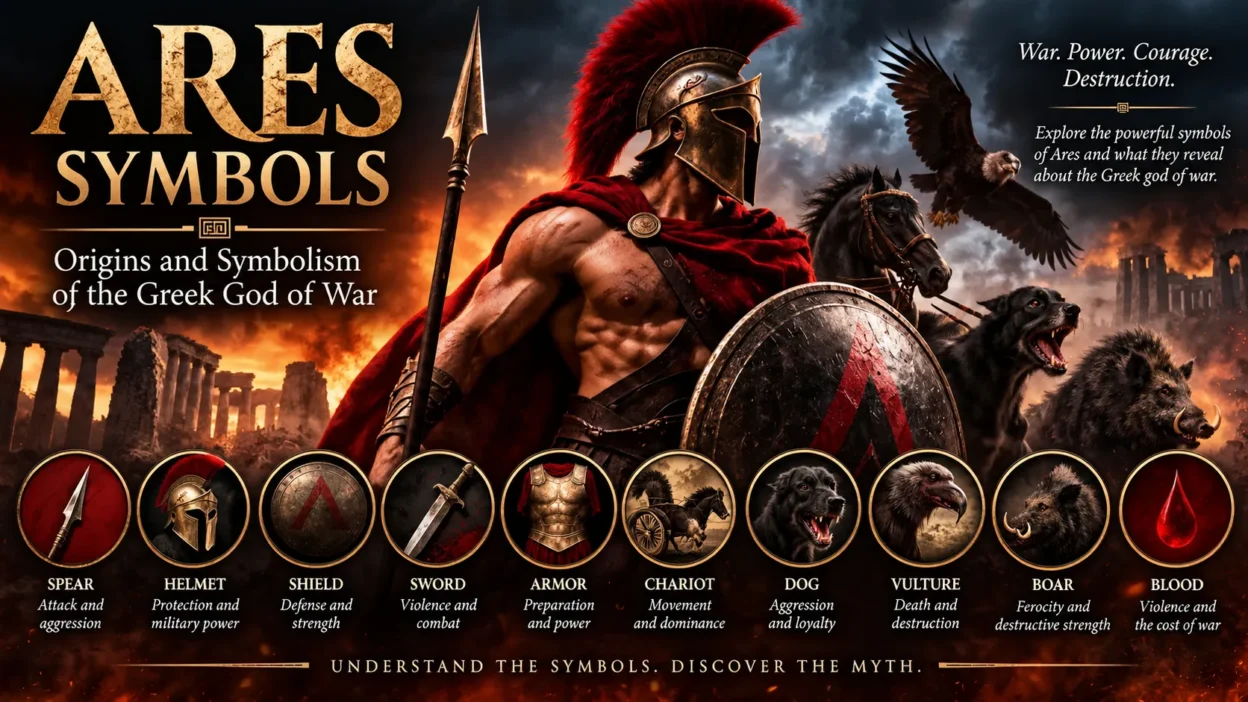
Ares is traditionally represented through weapons, protective battle equipment, and animals associated with aggression. These objects reflect his role as a powerful but often destructive god of war.
The most commonly associated symbols include:
| Ares Symbol | Meaning |
|---|---|
| Spear | Warfare, attack, and aggression |
| Helmet | Military power, protection, and readiness for battle |
| Shield | Defense, strength, and combat |
| Sword | Violence, bravery, and physical conflict |
| Armor | Military strength and preparation |
| Chariot | Power, movement, and warfare |
| Dog | Aggression, loyalty, and battlefield violence |
| Vulture | Death, destruction, and the aftermath of battle |
| Boar | Ferocity, danger, and destructive strength |
| Blood | Violence, injury, and the cost of war |
Not every object or animal in this table was an exclusive emblem of Ares. Some are traditional attributes associated with his mythological identity, while others represent broader themes connected with ancient Greek warfare.
🗡️ 1. The Spear: Ares’ Primary Weapon
The spear is one of the strongest visual representations of Ares. In ancient Greek warfare, spears were essential weapons used by soldiers during close combat and battlefield attacks.
As the god of war, Ares is frequently depicted carrying a spear to represent his aggressive nature and readiness to fight. It symbolizes direct confrontation, military power, and the willingness to face danger.
Symbolic meanings:
- Aggression and attack
- Courage in battle
- Physical strength
- Military authority
- Conflict and confrontation
The spear reflects Ares’ association with the violent and action-driven side of warfare.
🛡️ 2. The Shield: Protection and Defense
A shield represents the defensive side of battle. Although Ares is associated with aggression and destruction, warfare also involves protecting oneself and standing against an enemy.
Ancient Greek warriors carried shields to defend themselves from spears, arrows, and swords. In artistic representations, Ares may appear equipped with a shield as part of his warrior identity.
Symbolic meanings:
- Protection from danger
- Defense and resistance
- Strength under pressure
- Military readiness
- Survival during conflict
The shield also reminds us that war involves both attacking and defending.
🪖 3. The Helmet: Readiness for War
A helmet is another recognizable symbol associated with Ares. Greek warriors wore helmets to protect their heads during combat, making them an important part of military equipment.
Ares is often portrayed wearing a helmet that emphasizes his identity as a battle-ready warrior. It represents discipline, preparedness, and the ability to face dangerous situations.
Symbolic meanings:
- Preparation for battle
- Courage and bravery
- Protection
- Military identity
- Strength and determination
The helmet is especially useful in artwork because it immediately communicates Ares’ connection with warfare.
⚔️ 4. The Sword: Violence and Combat
The sword represents close-range fighting, physical confrontation, and the destructive nature of war. It is a familiar weapon in Greek mythology and appears in many artistic depictions of warriors.
When connected with Ares, the sword reflects his association with bloodshed, aggression, and the violent realities of battle.
Symbolic meanings:
- Combat and confrontation
- Physical power
- Aggression
- Bravery
- Destruction
The sword is also a broader symbol of warfare rather than an object exclusive to Ares.
🐕 5. The Dog: Aggression and Ferocity
Dogs are among the animals associated with Ares in ancient Greek tradition. Their connection with the god reflects the aggressive and threatening aspects of warfare.
The dog can represent loyalty, alertness, and protective instincts. In the context of Ares, it also suggests the fierce and unpredictable nature of battle.
Symbolic meanings:
- Aggression and intensity
- Loyalty and protection
- Alertness
- Ferocity
- Battlefield danger
Dogs were not simply symbols of violence in Greek culture; their meaning could vary depending on the story and artistic context.
🦅 6. The Vulture: Death and Destruction
The vulture is traditionally associated with Ares and the aftermath of warfare. As a scavenger that feeds on dead animals, it became a powerful image connected with death and destruction.
Its association with Ares reflects the devastating consequences of violent conflict.
Symbolic meanings:
- Death and mortality
- Destruction
- The consequences of war
- Bloodshed
- Loss and suffering
The vulture highlights the darker side of Ares’ identity, reminding us that war brings destruction as well as displays of strength.
🐗 7. The Boar: Fierceness and Destructive Power
The boar is another animal connected with Ares in Greek mythology. Known for its strength, aggression, and dangerous nature, it represents the untamed force often associated with the god.
Wild boars also appear in several Greek myths as dangerous creatures that challenge heroes.
Symbolic meanings:
- Ferocity and aggression
- Raw physical strength
- Destructive power
- Fearlessness
- Uncontrolled anger
The boar is a fitting symbol for Ares because it reflects the wild and unpredictable energy of combat.
🐎 8. The Chariot: Power and Movement
Ares is sometimes portrayed riding a chariot into battle. In Greek mythology, chariots were associated with military power, movement, and the dramatic spectacle of warfare.
His chariot represents the force and momentum of conflict, emphasizing his role as a god who enters the battlefield.
Symbolic meanings:
- Military authority
- Power and dominance
- Movement and speed
- Battle and conquest
- Warrior strength
In mythology and ancient artwork, Ares’ chariot reinforces his image as a powerful figure of war.
🩸 9. Blood: The Cost of Warfare
Blood is a symbolic representation of the violence and suffering associated with Ares. As a god connected with brutal combat, he represents the injuries, deaths, and destruction that accompany war.
Blood is not a physical object carried by Ares, but it is an important symbolic theme in interpretations of his mythology.
Symbolic meanings:
- Violence and injury
- Sacrifice
- Death and suffering
- The consequences of conflict
- The destructive side of human aggression
This symbolism captures the darker meaning of Ares beyond the traditional image of a heroic warrior.
🔥 10. Fire: Destruction and the Fury of Battle
Fire is sometimes used in modern interpretations and artistic representations to communicate the destructive energy of war. However, it is not one of Ares’ most firmly established ancient attributes.
Its association with him is mainly symbolic, reflecting the chaos, destruction, and intensity of violent conflict.
Symbolic meanings:
- Destruction and chaos
- Anger and aggression
- Intense energy
- Conflict and transformation
- Uncontrolled power
Fire can be an effective artistic symbol for Ares, but it should not be confused with his historically established attributes.
🔴 What Does the Ares Symbol Mean?
There is no single universally accepted ancient symbol that represents Ares in every context. Instead, his identity is communicated through a collection of objects, weapons, animals, and visual elements.
Together, these symbols represent the following ideas:
- War: Ares is the Greek god associated with violent warfare and battle.
- Strength: His warrior appearance reflects physical power and endurance.
- Aggression: His personality is connected with anger, confrontation, and violence.
- Courage: His battlefield identity represents the willingness to face danger.
- Destruction: His mythology highlights the suffering and devastation caused by conflict.
- Military power: His weapons and armor represent the equipment and authority of warriors.
Ares’ symbolism is complex because he represents both the power of a warrior and the destructive consequences of war.
🏛️ Ares vs. Athena: Different Symbols of War
Ares and Athena are both connected with warfare, but they represent different aspects of military conflict. Ares embodies aggression and the brutality of battle, while Athena represents strategy, intelligence, and disciplined military planning.
| Feature | Ares | Athena |
|---|---|---|
| Role | God of war | Goddess of wisdom and strategic warfare |
| Main qualities | Aggression and violence | Wisdom and strategy |
| Common symbols | Spear, helmet, shield | Owl, spear, shield, helmet |
| Approach to war | Physical confrontation | Planning and tactical thinking |
| Symbolic meaning | Brutal conflict | Intelligent defense and strategy |
This distinction is important when interpreting Greek mythology. Ares represents the violent reality of battle, whereas Athena represents the wisdom required to make strategic decisions.
♈ Ares and the Planet Mars
Ares is the Greek counterpart of the Roman god Mars. The Romans identified Mars with Ares, although Mars eventually developed a broader and more respected role in Roman religion.
The planet Mars is named after the Roman god, not directly after the Greek Ares. However, the two gods share a strong connection through mythology and traditional symbolism.
In astrology, Mars is associated with:
- Energy and motivation
- Courage and confidence
- Competition and ambition
- Anger and aggression
- Action and determination
The Mars symbol (♂) is also commonly associated with masculinity and is used as the astronomical and astrological symbol for the planet.
❓ Frequently Asked Questions About Ares Symbols
What is the main symbol of Ares?
Ares is commonly represented by a spear, which reflects his identity as the Greek god of war. His helmet, shield, sword, and armor are also important visual attributes.
What animal represents Ares?
The dog, vulture, and boar are traditionally associated with Ares. These animals reflect different aspects of his mythology, including aggression, death, and destructive strength.
What weapon does Ares carry?
Ares is commonly depicted carrying a spear. He is also associated with other weapons, including swords, as well as protective equipment such as helmets and shields.
What does the Ares symbol represent?
Ares’ symbols represent warfare, aggression, physical strength, courage, military power, and destruction. They reflect both the intensity of battle and its consequences.
Is Ares’ symbol the same as Mars’ symbol?
Not exactly. Ares is the Greek god of war, while Mars is his Roman counterpart. The ♂ symbol is associated with the planet Mars and the Roman god, although it is also connected with Ares through their shared mythology.
Is the owl a symbol of Ares?
The owl is primarily associated with Athena, the Greek goddess of wisdom. It represents intelligence and strategic thinking rather than Ares’ aggressive approach to warfare.
What colors are associated with Ares?
Red, bronze, and dark metallic shades are commonly used in modern artwork to represent Ares. Red suggests bloodshed and aggression, while bronze and metallic tones reflect ancient Greek armor and weapons. These are artistic associations rather than a fixed ancient color system.
Conclusion
Ares symbols reveal the different sides of the Greek god of war. The spear, sword, helmet, and shield represent his warrior identity, while the dog, vulture, and boar reflect his association with aggression and the destructive nature of conflict.
Although Ares is often remembered as a powerful warrior, his mythology also highlights the darker consequences of warfare. His symbols therefore represent more than strength and courage; they communicate violence, danger, fear, and the unpredictable reality of battle.

Jessica Morgan is a writer and content creator at Blesslume, dedicated to sharing meaningful blessings, heartfelt prayers, inspiring wishes, and uplifting messages. She is passionate about helping people find the right words to celebrate special moments, offer encouragement, and spread kindness. Through thoughtful and inspiring content, Jessica aims to bring hope, positivity, and connection to readers around the world.